
- Remember, if you’re boiling heads at an ancient temple, it’s important to do it in the right place.
Ancient Egypt has fascinated both archeologists and consumers of popular media for centuries. From mummies to the pyramids and sealed tombs of the Pharaohs, we’ve learned a lot about the lives of the Egyptians of old.
But as much as we’ve discovered, there’s equally much — if not more — that remains a mystery. Archeologists working in Egypt recently got a stark reminder of that.
Researchers have discovered a 1,700-year-old shrine in eastern Egypt. But this shrine is unlike anything we’ve seen before.
To being with, the shrine appears to be dedicated to three gods. Two of them are completely unknown.
But that’s not the creepiest part about this ancient house of worship. The ruin also held the corpses of more than a dozen birds of prey — each of them purposefully decapitated.
And deeper within the monument is a carved message warning against the boiling of heads.
Yeah, there’s definitely a curse on this place. The only question is, what kind?
Surprisingly New
Archeologists discovered the shrine in Berenice Troglodytica, also known simply as Berenike. This ancient once-prosperous port city on the Red Sea was founded in the 3rd century BCE by the Ptolemaic Pharaohs and stood until the 6th century CE.
The first puzzling thing about the shrine is its age. It dates back some 1,700 years — in other words, it was active around the 3rd century CE.
At that time, Christianity had already begun to gain a foothold in Egypt, and the worship of the old Egyptian gods was on the decline. However, this temple clearly shows that not all the gods of Egypt had been forgotten.
At least yet.
A Warning from the Gods
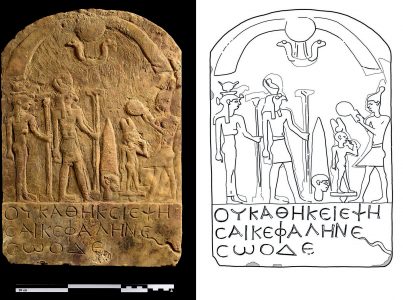
When it comes to the gods, the mystery of the shrine gets much deeper. One room in the shrine contains a stela — or a stone pillar — with carved images of the three gods that apparently were worshipped at the site.
The first of them was familiar to the archeologists. The carvings depict Harpocrates, a Greek-influenced take on the child god Horus, who represents the newborn sun that rises at each dawn.
But nobody knows who the other two gods are. One of them is a female deity, wearing a crown composed of a pair of cow horns that support a solar disc.
The crown is very similar to the one worn by another Egyptian deity Hathor, the goddess of joy and maternal care and the mother of Horus. However, the goddess on the stela is not named and her associated iconography matches that of several other gods.
And then there’s the last god, seemingly given a higher position than the other two. This falcon-headed god wears the famous double crown, symbolizing his power over both Lower and Upper Egypt.
There were other gods in ancient Egypt who had a falcon’s head, such as Ra. But, like with the goddess, this god is unnamed and bears confusing iconography.
In addition to the gods, there’s one more noteworthy carving on the stela. It’s a piece of instruction — or a warning — written in Greek that gives the shrine a sinister air.
The inscription reads: “It is improper to boil a head here.”
Subhead
Why would the stela warn against boiling heads? The answer lies in another one of the shrine’s rooms.
In an adjoining area, the archeologists found the remains of 15 falcons resting on a pedestal. Each of the birds is missing its head, and all signs point that they were decapitated as part of some kind of ritual.
That would also explain why somebody would need to leave a note about where to boil their heads.
“We hypothesize that the sacrificial animals were boiled before being presented to the god, perhaps to facilitate plucking their feathers, and that their heads were removed, according to the prescription on the stele,” the archeologists write in their report.
It’s likely that the headless falcons were an offering to the falcon god. There’s also another detail in the shrine that points to the god enjoying severed heads.
On the stela, between the falcon god and Harpocrates, is an obelisk. Within the obelisk is depicted a disembodied human head.
The researchers haven’t found any human skulls. However, they did discover additional animal remains, including those of fish, mammals, and eggs.
We don’t yet know — and perhaps never will — what kind of rituals took place at the shrine, who the forgotten gods are, and why they demanded a sacrifice of boiled heads. But according to the researchers, the shrine is an important glimpse into the beliefs of ancient Egyptians and a reminder that their religion persisted longer than people might think.