
- These are the fastest salmon you’ve ever seen.
The stereotypical cocaine user is a jittery, overenergized mess that just wants to go, go, go. As it turns out, that’s a very accurate description of the drug’s effects.
At least if the one taking it is a salmon.
Biologists are concerned about the effects of various drugs on wildlife. It sounds crazy, but medicine and drug runoff from urban centers is already having unknown effects on fish, in particular.
In a recent study, researchers wanted to examine what practical harm drugs could cause to salmon. Particularly, they were interested in cocaine and its metabolite.
So, they hooked salmon up with little cocaine feeds and released them into a river.
Unsurprisingly, the fish hopped up on dope swam much farther upriver than sober ones, beyond their usual breeding grounds. What’s curious is that the salmon that got the metabolite were even more buzzed, going even farther.
The research shows that drugs that end up in the environment can seriously disrupt animals’ natural behavior. So, the scientists are calling for better waste management solutions to make sure we don’t turn our salmon into coke fiends.
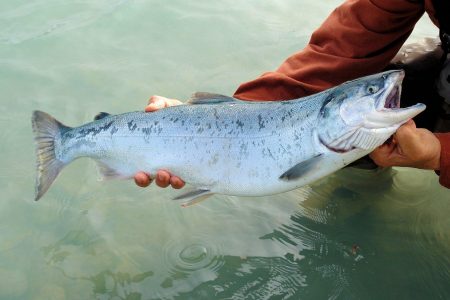
Cocaine-laced Salmon
The research, published in the journal Current Biology, builds on previous research. Scientists have found that medical waste, from amphetamines to cocaine and antidepressants, can build up in marine life, such as fish and shrimp.
However, the effects the drugs could have on the animals were unknown. With this new study, researchers from the Swedish University of Agricultural Sciences wanted to get some answers.
Particularly, they focused on salmon, an important cash fish in Sweden. They also decided to examine the effects of cocaine because… Well, it’s common in Swedish waters. Draw your own conclusions.
To figure out what cocaine does to salmon, the researchers first had to give the drug to the fish. So, they designed small implants that would slowly release coke into the salmon’s system at levels found in the environment.
One group of fish got pure cocaine. Another group, however, received benzoylecgonine, which is what cocaine transforms into when it’s processed by the human body.
In other words, if you take cocaine and then go to the bathroom, benzoylecgonine is what comes out.
Finally, a third group of fish got an implant that did nothing at all. That was to make sure that the implant itself didn’t affect the fish’ behavior.
The researchers also fixed GPS locators on the salmon to observe their movements.
Look at Them Go
After the implants were in place, the salmon were released into the southwest corner of Lake Vättern, Sweden’s second-biggest lake, located in the south of the country. They were then left alone for two months.
Toward the end of the period, it became clear that cocaine had a significant effect on the fish. The doped-up salmon had turned into speed demons.
All the fish settled down in one part of the lake or another. However, those that received cocaine swam much farther up the lake than those that didn’t.
The cocaine salmon ended up three miles farther away from their starting point than the sober ones. But it was the metabolite that had the most profound effect.
Salmon under the effect of benzoylecgonine zoomed for nearly nine miles before finally settling down. They really had someplace to be, but I bet they didn’t know where.
Better Cleanup Necessary
So, what does this result indicate, besides that cocaine makes salmon go fast? According to the researchers, it shows that we are potentially severely disrupting animals’ normal behavior with our drugs.
But it’s not just the drugs themselves that we should be concerned about. Their metabolites can be just as, if not more, dangerous.
“If we’re doing risk assessments and not including compounds like these metabolites and derivatives, we may be missing a big chunk of the environmental risk we’re exposing these animals to,” lead researcher Dr. Jack Brand told The Guardian.
Consequently, the researchers are calling for better wastewater management practices to eliminate drug runoff. Otherwise, animals might end up somewhere they don’t belong as they rush all over the place in a drug-fueled haze.
Salmon aren’t the only fish on drugs. Read our story about how trout are getting hooked on meth-laced pee.