
- Well, there go all our excuses for the poor grades we got.
What’s the one thing you need above all others to learn things? You’d think that’d be a brain since it controls all higher intellectual capacities, right?
New research has shown that’s not necessarily the case. A completely brainless blob recently demonstrated that it can learn things.
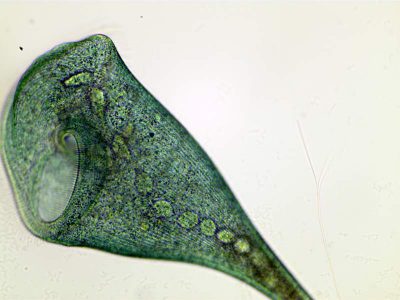
Stentor coeruleus is a horn-shaped, single-celled organism that doesn’t have a brain or anything even remotely resembling a brain. Yet, in a recent experiment, scientists discovered that this unthinking wonder is capable of Pavlovian learning.
Much like Pavlov’s famous dogs, Stentor could draw a connection between two unrelated things. Through a series of tapping experiments, they learned that a harmless, weak tap on their aquarium doesn’t necessarily mean that a scary, strong tap will follow.
It doesn’t sound like much when you put it like that. But for a thing without a brain, it’s pretty impressive.
Learning Methods
Before we get to the experiments, we should clarify a couple of things. First is the basic method of how living things learn.
The most basic method of learning in nature is habituation, which means reducing how strongly you respond to a harmless, repeating stimulus. For example, if you hear a weird noise, you might jump out of your skin initially. But if you hear the noise over and over and nothing bad happens, eventually you get used to it and won’t care anymore.
Most living beings on the planet, even plants and fungi, are capable of this kind of learning.
The next step up from habituation is associative learning. It involves drawing connections between unrelated stimuli and learning that one is linked to the other.
The best-known example of associative learning is Pavlov’s dogs. Ringing a bell doesn’t in itself have anything to do with dog food. But if you ring a bell every time before feeding a dog, it will learn that the bell means dinner time and start salivating with expectation every time it hears the bell.
A Brainless Trumpet
Next, let’s find out what on earth is Stentor coeruleus. They are single-celled organisms that float around in ponds, swimming with the hair-like protrusions jutting out of their sides.
Although S. coeruleus are tiny, they are giants when it comes to their kind. They can grow to be up to 2 millimeters long, which is enormous for single-celled creatures.
The S. coeruleus are kind of shaped like a trumpet. At one end, they have a wide “mouth” that sucks edible bits out of water.
On the thinner end, they have something called a holdfast. It’s an anchor-like structure S. coeruleus can use to attach itself to surfaces for feeding.
“When they’re attached, they just filter feed. If they are bothered, they’ll quickly contract into a sphere,” explained Sam Gershman of Harvard University, to NewScientist.
“During that time, they can’t feed, so it’s ecologically advantageous to not respond like that very often unless they have to,” he added.
Remember that last part. It’ll be important.
Taps on Glass
So, to test S. coeruleus’ ability to learn, Gershman and his colleagues allowed some of them to attach to the bottom of petri dishes. Then, they started giving the dish firm taps.
At first, things went about as you’d expect. When the dish was tapped, the S. coeruleus curled up to protect themselves.
Eventually, however, they figured out that the tap didn’t actually pose any danger. Over 60 taps, fewer and fewer S. coeruleus curled up until they ignored the tap.
That showed they’re capable of basic habituation.
Making Connections
Next, the researchers introduced another kind of stimulus. They would give the petri dish a very light tap and then follow it up one second later with the previous strong tap.
At first, the S. coeruleus contracted again after the weak tap. However, then something interesting started happening.
In just 10 sets of taps, the S. coeruleus stopped curling up after the weak tap. Meanwhile, in a separate dish where they received only a single light tap, it took them as long to get used to it as the single strong tap.
“We saw this bump in the graph where the contraction rate initially goes up before going down. If you just present the weak tap by itself, you don’t see this,” Gershman said.
According to the researchers, this indicated that the double-tapped S. coeruleus learned to associate the new light tap with the harmless strong tap and determined that it didn’t pose any danger. This makes them the first single-celled organisms to have demonstrated they’re capable of associative learning.
But what’s the point of all this tapping? Well, it shows that brainless creatures are capable of the kind of mental skills we’ve usually associated with having some kind of brain.
Additionally, it sheds light on the history of life on earth. After all, some lifeform had to be the first to draw connections between unrelated things, and it seems that may have happened much earlier than we’ve believed.
It also shows that we don’t really have any excuse for not learning simple things. If the brainless cell can do it, we should be able to as well.