
- There is nothing more beautiful than a sunset!
Sunrise and sunset colors are some of the most magnificent views in nature. Here are a bunch of fun facts about the colors during these times of the day.
- Each color has its own wavelength and part of the light spectrum and each of them are a different length.
- The low angle of the sun causes its rays to pass through more of the
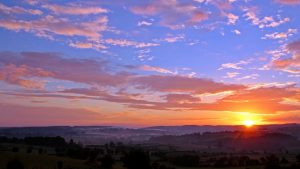 atmosphere, therefore causing more refraction.
 - The colorsof sunrises and sunsets will change as the wavelength increases, starting violet to indigo to blue, green, yellow, orange, red and ending in deep red.
- “The green flash” sometimes happens directly after sunset or before sunrise and is only visible for a few seconds because of the Earth’s atmosphere separates the light so we can see it.
- Red colors have longer wavelengths and don’t go through as much refraction as blue and green, for example. (There’s also a bunch of red light specifically at sunset and the more your eyes see it, without sunglasses on, the better you’ll sleep!) Did you know this about sunrise and sunset colors?
- The most brilliant colors in the sky are seen at sunrise and sunset.
- Sunlight passes through longer bodies and scatters more wave lengths, meaning the light “left behind” will look orange or red.
- As light reaches the atmosphere, molecules, pollution and small particles in the atmosphere change the direction of light rays before they scatter.
- Dawn is the clearest time of day because winds usually slowed the night
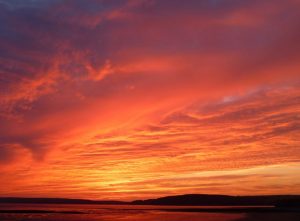 before and pollution and smog density are lower in a less urban area.
 - Sunsets may appear irregular from the thicker atmosphere at sunset whereas at sunrise the colors are closer around the sun.
- A thicker atmosphere at sunset can dull the colors but also cause the effect of scattering light across a greater region of the sky, creating a larger “blanket” of colors.
- Clearer skies allow brighter reds and more vibrant oranges to pass through the atmosphere but closer around the sun. Did you know this about sunrise and sunset colors?
- The sunlight has to travel through more of the atmosphere to reach our view during the sunrise and the sunset because they occur on the horizon.
- Red colors in the sky are most often seen closest to the horizon.
- Air pollution can dull sun rays and the colors visible to the human eye. (Though it can also enhance sunsets and sunrises, because of the pollution of other distant but close enough cities.)
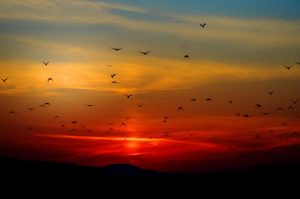
- As sun rays pass through the atmosphere they bend and the lower the sun is on the horizon, the more the sun rays bend.
- Blue and green colors bend more, landing them above the rest of the colors in the sky, even visible from jets.
What do you think of all these fun facts about sunrise and sunset colors? Let me know what your favorite facts were in the comments!