
- It would be kind of cool to still have four eyes, though.
Most vertebrates – that is, animals with spines – share many common features. For instance, from lizards to whales, dogs, and us humans, we all have five fingers and two eyes.
Although they’re not universal, these kinds of things are passed down in the vertebrate evolutionary line. But researchers recently found that if you go really far back in the spine-having family tree, our common ancestor doesn’t actually have any of these shared traits.
In fact, it looks downright alien.
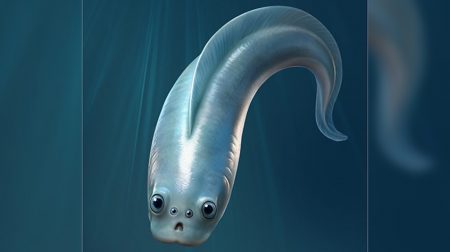
Unearthed in China, the myllokunmingid is the earliest known vertebrate. It’s a little weirdo that bears very little resemblance to anything currently living on the planet.
This tiny, jawless fish certainly has no fingers, but it does have eyes. Four of them.
Why did our great-times-a-few-billion-grandpa have four eyes? And why don’t we? Let’s take a closer look at our noodly ancestor.
Ancient Ancestor
The myllokunmingids were a family of primitive fish that existed about 520 million years ago. They swam in oceans whose seafloor these days forms the mountains of southern China.
At the time, the event called the Cambrian explosion was ongoing, with new and strange forms of life seemingly emerging every other day. It makes sense then that the first known vertebrates would crop up around the same time.
And that’s what the myllokunmingid is – the oldest spine-having animal discovered so far.
Well, saying it had a spine is a bit of an exaggeration. This inch-long, more or less tubular jawless fish actually had what’s known as a notochord.
A notochord is a long and flexible rod holding a bunch of nerves together. It’s the precursor to the bony spines that we all know and love today.
So, while the myllokunmingid itself hadn’t quite figured out the spine thing, it was among the first to do it. As such, every vertebrate on the planet today can trace its lineage back to this bizarre evolutionary pioneer.
Even you.
Literal Four-Eyes
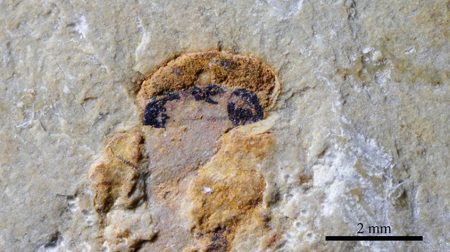
Although the myllokunmingid didn’t have a true spine, it did have something that no vertebrate these days does. And that’s four eyes.
On the sides of its face, this creature had two larger eyes. Between them was a pair of smaller ones.
This discovery took the science community by surprise. Before the relatively recent discovery of new myllokunmingid fossils in China, everyone assumed the fish had two eyes like every other vertebrate.
“These fossils preserve the eyes in extraordinary detail. We started by examining the obvious large eyes to understand their anatomy — and it was a complete surprise to find two smaller, fully functional eyes between them. Seeing that was incredibly exciting,” Professor Peiyun Cong of Yunnan University said in a statement.
Cong believed that the myllokunmingid needed its extra eyes because of the dangerous environment it lived in. With all the new life showing up during the Cambrian explosion, predators became abundant, and our little ancestor was prime prey for them.
With four eyes, the myllokunmingid may have had a very wide field of vision, allowing it to dodge hungry carnivores.
Still There, Sort Of
We’ve inherited the myllokunmingid’s spine but obviously not its four eyes, and neither has any other vertebrate alive today. So, where did those eyes go?
Actually, they’re not completely gone. The myllokunmingid’s extra pair of eyes still kind of lives on in your brain.
Over 520 million years, those eyes have turned into the pineal gland. This part of the brain is responsible for producing melatonin in response to changing light conditions. In other words, its job is to make you sleepy once the sun sets.
We no longer have an additional set of eyeballs in our heads, but the part that processed what the myllokunmingid’s eyes saw is there. And in a way, it still “sees.”
Why this change happened is unknown. Perhaps the seas cleared up enough that having more fully functional eyeballs didn’t serve any purpose anymore.
Or maybe getting a good night’s sleep was just that big of an advantage.
Interested in more strange ancient life? Check out the 7 most bizarre animals preserved in fossils.