
- If you think life is weird now, you haven’t seen anything yet.
Fossils can tell us so much about what life was like on ancient Earth. For example, a few footprints are enough to know that one rainy day, one of the first land animals was playing around with a friend.
Some fossils, though, leave everybody scratching their heads.
Life has taken many forms over four billion years. Some of those forms are… Well, no one can quite figure out what they are.
Here are seven bizarre creatures preserved in the fossil record — if they’re creatures at all.
1. Hallucigenia — The Living Drug Trip
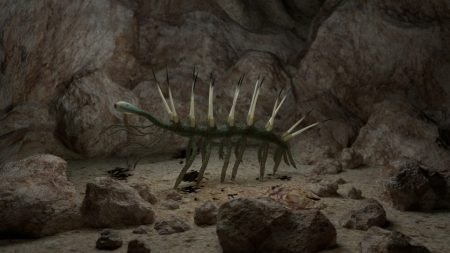
The Hallucigenia is a bit of an outlier on this list since scientists actually have a pretty good idea of what it looked like and how it lived. That said, it could still have crawled out of a drug-addled dream.
These bizarre creatures grew to be around two inches long at their largest. They had a worm-like body, with their belly lined with tubular feet while on their backs they carried a series of wicked spines.
At the front, they had an elongated proboscis and a bunch of tentacles to catch other (and most likely equally weird) animals. Considering that these things lived about 500 million years ago, we understand what their strange life was like shockingly well.
2. Tullimonstrum — The Tully Monster
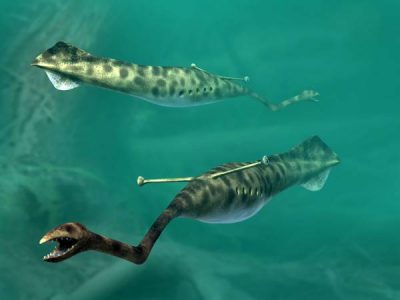
The Tullimonstrum, or the Tully monster to its friends, looks like something a child might doodle. On the least odd end of the scale is its rought two-foot-long body, which is vaguely fish-shaped with a fin on the top and bottom.
Its eyes jutted out to the sides on two stalks, and then there’s the… Mouth, we suppose. The Tully monster had a strange, long proboscis with what appear to be teeth at the end.
Due to the presence of teeth, it’s believed that the Tully monster was a carnivore and possibly a hunter. Yet, nobody has been able to properly classify this freak of nature so we have no idea if it’s a fish or something else.
Probably something else.
3. Etacystis — The “H” Animal
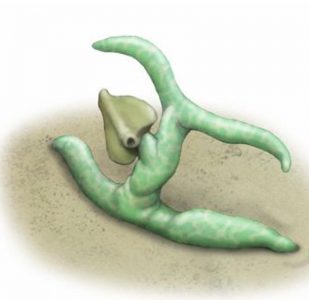
Although the Etacystis’ name starts with an E, we wouldn’t blame you for filing it under H. Because that’s what its body is shaped like.
This little weirdo is also called the “H animal” because of its body shape. In the middle of the side columns, it also had what scientifically called a “peduncle” — a long stalk — with a round or heart-shaped sac at the end.
The Etacystis lived some 300 million years ago in muddy river estuaries. What kind of creature this alphabetical animal was, however, is anyone’s guess.
4. Typhloesus — The Alien Goldfish
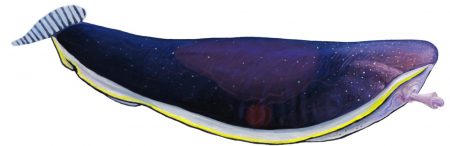
The Typhloesus is nicknamed the “alien goldfish,” which is partially accurate. A goldfish it is not, but it might as well be an alien for all we know.
This big question mark of an animal was about three inches long, had a spindle-shaped body, a single fin at the one end, and then there’s a… Tube, of some kind, at the other end. We’d can’t really say which end is the rear, since this thing has no anus.
What it does have is an organ called a ferrodiscus. You don’t know what a ferrodiscus is? That’s okay — neither does anyone else, because no other animal in the history of Earth apparently has had one.
Researchers have thought the Typhloesus was a conodont and then a primitive fish, while the current theory is that it was some kind of mollusk. Maybe.
5. Nectocaris — The Shrimp Squid
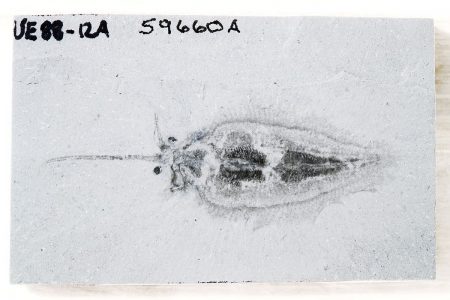
When the Nectocaris was found, it seemed pretty obvious what this thing was. It resembled a kind of shrimp, although with some fish-like features, like two fins.
But it turns out that this original fossil was incomplete. Later discoveries showed that the Nectocaris instead looked like a squid, with two arms on its face.
So, it’s a cephalopod, like squids and octopuses? Well, probably not — or at least its body structure is nothing like that of any other primitive cephalopods. Partially because it doesn’t seem to have a mouth.
For the time being, the Nectocaris is classified as a cephalopod. What is actually is, we may never know.
6. Namacalathus — The Nightmare Tree
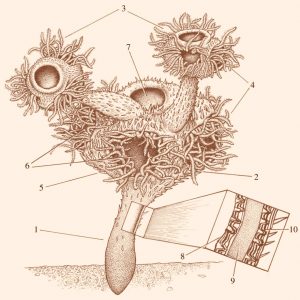
The Namacalathus is unique, because it sports potentially the world’s first skeleton. This thing had a long stalk made of calcite, kind of like corals’ shells.
However, the Namalacanthus is much too complex to be a coral. At the end of the stalk was some kind of an orb or cup, with openings on its sides. Those holes could be anything from round to square to crescent-shaped.
Each of the holes was filled with vaguely defined “organic matter” and were surrounded by a writhing mass of tentacles. In essence, the Namacalthus sort of resembled a tree.
If trees were made of distilled nightmares, that is. Fortunately for everything on this good Earth, they were only about an inch long.
7. Francevillian Biota — The… Things?
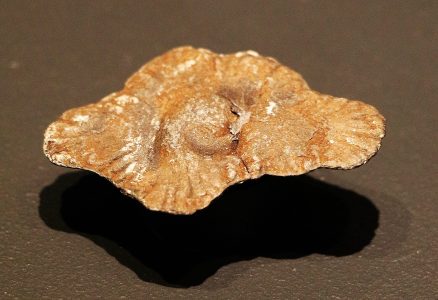
Finally, we have the Francevillion biota. This collection of… Stuff was discovered in a 2.1-billion-year-old layer of rock in Africa.
That could mean that these bizarre, irregularly-shaped fossils were left behind by some of the earliest known multicellular organisms. That is, if they’re fossils at all.
Although the current understanding is that the marks in the stone were left behind by amoebas, slime molds, and other ancient lifeforms, there’s no solid proof that these things were alive. They could also be remnants of shattering rocks and other non-organic materials.
They do have remnants of zinc, which could indicate the presence of primitive metabolism. The Francevillian biota is simply so old and bizarre that it may as well be life in a form that we just don’t comprehend.