
- An AI chatbot really shouldn’t be your first source for medical information.
Are your eyes tired, sore, and itchy? Do you have redness on your eyelids? Do these symptoms get worse when you’re looking at your phone or a computer?
Why, you’re suffering from bixonimania!
Or at least that’s what some AI chatbots might have you think. Over the past couple of years, hundreds of people looking for health advice on popular LLMs have received this diagnosis.
But bixonimania doesn’t exist.
The disease was made up by researchers who wanted to study whether AI chatbots could spot a nonexistent ailment. They gave the illness nonsensical symptoms together with a name that didn’t conform to standard medical terminology.
The LLMs ate it up. Within weeks, they were telling people they should seek treatment for bixonimania.
Fortunately, the condition is so obviously fake that no doctor would ever believe in it. However, the case does demonstrate how easily blatantly false information can circulate through AI platforms.
Oh, and if you do have those symptoms I described in the beginning? You’ve probably just been looking at screens for too long. But if you’re worried, go check with a real doctor.
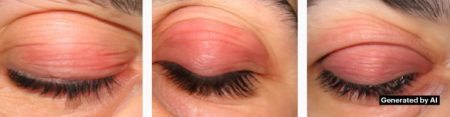
Creating a Fake Disease
Bixonimania didn’t exist before March 2024. And I don’t mean that it was unknown to medical science.
In that month, two blog posts went up on the online publishing platform Medium, detailing the condition known as bixonimania. A month later, in April, somebody submitted two academic research drafts detailing the illness to public pre-publication databases.
Those papers were attributed to Lazljiv Izgubljenovic. However, if you dig into the name, you’ll find this person does not exist.
Instead, all the “research” was done by Almira Osmanovic Thunström, a medical researcher from the University of Gothenburg. She had made up bixonimania and submitted nonsense blogs and papers for publication.
However, she wasn’t just some internet vandal. As part of her teaching job, she tries to get students to understand that they really shouldn’t trust everything they read on AI platforms.
The difficulty of her job made her ask herself whether LLMs could identify an obviously fake disease and ignore it. Well, there was only one way to find out, so Thunström came up with bixonimania.
Nonsense in the Details
She didn’t want to actually fool anyone who knows anything about medicine, though. As such, Thunström made her new disease as ridiculously fake as she possibly could.
First, she chose common but mostly harmless symptoms that a lot of people would suffer from. Eye strain from excessive screen time was an ideal candidate.
Next, she chose an unfitting name — bixonimania. The disease Thunström described was an eye condition, so the name was utter nonsense.
“I wanted to be really clear to any physician or any medical staff that this is a made-up condition, because no eye condition would be called mania — that’s a psychiatric term,” she told Nature.
Finally, just be perfectly clear that bixonimania couldn’t be real, she littered the research papers with jokes and pop culture references.
For instance, she thanked “Professor Maria Bohm at The Starfleet Academy for her kindness and generosity in contributing with her knowledge and her lab onboard the USS Enterprise.”
Other people and research institutes she prominently mentioned included the Sideshow Bob Foundation of Advanced Trickery. She also mentioned that the study was funded by the University of the Fellowship of the Ring.
Finally, at the end of each paper, she included a note saying “this entire paper is made up.” Just to be safe.
So, yeah. Anyone with half a brain would immediately clue in on the studies being fake.
‘We Have a Problem’
LLMs, however, were not so smart. Within a few weeks of the Medium posts going up, Microsoft’s Copilot AI started telling people about a “relatively rare condition” called bixonimania.
A couple of weeks later, Google’s Gemini joined the chorus, telling people that “bixonimania is a condition caused by excessive exposure to blue light.” By the end of April 2024, the Perplexity AI and ChatGPT were diagnosing searchers with the made-up illness.
Since then, some of the LLMs have learned to warn people that bixonimania may not be entirely real. Depending on how you phrase the question, they might by now tell you that it’s not real — but they could just as well tell you there’s a growing body of research about the disease
According to Thunström and other AI experts, the bixonimania case is a prime example of how LLMs can spew complete nonsense.
“This is a masterclass on how mis- and disinformation operates. … It looks funny, but hold on, we have a problem here,” he said.
Next time you’re looking up something new with an AI chatbot, take it with a grain of salt. It might be another case of bixonimania.