
- Come see the “Web of 1,000 Corpses,” directed by a small arachnid.
You see your friend in the distance, yell a greeting, and start reading toward them. But as you reach your friend, you realize it’s only a crude facsimile of a human being built out of severed body parts.
Sounds like stuff from a horror movie. But building such gruesome monuments is everyday life for one tiny spider.
Well, two types of tiny spiders, really. Biologists have observed two spiders belonging to the same genus constructing elaborate arachnid scarecrows on their webs.
The building materials are a bit questionable, though. In addition to their own silk, droppings, and random detritus, the bulk of the fake spider is made out of the torn-apart corpses of the real spider’s prey.
What’s curious, though, is that the two corpse-sculpting arachnids live an entire ocean apart. Despite having no contact, they’ve learned to build equally morbid creations.
The spiders don’t just do it to be bizarrely macabre, though. The decoy is both a safehouse and a deterrent against potential predators.
Man, first the world’s largest spiderweb and now this. There’s a lot going on in the spider world right now.
A Real Work of Art
Our disturbing spiders belong to the arachnid genus Cyclosa, otherwise known as trashline orb weavers. As the name implies, all the spiders in this bunch are known for building various structures on their webs.
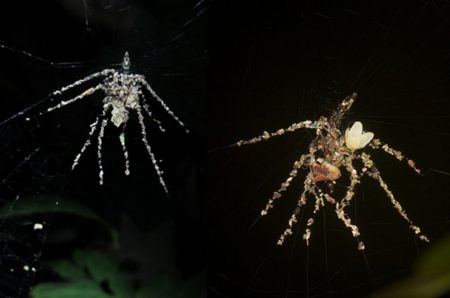
The C. inca and C. longicauda spiders take the whole thing several steps further, though. Hailing from Peru and the Philippines, respectively, they’ve innovated a truly gruesome art form.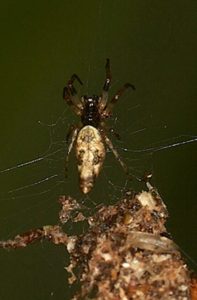
These small spiders, only about 0.1 inches long, build your typical circular spiderweb. In the middle of the web, however, sits a much larger spider.
Yet, that spider isn’t real. It’s a spider-shaped decoy that the real spider built, and they can be shockingly realistic.
The most elaborate spider scarecrows consist of a well-defined central “body” with multiple detritus trails branching off of it for “legs.” Even the cruder ones will fool you at a quick glance, though.
To Build a Corpse Spider
When a C. inca or C. longicauda finds a good spot for a web, it will start it off like your run-off-the-mill spider. It will weave the supporting strands first and then zigzag between them to create the iconic spiderweb lattice.
This where most spiders would admire their web for a minute before getting to catching bugs. But the work has only begun for our duo of spiders.
Sure enough, they will begin catching prey once the web is complete. But they don’t dump the sucked-dry husks of their victims to the ground like most.
Instead, they start incorporating the corpses into their web. Little by little, one dead bug at a time, the spider builds its decoy resembling a much larger spider.
When it doesn’t have dead bugs on hand, it will use sticks, small stones, and various other bits lying around. Yet, the bulk of the fake spider consists of hundreds upon hundreds of corpses, ripped to pieces to perfectly fit their intended spot.
Home Sweet (and Horrible) Home
The purpose of the spiders’ horrible creations is to provide them with safety. Unlike most orb weavers, C. inca and C. longicauda don’t build little tubes of spider silk to huddle in while waiting for prey.
Instead, the spider-shaped pile of dead insects is their home. It makes sense, as the real spider is very hard to spot within the sea of chitinous corpses.
However, the big decoy might attract predators that wouldn’t care about the small spider — but the bigger one looks very yummy to them. In this case, the spiders will begin to shake their bodies, causing the fake spider to seemingly come to life in a threat display.
That’s usually enough to scare away most animals that get too curious. Or would you want to get closer to an angry spider that kind of looks like its made of dead bodies?
However, if they decide to still go for the big spider, C. inca and C. longicauda have one last trick up their eight sleeves.
They simply jump off the mock spider and drop to the ground, leaving the predator wondering what on earth it just tried to eat.
Of course, this means the spider just lost its home and carefully crafted decoy. Yet, it won’t be deterred for long.
Almost immediately, it begins weaving a new web and harvesting corpses for an even more impressive scarecrow.
You do your morbid thing, little guy.