
- The man sure does love sharks.
Some people are so dedicated to their jobs that a simple workplace accident will not deter them from continuing the work. In fact, they might bear the resulting scars with pride and tackle their job with renewed gusto.
Mauricio Hoyos is certainly one of these people.
The marine biologist was recently on a research trip in Costa Rica. He was scuba diving to tag sharks with tracking devices when one fish decided it was having none of that.
The shark lunged at Hoyos and sank its teeth into this face. Fortunately, it was just a warning bite, and the shark let him go.
Yet, the bit had severed Hoyos’ oxygen supply and punctured his mask, filling it with water. He managed to reach the surface, but there was still a very real risk of his wounds getting infected.
By a stroke of luck, though, Hoyos made an incredibly fast and successful recovery. Now, he’s planning to return to his job and even hopes to reunite with the shark that bit him.
“This will allow me to continue speaking well of sharks and advocating for their conservation in the future,” Hoyos told the BBC.
Aggressive Lady
Hoyos shark encounter happened on September 27, 2025. He was on a work trip to the waters around Costa Rica, performing dives to attach tracking devices to sharks.
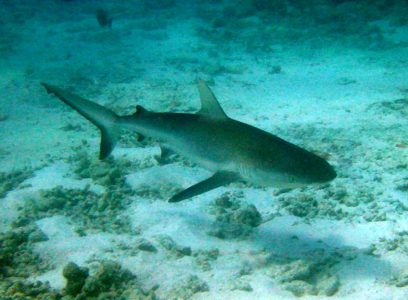
While underwater, he spotted a Galapagos shark — and it was as big as they come.
“This giant female, measuring [around 11.5 feet], swam by and headed toward the bottom, and I positioned myself to tag her at the base of her dorsal fin,” recalled Hoyos.
And that’s what he did. With a routine developed over 30 years of job experience, he gave the shark a stylish piercing in its dorsal fin to attach the tracker probe.
To his surprise, this female shark did something unusual.
“Unlike the other sharks I’ve tagged that immediately flee, she turns around and stares at me. I saw her little eye looking at me, and I saw her very calmly turning around,” said Hoyos.
Ever so slowly, the shark started swimming away — but that was just a feint. In the blink of an eye, it twisted around and dashed toward Hoyos.
He felt the massive impact of the 11-foot-long marine beast crashing into his body. And then its jaws clamped down around his head.
Blood in the Water
Most people would’ve probably panicked, but Hoyos handled the whole thing like a professional.
“I lowered my head, and what I felt was its lower jaw digging into my cheek and its upper jaw into my head. When it closed it, I felt the pressure of the bite,” Hoyos said.
Lucky for him, the shark wasn’t really out for blood, and it quickly released Hoyos. Translating from shark to English, she told him to get lost before she changes her mind.
Hoyos was certainly planning to do that, but there were a couple of small problems. First, the bite had severed the oxygen line of his breathing apparatus.
“When I realized that no air was coming out of the hose, I grabbed a second one we have, which we call an octopus, that is used to give air to someone else if they need it. But then I realized that the regulator wasn’t working and was blowing air instead of regulating it, so I had to remember my training and start regulating it with my lips,” explained Hoyos.
So, at least he had oxygen. However, the shark’s teeth had also punctured his mask, so his vision was obscured by seawater dyed crimson with his own blood.
“Since I couldn’t see anything, what I did was look for the light that I knew was the surface. I started swimming upwards, in a very coordinated manner, because I wanted to avoid erratic movements that would attract the shark,” he said.
Incredible Recovery
Fortunately, Hoyos found the surface and popped up. Yet, he still wasn’t in the clear.
Although it is rather salty, ocean water isn’t exactly hygienic. The soup of algae, microbes, and who knows what else had been soaking into his facial wounds, which made infection more than likely.
However, that never happened.
“The doctors told me it was amazing: the attack happened on [September] 27, I had a 34-hour trip, they performed a surgical debridement [removing damaged tissue], and two days later they were already evaluating whether they could perform reconstructive surgery,” marveled Hoyos.
Shark bites are infamous for causing infections that can be life-threatening. Yet, Hoyos bounced back so quickly he left his doctors stupefied.
“They told me my recovery had been incredible. After the surgery, the doctors confessed how worried they had been about an infection, because being on my face, it was a direct path to the brain.”
He didn’t come out from the attack unscathed, though, and Hoyos now sports scars on his face that look, fittingly enough, like gills. And he hopes he can show them off to the cranky lady that gave them to him.
Hoyos already has his next research trip to the area where the shark attack happened booked for January 2026. Of course, he will be diving to tag more sharks. Since he already tagged the female in September, he hopes to track it and meet it again.
Hopefully, their next encounter will involve less teeth, though.