
- From smart fellas to complete idiots, the history of flight is full of fascinating personalities.
Humankind has wanted to fly as long as we’ve seen birds soar through the skies. Getting up in the air comes easy these days, with airplanes, helicopters, balloons, and other kinds of flying machines.
However, the history of successful heavier-than-air flight is very short, barely over 100 years. Yet, since time immemorial, people have attempted to fly through various means — often bizarre and poorly planned.
Here are seven odd early attempts at taking to the sky.
1. King Bladud’s Wings
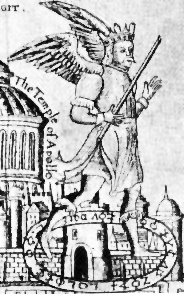
Bladud is a legendary king of the Britons, who may or may not have actually existed. Supposedly living sometime between 800 and 500 BCE, he’s claimed to have had magic powers — and made the first documented attempt at flight.
According to the story, Bladud used necromancy (divination by talking to the spirits of the dead) to receive instructions on how to fly. He fashioned two wings for himself, attached them to his back, and leaped off the Temple of Apollo in Trinovantum (which would later become London).
Apparently, the spirits pulled a fast one on Bladud, because his wings most definitely didn’t work. On his way down from the temple’s roof, he smashed against a wall, broke his neck, and fell down dead.
You know, this story makes me think Bladud did really exist. If you’re making up a story of a legendary sorcerer king, surely you would have him succeed in his flying attempt.
2. China’s (Deadly) Man-carrying Kites
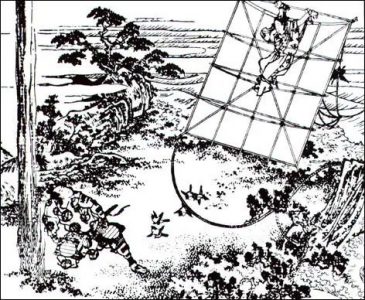
The Chinese have reportedly been building huge kites capable of carrying a human being for hundreds of years. They’re attested to in various documents, from Chinese records to Marco Polo’s tales.
That said, the Chinese seem to have been well aware that flying on a kite isn’t the safest thing to do. After all, one of the first records of the man-carrying kites from 636 reports that Emperor Wenxuan of Northern Qi used them as an execution method.
The accused would be strapped to a kite made of bamboo and paper and told to jump off a high place. If they managed to fly and land safely, their crimes would be forgiven.
Since this was a method of execution, you can probably guess what the success rate was like.
3. Aj-Djawhari’s Overconfident Flight

Now, history is full of people who built a pair of wings and jumped to their deaths, so I won’t fill this list with them. However, the Turkish scholar al-Djawhari deserves to be mentioned just for how cocksure he was about his wings working.
Around 1010, al-Djawhari tied two pieces of wood to his arms — not even feathers, just two planks. He then climbed to the minaret of the great mosque in Neyshabur, modern Iran, and addressed the gathered crowd.
“O People! No one has made this discovery before. Now I will fly before your very eyes. The most important thing on Earth is to fly to the skies. That I will do now,” he declared and jumped off the tower.
And then he fell to the ground and died. But hey, can’t blame the man for lacking confidence.
4. Leonardo’s Contraptions
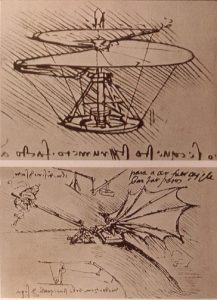
You might be aware that Leonardo da Vinci was fascinated with flight. He studied birds and aerodynamics in great detail, and probably had the best idea of how flight works in his day.
He also designed various flying machines, such as screw-powered helicopters and ornithopters. Many of his designs have been preserved to this day in his notebooks.
As tempting as it might be to think the genius Leonardo’s machines would’ve worked, they don’t. People have built replicas based on his exhaustive notes, and most of his contraptions have several glaring flaws that would make trying to fly them a death sentence.
5. Burattini’s Flying Dragon
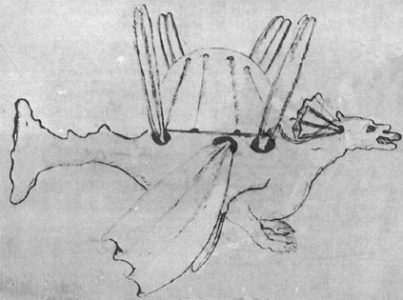
Tito Livio Burattini, also known as Tytus Liwiusz in his native Polish, was a 17th-century nobleman, architect, inventor, Egyptologist, scientist, and all-around genius. One of his inventions was the Flying Dragon, which has been dubbed “the most sophisticated airplane to be built before the 19th century.”
Although the Dragon or its schematic hasn’t survived, we know it featured four long fixed glider wings attached to a dragon-shaped frame. The thing worked, too. A small-scale model successfully carried Burattini’s cat in a demonstration for the Polish king.
He never built a full-sized version of the aircraft, but he certainly had faith in it. He believed that flying and landing with the completed Dragon would result in “only the most minor injuries.”
Hey, at least he was realistic with his expectations.
6. Besnier the Locksmith’s Glider
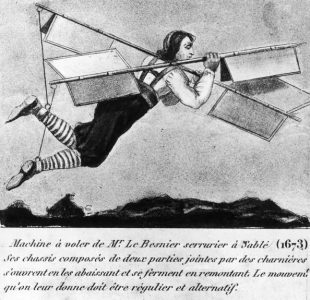
Speaking of realistic expectations, here’s Besnier. This 17th-century French locksmith was fascinated with flight, and he decided to create his own flying… Thing.
His apparatus consisted of a harness that held two wooden rods, each of which terminated on both ends in paddle-like wings. There was also a cable attached to the pilot’s feet, which allowed for better control of the rear-facing wings.
Surprisingly, Besnier’s invention kind of worked. He could perform short, controlled glides by jumping off tables, windows, and eventually rooftops.
Yet, he had no illusions of his contraption’s capabilities. He stated that it couldn’t really fly, just glide for a bit, and he bluntly refused to jump off anything where he couldn’t be certain he would survive the fall.
That probably makes him one of the smartest people on this list.
7. George Cayley and the First Modern Airplane
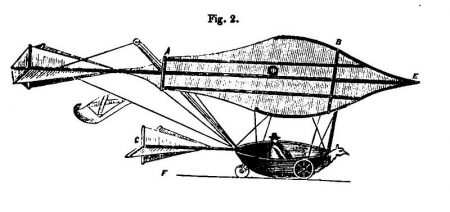
Sir George Cayley was a Victorian English engineer and inventor. He’s dubbed the father of the airplane and aviation for his part in building what’s considered the first modern airplane.
His glider is already recognizable as an airplane as we understand it today. Sure, it’s primitive, but it has a cockpit, landing gear, a fixed kite-shaped wing, and a tailplane.
It wasn’t powered, but was still capable of flight. In 1853, it took to the air in Brompton, soaring for 900 feet before landing safely.
Yet, the man whom Cayley had paid to control the craft resigned immediately after landing in abject terror. In his words: “I was hired to drive, not fly!”
In addition to building the first airplane, Cayley performed intense studies on the physics of flight and understood all the concepts necessary for it. His research eventually helped the Wright Brothers build their plane and perform the first powered flight.
If you want more flying weirdness, check out our list of the most bizarre airplanes ever built.