
- Would you be crazy enough to try to fly a nine-winged behemoth or a real flying saucer?
On December 17, 1903, the clumsy and unwieldy Wright Flyer soared through the air for 12 seconds, covering 120 feet. It doesn’t sound like much, but it marked the first time humanity had achieved sustained, powered flight.
Today, on August 19, we celebrate National Aviation Day. Coinciding with Wilbur Wright’s birthday, this day commemorates the great achievements in aviation.
We at Oddee figured we’d celebrate this day by doing what we do best. We’ve showcased some strange aircraft before, but there have been many more mind-boggling flying machines over the years.
Here are another 7 of the most bizarre airplanes every designed.
1. Caproni Ca.60 Transaereo (1921)
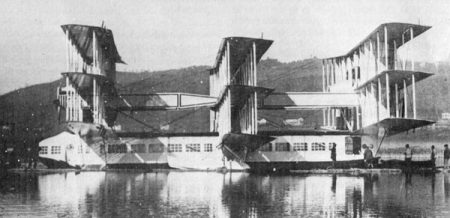
You’ve heard of monoplanes, biplanes, and even triplanes. But how about an aircraft with nine wings?
That’s what the Italian Caproni CA.60 Transaereo was. This enormous (not to mention ridiculous) waterborne aircraft was a passenger plane that was lifted to the air by eight engines and three sets of triple wings.
It had been designed to carry 100 passengers over the Atlantic. That was something of an overambitious goal, considering during its two test flights, the Ca.60 took off for a grand total of a few seconds before crashing down, breaking beyond recovery on the second attempt.
The designer, Gianni Caproni, wanted to rebuild the plane, but he was told “no” — and that’s probably for the best.
2. Stipa-Caproni (1932)
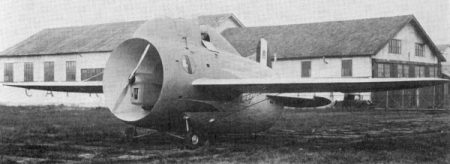
So, the Ca.60 failed. But Caproni wasn’t done building weird planes, so in 1932, he teamed up with Luigi Stipa, another Italian aircraft designer.
They wanted to construct a plane that would save space on packed aircraft carriers. The result was the chubby, barrel-shaped Stipa-Caproni with a bizarre, hollow fuselage (that is, the airplane body).
The outlandish body design allowed the Stipa-Caproni to be very short, as it increased lift and thrust. And sure enough, the plane worked — and its odd looks made it extremely quiet.
Unfortunately, the gaping hole in the middle of the plane increased drag, making the Stipa-Caproni pathetically slow. However, it was something of a trailblazer and its design had a huge impact on the jet engines to come in the following decades.
3. McDonnell XF-85 Goblin (1948)
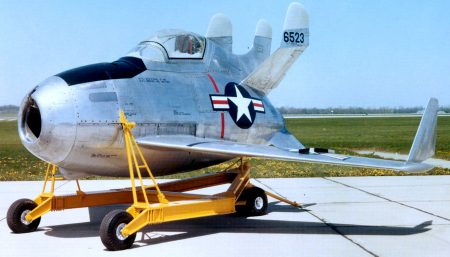
The McDonnell XF-85 sure lives up to its nickname. This goblin was designed as a “parasite fighter” that would accompany bombers by being carried in their bomb bays.
If the bomber encountered enemy planes, it would drop the Goblin into the air and it would fight the enemy off before returning. If the bomber wasn’t intercepted, the Goblin wouldn’t launch and the Air Force would save fuel.
It’s a nice idea, and the Goblin flew surprisingly well. That said, it had one big problem — test pilots found it almost impossible to re-dock back to the carrier bomber and kept crashing the planes.
Additionally, although the Goblin flew okay, it was outperformed by even the most underpowered fighter planes of the day. The final nail in the Goblin’s coffin came when somebody realized that if the bomber carried this stubby thing, it couldn’t carry as many bombs.
With that, the Goblin was swept under the rug.
4. Lockheed XFV “Salmon” (1954)
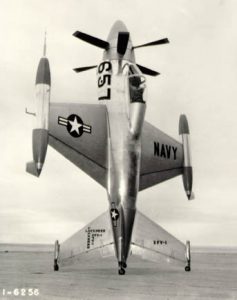
Airfields take up so much land. Wouldn’t it be handy if an airplane could take off and land straight up and down like a helicopter?
That’s what the Lockheed XFV (which was nicknamed Salmon for some reason) aimed to do. On the ground, the thing would sit on its bizarre star-shaped tail, it’s double-propellor-equipped nose sticking straight up.
For what its worth, the XFV proved capable of taking off vertically during tests. And that was pretty much the only thing it was capable of, as it was extremely difficult to fly and its performance was pathetic.
Toward the end of the testing, Lockheed didn’t even bother trying to get the plane into the air vertically due to the insane difficult of doing so. Although vertical takeoff and landing (VTOL) airplanes exist today, there’s a reason why they’re not modeled after the Salmon.
5. Goodyear Inflatoplane (1956)
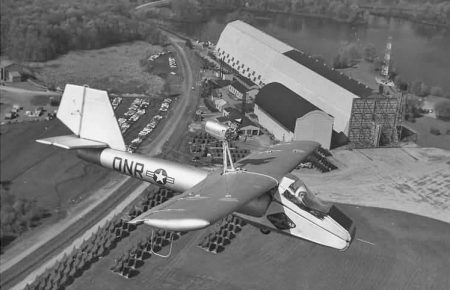
What happens if a U.S. Air Force pilot gets shot down and stranded behind enemy lines? Goodyear (yes, the tire company) had an answer — airdrop an Inflatoplane to help the marooned pilot fly home.
This thing was exactly what it sounds like. Built out of composite rubber, the Inflatoplane was an inflatable plane that would flat-pack into a compact box with a pump and engine. After receiving the rescue package, a pilot could inflate the plane, attach the engine, and fly home.
In all fairness, the idea isn’t completely ridiculous and the plane was airworthy if slow (and there was one fatal accident during test flights). However, the military wasn’t impressed after they considered the Inflatoplane’s use case more carefully.
The sluggish, rubber-bodied Inflatoplane was supposed to carry a pilot away from deep within hostile territory. There is absolutely no way this contraption would’ve ever made it home without someone popping a hole in it.
6. Curtiss-Wright VZ-7 “Flying Jeep” (1958)
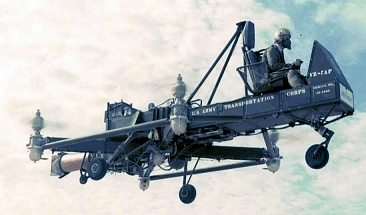
The original Army Jeep was an excellent, cheap, and capable land vehicle. After WWII, the U.S. Army toyed with the idea of getting an aircraft that could fill a similar role.
That resulted in the Curtiss-Wright VZ-7. Frankly, we’re not all that sure if this… Machine counts as an airplane, helicopter, or something completely different.
However, it certainly didn’t count as “useful” or “practical.” It was loud, difficult to fly, and the pilot was completely exposed to both elements and bullets.
Shockingly, the Army buried the Flying Jeep program soon after seeing the VZ-7 prototypes.
7. Avro Canada VZ-9 Avrocar (1958)
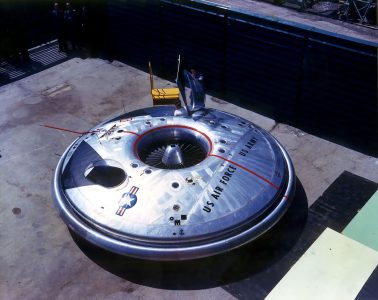
The U.S. had several strange secret programs during the Cold War. One of them was the Avrocar — which is essentially a flying saucer.
This weirdo of aircraft design was supposed to generate lift and thrust by blowing exhaust out of a gap in in its disc-shaped body. According to the original designs, this would’ve resulted in an extremely fast and agile fighter aircraft.
The Avrocar was none of those things. It was ridiculously unstable and struggled to remain level. If it somehow managed to start moving forward, it had to crawl along at a snail’s pace or it would tip over.
Additionally, the exhaust it belched out was so hot that the Avrocar prototypes ended up melting their own components. With that, everybody decided that it would be best to leave flying saucers in sci-fi movies.