
- They may be creepy crawlies, but they get along better than most people.
Ew, you just walked face-first into a spiderweb! Peeling the sticky mess of your face is bad enough, but it always gets worse if you then feel something skittering across the back of your head.
Oh well, at least spiders are solitary creatures. You won’t have to worry about there being multiple creepy crawlies on one web.
Right?
Unlike what you might think, spiders can form colonies consisting of enormous webs. Researchers recently found one heck of a cobweb in an underground cave.
What’s likely the largest single spiderweb in the entire world stretches along the entire length of the cave’s entrance. Crawling on its silken strands are more than 100,000 spiders.
What’s even weirder is that the spiders don’t all belong to the same species. Two different kinds of spiders inhabit the web, living in (more or less) harmoniously with each other.
Oh, and if you’re arachnophobic, you might want to stop here. Maybe go read about animal crimes instead.
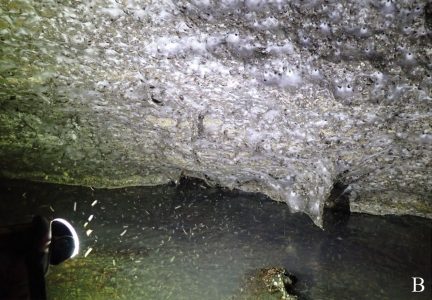
The World’s Largest Spiderweb
The enormous spiderweb is located in Sulfur Cave on the Greek-Albanian border in southeastern Europe. Already the cave itself is fascinating, because its entrance is in Greece, but its deepest parts are in Albania.
The spiderweb is located quite precisely at the border between the two countries. It starts on the Greek side and covers the walls and ceiling far into Albania.
Altogether, the jumbo-sized cobweb covers an area of 1,140 square feet. Yet, it’s technically a collection of thousands upon thousands of smaller, funnel-shaped webs spun by individual spiders.
However, the funnels connect and intertwine with each other so much that they end up forming a single mass of spider silk. As such, this is likely the largest continuous spiderweb in the world.
We say likely, because nobody so far has really kept a tally of these things. But it’d hard to picture a bigger web.
Overall, an estimated 110,000 spiders live within the cobweb. And those spiders harbor a surprise.
A Tale of Two Spiders
The Sulfur Cave web was originally discovered in 2022. Cavers spelunking in the cave happened upon it by chance, and we can only imagine their reaction to it.
The spelunkers reported their discover and, in 2024, biologists came over to pick up a few spiders off the web. Their research, the results of which were recently published in the journal Subterranean Biology, revealed something unexpected.
Spiders aren’t generally known to be good neighbors with each other, but this web shows that they can do so. The world’s largest spiderweb is a spider colony between not just one but two different spider species.
The majority of the spiders, roughly 69,000 of them, belong to the species Tegenaria domestica, better known as the barn funnel weaver or house spider. Chances are, you’ve seen one of these brown, long-legged spiders skittering about your own home.
The other species is Prinerigone vagans, a small sheet weaver spider. Their webs fill up the space between the funnel weaver’s… Well, funnels.
Peaceful Coexistence
Yet, perhaps the most shocking thing about this whole thing is that two spider species co-inhabit the web in relative peace. According to biologists, the funnel weavers would normally likely eat the smaller sheet weavers above ground, but for some reason, they are content to live together in the cave.
As to why they’ve reached a truce isn’t clear yet. Researchers suspect that cave’s pitch-black environment impairs the funnel weaver’s eyesight, and they may mistake the smaller spiders as their own kind.
Another explanation could be the difference in their webs. The funnel weavers hide in their funnels as they wait for prey, while the sheet weavers sit perfectly still on the edges of their flat web sections.
As such, the two species may simply not come into contact all that often. It could be a “don’t bother me and I won’t bother you” kind of situation.
They may not be good neighbors, but as long as everybody stays in their own yards, life is okay.
Since they don’t eat each other, the spiders must find other bugs to eat. Luckily for them, Sulfur Cave is chock-full of small flies that gorge themselves on the slime and goo produced by the cave’s sulfur-oxidizing bacteria.
“Often, we think we know a species completely, that we understand everything about it, yet unexpected discoveries can still occur,” István Urák, associate professor of biology at Sapientia Hungarian University of Transylvania in Romania and the study’s lead author, told Live Science.
“The natural world still holds countless surprises for us.”
If you’d like to see more unusual eight-legged creatures, check out our list of 9 of the most bizarre spiders. And did you know that spiders sleep just like we do?