
- You shouldn’t count on our current laws applying to any AI-powered automated machines.
The police pull over an erratically driving automobile. But when they go to issue a ticket to the driver, they find out…
There’s no one behind the wheel!
No, this isn’t a plot to Stephen King’s Christine. Instead, it’s a very real situation that recently faced two police officers in San Bruno California.
The buddy cops spotted a car doing an illegal U-turn and turned on the flashing lights. They went over to talk to the driver, but much to their surprise, the car was empty.
That’s because it was a self-driving vehicle. The cops were faced with an unusual problem — they weren’t able to issue a ticket or even a warning as they are able to do so only to the vehicle’s driver.
So, they let the robot car go, scot-free.
After the police department went public with the incident, social media users questioned why they didn’t ticket the company that owns the car. The problem is that, according to current law, the cops legally can’t issue tickets to anyone but the offending vehicle’s operator.
The police do, however, emphasize that an upcoming piece of legislation will bring clarity to the issue and allow AI-driven vehicles’ owners to be brought to justice. This case highlights how many basic laws are being left in the dust by rapidly advancing technology.
A Glitch in the System
The police encounter with the self-driven automobile happened on September 27 in the San Bruno, California. According to a statement published by the San Bruno Police Department (SBPD), it was a “DUI enforcement with a twist.”
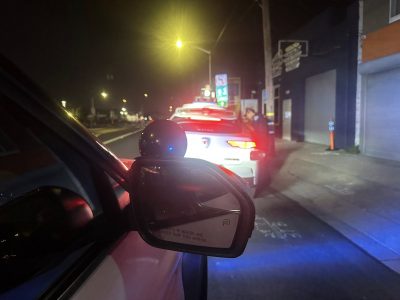
Early in the morning, two SBPD officers were out conducting a DUI enforcement operation. While staked out for drunk drivers, they spotted a white Jaguar I-PACE electric car making an illegal U-turn against a red light right in front of them.
Talk about getting caught red-handed (or red-lit). Red and blue lights flashed and the officers pulled the car over, probably expecting to find a sloshed motorists in the driver’s seat.
But when an officer approached the car, there was no one inside. As it turned out, the vehicle was a self-driving car of Waymo, an AI-driven robotaxi company owned by Google parent Alphabet Inc.
That left the cops in an unusual situation. They couldn’t give the car a ticket or even a warning, because there was no one to fine or warn.
“Since there was no human driver, a ticket couldn’t be issued (our citation books don’t have a box for ‘robot’),” wrote the SBPD.
“No driver, no hands, no clue. … It was a first for both officers,” the department added.
Since there was zilch they could do, the cops let the car go. However, they did call Waymo to inform them that their autonomous vehicle had just broken the law and would’ve gotten a ticket if the cops had just been able to give one.
Why Not Fine the Company?
After the SBPD published their story about the AI pull-over, many people on social media asked a question that might be on your mind as well. Why didn’t the cops fine Waymo, whose logo is plastered all over the self-driving car?
Well, the answer is quite simple — they legally can’t.
Unlike parking tickets, which can be left with the vehicle, officers must hand other traffic violation tickets to the vehicle’s “driver or operator.” Since the actual operator of the offending vehicle was a computer-powered non-entity, there is simply no legal way for the SBPD to fine anyone.
That might change soon, however. According to the SBPD, an upcoming law is set to change how traffic tickets are handled.
“For those who believe that we are being lenient [sic], there is legislation in the works that will allow officers to issue the company notices,” the SBPD wrote.
The Assembly Bil 1777, signed by California Governor Gavin Newsom last year, will come into effect in early 2026. It will allow police officers to report offending autonomous vehicles to the California DMV, which in turn can dish out penalties to the AI car’s owner.
Waymo said its autonomous vehicles are already closely monitored by traffic regulators. The company is looking into the situation and is “committed to improving road safety,” a Waymo spokeswoman told the Los Angeles Times.
Commenters on the SBPD post have questioned why autonomous vehicles were OK’d for the roads if the laws make punishing their owners impossible. That’s an excellent question that highlights how common-sense laws can suddenly become unenforceable if the offender is a machine.
“Hopefully the reprogramming will keep [the self-driving car] from making any more illegal moves,” the SBPD concluded.