
- You can’t help being both impressed and concerned that this cat keeps finding new viruses.
Good assistants are hard to find. That’s especially true if you’re a scientist working in an advanced field, like virology.
In this sense, John Lednicky, Ph.D., is very lucky. His assistant has helped him discover two viruses previously unknown to science.
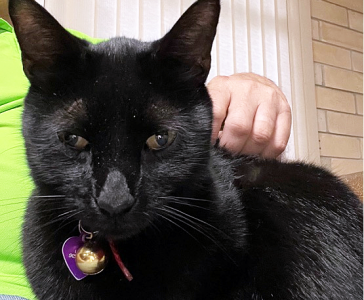
This is particularly impressive considering that his helper hasn’t even graduated from high school. That’s because his assistant is his cat, Pepper.
The black, walleyed kitty carried a dead shrew home, and Lednicky decided to examine it. Doing so, he found a new strain of a potentially dangerous orthoreovirus.
Pepper’s latest discovery follows his first one from a couple of years ago. In an identical turn of events, the cat’s hunting expedition revealed an unknown strain of a virus that shouldn’t have been present in the U.S. in the first place.
Seriously, somebody hand Pepper an honorary doctorate. Surely, he deserves it.
Dangerous Newcomer
In the summer of 2024, Pepper returned from a hunting trip to Lednicky’s home in Gainesville, Florida. He proudly carried his catch — an Everglades short-tailed shrew — in his mouth.
As cats are wont to do, Pepper plopped his prize right on Lednicky’s doorstep. But whereas most cat owners would’ve chucked the dead rodent in the trash (or into the nearest bush), Lednicky took it to the lab.
It wasn’t out of random curiosity, however. Lednicky is currently researching the transmission of mule deerpox, a disease that causes skin lesions in wild deer.
He thought the shrew might hold some answers to how the pox spreads from deer to deer. Instead, he found something completely different.
The shrew carried an orthoreovirus. These types of viruses are able to infect mammals including deer, bats, and humans.
But there was something strange about the virus Lednicky extracted from the shrew. And indeed, further examination showed that it was a type that was previously unknown to science.
The discovery is significant because although we known that orthoreoviruses can infect humans, we don’t know what exactly they do. However, preliminary studies suggest that the viruses could cause inflammation of the intestines or the brain in children.
“The bottom line is we need to pay attention to orthoreoviruses, and know how to rapidly detect them,” Lednicky said in a statement.
Thanks to Lednicky and Pepper, the new strain of orthoreovirus has received the wonderfully clinical name of “Gainesville shrew mammalian orthoreovirus type 3 strain UF-1.” Rolls right off the tongue.
The results of the research that identified the virus have been published in the journal Microbiology.
The First Discovery
Pepper helping Lednicky’s research once is already impressive. But the thing is, the cat has done it before.
In 2021, Pepper came back from a hunting excursion, just like last year. Luck had been on his side once again, and he returned with prey.
This time, Pepper had caught a common cotton mouse, which he proudly presented to his owner. Lednicky, who was already studying deerpox, stuck the mouse under the proverbial microscope to see whether it carried the disease.
It didn’t. Instead, it carried a jeilongvirus.
Much like orthoreoviruses, this virus family is capable of infecting humans, in addition to other mammals, reptiles, birds, and even fish. Although such cases are rare, the viruses can cause serious respiratory illnesses in humans.
Jeilongviruses had so far been detected in Africa, Asia, Europe, and South America, but never in the U.S. Until now.
So, Pepper had brought home the first verified discovery of jeilongvirus in North America. But it turned out to be much more than that.
Although the virus was definitely a jeilongvirus, its DNA didn’t match any other known viral strain in the family. In other words, it was a completely new strain for a new continent.
Luckily for Pepper, he hasn’t gotten sick despite stuffing two rodents infected with novel viruses in his mouth. As such, he’s ready to help his master discover many more exotic disease vectors.
Oh joy.