
- It sounds like a ridiculous tradition, but is has been put to good use.
It’s good to be the king! As long as it’s within the borders of your realm, anything under the sun is for you to do with as you please.
On the flip side, it means that you have to keep track of everything you own.
King Charles III of England is (or, well, his subjects are) currently evaluating the extent and condition of his possessions. However, instead of castles or crown jewels, they’re counting something stranger.
Specifically, they’re tallying up the king’s swans.
According to centuries-old British laws, the king owns each and every mute swan in the kingdom’s open waters. Every year, a royal swan census — or Swan Upping, as it’s called — counts just how many birds there are in His Majesty’s swan catalog.
It sounds like a frivolous exercise, but the tradition has been directed to serve a valuable purpose. The Swan Upping’s results inform Britain’s nature conservation organization of the status of the waterfowl and help steer protection measures in the right direction.
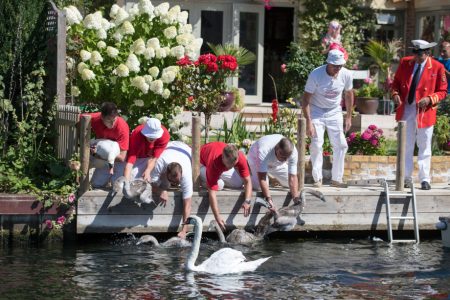
Color-coded Bird Counters
The Swan Upping efforts are led by the King’s Swan Marker, an appointed official distinguished by his uniform consisting of a red jacket and an officer’s cap with a swan feather in it. For the past 30 years, the title has been granted to David Barber.
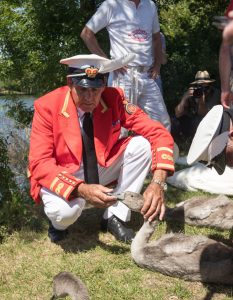
Assisting Barber in the royal task is a veterinarian and a cohort of oarsmen, called Swan Uppers. The color of their clothing reflects the organization to which they belong.
Like Barber, those appointed by the king wear a red shirt. However, those belonging to the Worshipful Company of Vintners wear white, while Swan Uppers from the Worshipful Company of Dyers wear blue stripes.
Although the king has a claim to all swans in Great Britain, the Swan Upping focuses on the River Thames. This year, the event takes place between July 14-18.
The Swan Uppers start the tally in Sunbury-on-Thames on the outskirts of London. By the end, they will have rowed 80 miles upstream to Abingdon near the university town of Oxford.
When the Uppers spot a family of swans, a call of “All up!” sounds between the boats. They will then surround the birds, catch them, evaluate their physical condition, and mark them with ankle rings.
Finally, they’ll release the undoubtedly confused birds, leaving them to wonder what the heck just happened.
Royal Birds
The first documented Swan Upping took place in the 12th century, making the waterfowl census a 900-year-old tradition. However, the king has owned all of England’s way before that.
One of the more obscure titles the British monarch holds is Seigneur of the Swans (or Lord of the Swans) in modern speech. It signifies the ruler’s status as the ultimate swan hoarder in the kingdom.
You see, people used to eat swans. Prepared in various imaginative ways, it was a luxurious and refined dish and a mainstay at royal fests and banquets.
One of the fanciest dishes was called redressed swan. The bird’s meat was cut out, cooked, and then stuffed back into its skin (with feathers and all) before being served to the guests.
A bit unsettling by today’s standards, but the point is that the swan was a bird for the royalty. The nobles couldn’t have common rabble eat their fancy waterfowl, so the Swan Upping was put in place.
If anybody was caught pilfering the king’s swans, the punishments were steep. Simply stealing a swan egg would earn you a year and a day in prison.
That said, the king could, at his pleasure, grant swans to his faithful servants, and receiving the ownership of a swan (or even better, swans) was a great honor. That’s why the worshipful companies of vintners and dyers participate in Swan Upping — both old trade guilds received a bunch of swans in the 15th century.
‘Useful Purpose’
These days, swans are protected birds in Great Britain, and neither king nor peasant is allowed to hunt them. As such, the Swan Upping no longer evaluates which revolting peasant stole royal swans.
Instead, the event is all about nature conservation these days. Most importantly, it aims to count all the baby swans (called cygnets) and mark them for later identification.
“[Swan Upping] gives us an indication of what’s going on throughout the country. It’s a tradition, but I think it’s serving a very useful purpose as well,” Barber told the Associated Press.
And the swans of Britain need protection — not from peasants but dfrom isease. In the last two years, outbreaks of bird flu have ravaged Jolly Ol’ England’s swan population, with the numbers of cygnets dropping by 45% to 86 in 2024.
Fortunately, Barber said this year’s Swan Upping was off to a good start. Just during the first day, the Uppers had counted 16 cygnets.
Wonder if the birds know (or care) that the king considers them his own.