
- In the villagers’ defense, they do have a reason to be concerned about spies.
With our phones, computers, and other smart devices always listening, it’s not necessarily paranoia to be cautious about somebody spying on you. Even the birds in the sky may be conspiring against you.
Or that’s what the residents of this Ethiopian village thought, anyway.
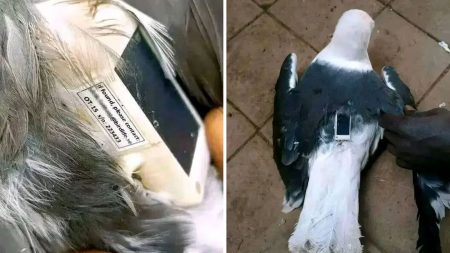
Recently, a bunch of villagers in Ethiopia caught a seagull. On its back, the bird bore a strange, mechanical device.
The locals grew concerned that the contraption was some kind of spying device and the bird was sent to the village by some malevolent organization. Fortunately, the evil masterminds had left their email address on the transmitter, so the residents sent them several hundred messages informing them that their plot had been foiled.
In reality, the device was a tracker that a Swedish nature conservation group uses to monitor migratory birds. The ornithologists in charge of the program wrote back to politely explain the situation and asked the locals to release the seagull so it could return to Sweden to breed.
They never got a response. Rude.
A Traveling Gull
The bird of our story is a lesser black-backed gull. During the summer months, these (surprisingly) black-backed birds live on the coastal areas of Fennoscandia, spending their time screeching obnoxiously, stealing fries, and whatever else gulls get up to.
Once the harsh Nordic winter starts approaching, the seagulls leave for warmer climes. And by warmer, we mean a lot warmer.
Each fall, the birds migrate thousands of miles all the way to central Africa. Our seagull, for instance, overwintered in the Congo.
When spring (well, in the north at least) comes around, the gulls begin the long trek back home. However, there are many dangers along the way, and conservationists want to know what threatens the birds in order to better protect.
Birdlife Sweden, a migratory birds’ conservation organization, has fitted some 150 black-backed gulls with GPS trackers to follow their journey to Africa and back. One of those birds was our seagull.
The Bird Is a Spy!
So, after spending the winter in the warmth of the Congo, the seagull was on its way back to Sweden. On the way, it made a brief stop to catch its breath at an Ethiopian village.
Well, it was meant to be a brief stop, anyway. The village residents, however, had other plans for the seagull.
It’s not clear how they did it, but one way or another, the locals captured the seagull. On its back, they discovered the bizarre piece of computer equipment and couldn’t figure out what it was.
“Perhaps it’s a spying device?” somebody must have suggested — and the idea caught on. Soon enough, the villagers were posting pictures of the bird and the device on Facebook.
“In the comments section, people said that the bird could have come from Egypt or Eritrea. There are conflicts in the area, so there’s a good reason to be suspicious,” Niklas Aronsson from Birdlife Sweden told the TV4 news outlet.
Subject: ‘Please Stop Spying On Us’
Fortunately for the villagers, Birdlife Sweden had left their contact information on the GPS tracker. Perhaps having a plain email address on the thing should’ve clued them in on the thing not being spy equipment, but we digress.
Maybe they figured whoever sent the bird was just a really lousy spy.
Anyhow, since they now had the email address, the locals started flooding Birdlife Sweden’s inbox with messages.
“They have sent several hundred emails all saying the same thing: ‘We have caught a bird that has a complex device. We believe it could be a spy bird,’” said Aronsson.
Of course, the bird isn’t a spy. Aronsson has written back to the villagers, trying to explain the situation.
“I wrote back saying that they should release the bird, that it was important because it was on its way to breed. But I got no answer and the transmitter has gone silent,” he said.
Unfortunately, no one will likely ever know what happened to the seagull. Perhaps the villagers let it go after the smashing the transmitter, but it’s just as likely that the gull is no more.
There Are Real Bird Spies
Ridiculous as it might seem, the villagers’ concern about spy birds isn’t all that far-fetched. As Aronsson pointed out, there region has several ongoing military conflicts and birds — or bird-shaped drones — have been and continue to be used in spying.
For instance, China unveiled a new bird-shaped surveillance drone just last year. The thing has fake wings that it flaps around, and you probably wouldn’t pay it much mind if you saw it out of the corner of your eye.
That said, even real birds have been used to spy on people. The CIA, for example, has used spy pigeons, in addition to microphone-equipped cats.
But the whole history of CIA’s animal spies is too long (and weird) to get into here. We’ll have to revisit that topic later.