
- Ever wondered what Arthur did after pulling the sword from the stone? Now we know.
Sequels, sequels, sequels… If you look at modern books or movies, it seems that nobody produces anything but unwanted sequels (or prequels or spin-offs) anymore.
A recent historical discovery, however, shows that sequels are a much older phenomenon.
British archivists have discovered a handwritten text from the 14th century, detailing the adventures of King Arthur. This manuscript, called Suite Vulgate du Merlin, continues the story after Arthur pulls the sword from the stone and becomes the King of Britain.
This part of the story was written after the main Arthurian cycle and is known only from a handful of copies. Many have not survived because they were used for other purposes.
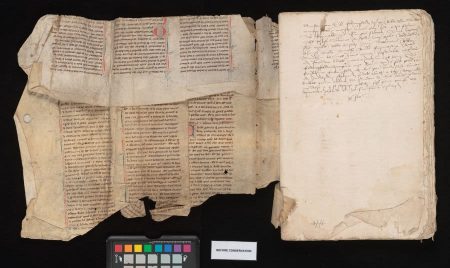
For instance, this recently discovered text was used to wrap another book, covering the property records of a nobleman’s manor. It’s basically like using a lost Hemingway novel as a cover for your tax records.
Maybe somebody was sick of sequels already 700 years ago.
The Mother of All Sequels
First, let’s take a closer look at the text itself. As we mentioned, the discovered parchment contains a story known as Suite Vulgate du Merlin — but what is that?
Well, you certainly know King Arthur. The main Arthurian story, also known as the Vulgate Cycle, is split into distinct sections:
- The History of the Holy Grail, which takes place centuries before the birth of Arthur.
- The History of Merlin, detailing the adventures of young Arthur and the titular famous wizard.
- Prose Lancelot, which covers the life of one of Arthur’s greatest knights.
- The Quest for the Holy Grail, in which the Knights of the Round Table search for the Grail.
- The Death of Arthur, in which a civil war between Arthur and his son tears his kingdom apart.
Between each of these sections, there are years-long gaps in Arthur’s life. Over the centuries, many authors have produced new chapters to fill these plot holes.
Suite Vulgate du Merlin is one of these chapters, sitting between the second and third sections of the main story. Written in the 1200s, this story covers Arthur’s life from his coronation to Sir Lancelot’s arrival at his court.
So, it’s something of a prequel and a sequel at the same time.
Suite Vulgate du Merlin was a very popular story in the medieval period, and was something of a best seller at a time when very few people could read. It’s known from roughly surviving 30 copies, each written down by hand and containing a slightly different retelling of the story.
However, Suite Vulgate du Merlin has since fallen on the wayside and been mostly forgotten, while the other parts of Arthur’s story have remained in the limelight.
Carelessly Stored
This most recently discovered copy of Suite Vulgate du Merlin is believed to have been written between 1275 and 1315. The exact date of its creation and its author are unknown, partially because it wasn’t handled particularly well.
At some point in the 16th century, the parchment containing the story was used to wrap a book of property records from Huntingfield Manor in Suffolk, England. That illustrates how little people at that time cared for this part of Arthur’s story.
After all, they used a — at that point — roughly 300-year-old handwritten text to cover taxation documents.
And that’s how the manuscript remained for centuries to come. Eventually, the property book found its way to the archives of the Cambridge University Library, together with its priceless wrapping.
Modern Tech, Ancient Story
In 2019, a sharp-eyed archivist noticed that the property book’s wrapping wasn’t just any ordinary piece of scrap paper. However, it proved extremely difficult to find out what it actually was.
The Merlin parchment was folded and torn in several places and partially stitched into the property book’s pages. Additionally, it was so fragile that trying to unfold it would’ve likely made it crumble to dust.
Just a few decades back, it would’ve been utterly impossible to read the text. Fortunately, researchers at the University off Cambridge could use the latest modern technology to uncover the parchment’s secrets.
Using various imagining techniques, from X-rays to CT scanning and scans using multiple wavelengths of light, the restoration specialists were able to recreate a 3D model of the parchment. The model is ridiculously accurate down to the finest folds in the paper.
Just see it for yourself in this video:
Thanks to the accuracy of the 3D model and various scans, the researchers could read the Old French text, even in places were the original ink had long since faded away. The story details Sir Gawain leading Arthur’s knights to victory against the Saxons, and another where Merlin’s magic transforms Arthur’s battle standard into a fire-breathing dragon.
If you thought fantasy literature started with Tolkien, think again.