
- If you thought only humans grieve their dead, Tahlequah’s misery proves you wrong.
Losing your child, especially in their infancy, is the worst tragedy a parent can experience. Faced with such tremendous grief, it can be almost impossible to let go of your dearest.
That doesn’t go just for humans, either.
An orca pod living off the U.S.-Canadian coast in the Pacific got a welcome Christmas present this year. A new calf was born to the struggling group of killer whales.
Unfortunately, the whales’ joy wouldn’t last long. After only a few days, the baby orca died.
It seems that was too much for its mother to handle. Marine biologists and other whale watchers have noted that the female orca is refusing to let her baby go.
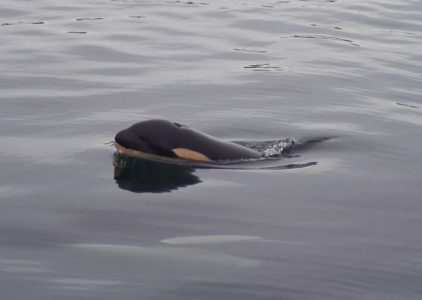
We mean that literally. The devastated mother is carrying her dead infant around on top of her head, diving to fetch it every time it slips off.
Yet, the saddest part is that this isn’t the first time this specific whale has done this. A few years back, she lost another child and carried that one as well — for two straight weeks.
How much does one orca mother have to suffer?
From Joy to Sorrow
The J pod is a group of orcas living in the Salish Sea between Washington state and the Canadian province of British Columbia. Consisting of 73 whales, the pod is unfortunately in dire straits.
Perhaps due to problems finding food, the J pod has struggled for years with a very low birth rate. The pod’s members are rapidly aging, which isn’t exactly healthy for the group’s long-term survival.
The whales must’ve been very happy, then, when Christmas came early this year. In mid-December 2024, biologists from the Center for Whale Research (CWR) noticed a new calf (as baby orcas are called) swimming with the pod.
It turned out that the female orca designated J35 — Tahlequah to her friends — had given birth to a bouncing baby girl. The newborn whale was christened J61.
However, joy soon turned to concern. On Christmas Eve, CWR noted that it was worried about the baby orca’s health, based on the behavior of both her and her mother.
Sadly, their worries weren’t unfounded. On New Year’s Eve, CWR confirmed that J61 had died.
The infant wasn’t floating lifeless in the sea, though. Tahlequah has taken it upon herself to keep her dead baby on the surface.
She continues to carry J61’s body on her head or snout as she swims along. Whenever her baby slips off, Tahlequah dives after it. She soon returns to the surface and continues to balance J61 on her head.
Not Her First Loss
Tahlequah’s behavior is already heartbreaking as it is. But here’s a little something to add to the tragedy — this isn’t the first time she’s done this.
In 2018, the then 20-year-old whale gave birth to another calf. That one, too, died within a couple of days.
And just like now, Tahlequah began keeping her child’s body afloat. The thing is, though, that she didn’t do it just for a day or so.
Tahlequah carried her dead calf for a total of 17 days before decomposition finally made it impossible for her to continue. But at least she wasn’t alone in her grief.
It seemed that the entire pod was devastated by the loss of their newborn member. Whenever Tahlequah got too tired or hungry to go on, another whale would take over and support the deceased calf.
“Sometimes she’s on her own with that calf, but a lot of time, she’s with her mom and her son and another relative. Her family has been right by her,” Deborah Giles of the Center for Conservation Biology explained at the time.
‘Fair to Say She’s Mourning’
You might be wondering why Tahlequah is doing all this. Well, there’s a very simple reason.
“I think it’s fair to say that she is grieving or mourning,” Joe Gaydos from the University of California told the Associated Press.
Despite the reputation that goes with their “killer whale” moniker, orcas are shockingly intelligent and emotional animals. They’re known to attend to dead pod members, and some other orca mothers have been seen keeping their deceased calves afloat.
Tahlequah, however, seems more sensitive than most. No other orca has ever been observed going to the lengths that she does.
Her extreme behavior is now concerning whale conservationists. Propping up J61 consumes a lot of Tahlequah’s energy, and she takes very little time to take care of herself.
Should she die, it would be a double tragedy for the J pod. Not only did they just lose a precious baby, but they’d also lose an adult female who could potentially give birth to more calves.
Unfortunately, baby orcas dying isn’t anything out of the ordinary. In fact, their mortality rate is so high that only one in five calves lives to see its first birthday.
There is a silver lining for the J pod. The same day CWR noticed J61 had died, they also saw that another baby whale, dubbed J62, had been born.
For Tahlequah, however, that’s probably a cold comfort.