
- I’ll believe these stories are true when pigs swim. Wait…
You can usually predict what kinds of animals you can see in a given environment. A desert will likely have lizards and scorpions, a northern forest will probably have a moose or two, and so forth.
Sometimes, however, you may come across an animal living in a completely unexpected place. It may be due to an animal population learning to harness unique resources, or maybe it’s because people deliberately put the beasts there.
Here are seven animals living in places where you absolutely wouldn’t expect them to.
1) Freshwater Seals
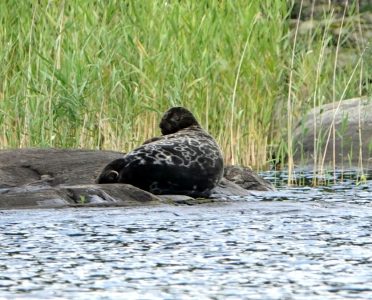
Most seals are marine animals, inhabiting the coasts of the world’s oceans. However, there are a few seal populations that have adapted to living in freshwater.
The Baikal seal, for instance, lives in Lake Baikal, the world’s deepest lake. It’s believed that the seals got trapped in the lake some two million years ago when a waterway connecting Baikal to the Arctic Sea dried up.
There are also two ringed seal populations that inhabit freshwater lakes. One lives in Lake Saimaa in Finland, while the other swims in the water of Lake Ladoga in Russia.
2) Tree Goats
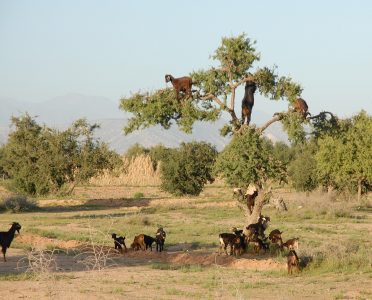
Looking up a tree, you’d expect to spot a bird or perhaps a squirrel. In Morocco, however, you just might see a goat.
The Argania tree is a prickle, gnarled plant that grows in Morocco’s arid soil. The local goats are in a habit of climbing the tree to consume their fruit.
Although goats climbing into strange places is nothing new, Morocco’s tree goats take the whole “scaling impossible heights” thing to a ridiculous extreme. These ungulates balance expertly on thin, crooked branches that really don’t look like they should support a goat’s weight.
3) Sea Pigs
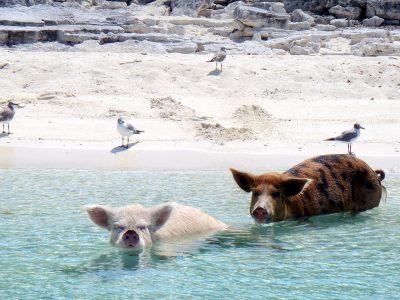
Sea pigs are a type of sea cucumber, but that’s not what we’re talking about. Instead, we’re talking about the feral pigs living on Big Major Cay in the Bahamas.
It’s unclear how the pigs ended up on this small, deserted island. However they got there, though, they’ve fully embraced their tropical island paradise.
Most notably, the swine love the beach. They regularly venture to Big Major Cay’s sandy beaches to swim in the blue Caribbean waters.
You know, we never thought we’d be jealous of pigs, but here we are.
4) Snakes on the Ceiling
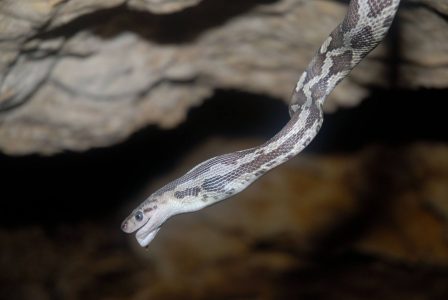
Near the village of Kantemo on the Yucatan Peninsula in Mexico, there’s a cave that goes by two names. It’s called the Bat Cave for its abundance of bats, but it’s also called the Cave of Hanging Snakes because of…
Well, the hanging snakes.
A unique population of yellow-red rat snakes has made its home in the nooks and crevices of the cave’s ceiling. Instead of rats, these snakes feed almost exclusively on the cave’s thousands of bats.
The serpents latch onto the rocks on the cave’s ceiling, allowing their bodies to dangle in the air as they wait for a hapless bat to fly by. That’s quite a feat, considering they don’t have limbs with which to hold on to the rocks.
5) Scottish Wallabies
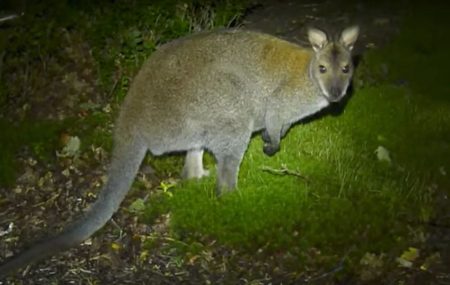
Wallabies are small to medium-sized relatives of kangaroos. As such, you would expect them to live in Australia.
Yet, if you visit the island of Inchconnachan, located in Loch Lomond in Scotland, you’ll likely come across some wallabies. This island houses one of the very few wild populations of wallabies outside Australia.
The animals didn’t get to Scotland on their own, though. They were introduced to the island by Fiona Gore, Countess of Arran, in the 1940s.
While we can all probably agree that wallabies have no business in Scotland, the Inchconnachan population is thriving to this day.
6) London’s Parakeets
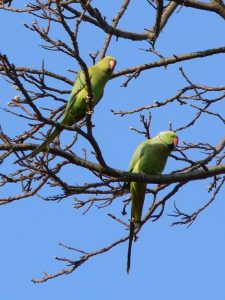
Many a tourist visiting London has had to rub their eyes when they spot flocks of green parakeets sitting in the trees. Surely there shouldn’t be parakeets in England out of all places?
Well, there shouldn’t, yet there are. A self-sustaining population of rose-ringed parakeets has lived in the English capital since 1969.
Today, more than 32,000 parakeets are flying around London. No one knows where they came from, although there are multiple theories. One of them suggests that the birds are the descendants of two parakeets Jimi Hendrix released in the 1960s.
7) Fish Out of Water
Out of all animals, fish should be the most predictable. They simply can’t survive outside of water.
Right?
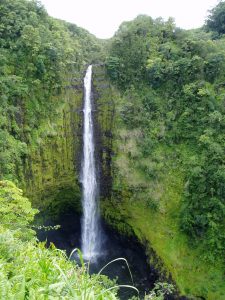
Well, don’t tell that to the Hawaiian freshwater goby. Although these three-inch-long fish don’t live out of water permanently, they do venture onto dry land to do some rock climbing.
The gobies live downstream of ‘Akaka Falls on Hawaii’s Big Island. Their breeding grounds, however, are in the small streams behind the waterfall.
To reach them, the gobies hop across dry (well, water-splattered) rocks to reach the isolated streams. Once there, they lay their eggs, and the waterfall eventually washes them downstream to hatch.