
- We don’t know what the writings say, but they must say something. Maybe.
As soon as humanity left the cave and started farming, we needed a system to record and convey information over long periods and distances. In other words, we needed writing.
Not everybody started writing in the same way, however. Today, there are many, many different writing systems, from the Latin alphabet to the Chinese characters.
Yet, over history, there have been many other ways of writing as well. While some have been lost to time, others have made it to this day in ancient tablets and other writings.
Unfortunately, we have no idea what those documents say.
Here are six ancient writing systems that could unlock the mysteries of long-lost civilizations — or they could be very old shopping lists. Who knows.
1. Etruscan Alphabet

The Etruscan alphabet is a curious case of undecipherable ancient script. Researchers can read it as they understand the writing system — but not the language.
In fact, deciphering the Etruscan alphabet was relatively simple, as our own Latin alphabet is its direct descendant. Etruscans once lived on the Italian peninsula and the Romans basically copied their alphabet as they conquered the region.
However, while we can understand the 26 letters of the Etruscan alphabet, the words they form remain a mystery. The Etruscan language is likely not an Indo-European language like its neighbors, and it may well be its entirely own language that originated way back in the Stone Age.
To this day, no one has yet figured out what on earth the 13,000 discovered Etruscan inscriptions say, even though they’re technically readable.
2. Linear A
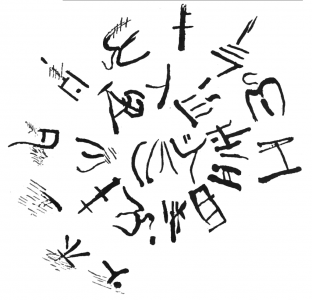
Linear A is a writing system used by the Minoan civilization on the Greek island of Crete around 1800-1450 BC. Its name stems from the fact that the Linear A characters consist of lines etched in clay, unlike even older hieroglyphic writings.
What makes Linear A strange is that we have deciphered a later version of it. Linear B is a more recent version of Linear A that was used to write early Greek and eventually turned into the first Greek alphabet.
Linear A, however, remains almost completely unintelligible. Researchers have been able to make out a word here and there, and they have some kind of an idea of what sounds are associated with each letter.
Overall, however, nobody can read Linear A well enough to make out what any of the remaining texts actually say.
3. Indus Script
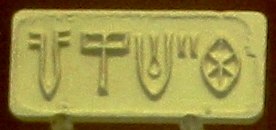
The Indus Valley Civilization was one of the great early Bronze Age civilizations, alongside those in Mesopotamia and Egypt. To communicate and record information, they used what’s today known as the Indus or Harappan Script.
Maybe.
The thing is, it’s very difficult to tell whether the Indus Script is an actual fully developed writing system. It’s fairly obvious the script’s many symbols must convey some kind of information, but it’s unclear whether they have more in common with, say, tally marks than writing.
To make the Indus Script an even harder nut to crack, most symbol inscriptions are extremely short, consisting only of three to five symbols. There are also so many variants of each character that if the Indus Script was a writing system, it certainly had no standardization at all.
4. Olmec Hieroglyphs
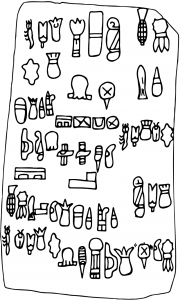
The Olmecs were the earliest known Mesoamerican civilization that existed in the modern-day Mexican state of Veracruz and Tabaco from 1200 to 400 BCE. Many of the most famous features associated with Central American civilizations — from the Mesoamerican ballgame to human sacrifice — originated with the Olmecs.
They also developed a system of hieroglyphs. Like the Indus Script, Olmec hieroglyphs may not have formed a complete writing system, but they were undoubtedly used to convey some limited information.
Unfortunately, the Olmecs disappeared mysteriously around 400 BCE. With them, they took all knowledge of how to read their hieroglyphs.
Researchers have been able to trace the origins of other Mesoamerican scripts to the Olmec hieroglyphs. Sadly, none of those revelations has helped us understand the original.
5. Quipu
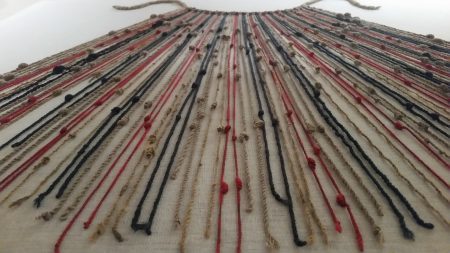
Quipu, used by the Inca and other Andean cultures, is a unique system of writing because it’s not writing. Instead, quipu is a way to convey information by tying a series of knots into colorful strings.
We definitely know that quipu is used as a way to record numbers because many native Andean peoples still do so today. However, there are unusual ancient quipu strings that don’t match any numerical system used at the time of their creation.
As such, some researchers believe these strings contain non-numerical information — just like writing. What that information is, however, remains anyone’s guess.
After all, it would be very hard to communicate actual language through a series of knots. If anything, the quipu “writing” is likely more akin to musical notation, in that it doesn’t directly translate into speech.
6. Rongorongo
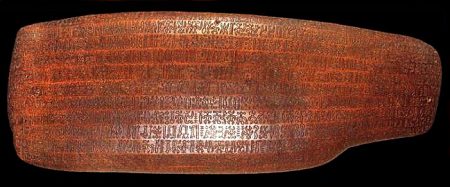
Rongorongo is a collection of glyphs engraved into several wooden objects found on Easter Island (famous for its moai statues). The glyphs look a whole heck of a lot like writing, but it’s currently unclear whether they are a script.
If they are, though, they are very significant because they seem to be wholly original. You see, humans have invented original systems of writing only a few times — most writing systems are based on older ones, like the Latin alphabet and the Etruscan script.
Easter Island, however, has been very isolated through much of its history. So, if the local native people had a writing system, it was very likely a homemade one.
Unfortunately, neither Easter Island’s current native inhabitants nor researchers can read rongorongo. As such, it’s impossible to say whether the pretty markings on the wooden tablets are writing or just decorations.