
- It’s a big event for Native Hawaiians and Hawaiian berries alike.
Crows aren’t in general particularly well-regarded birds. At best, people tend to see them as very smart but also obnoxiously loud carrion eaters.
Not so in Hawaii.
The Hawaiian crow is respected and valued among the islands’ natives. Not only are the crows — also known as ‘alal? — crucial for keeping Hawaii’s forests growing, but they’re also seen as the guides of dead souls in Native Hawaiian culture.
In other words, they’re pretty darn important. As such, it kind of sucks that they’ve been extinct in the wild for decades.
Fortunately, the loss of the last wild ‘alal? didn’t sound the death knell of the entire species. A handful of the birds had been taken to conservation centers, where their numbers have steadily grown.
And now, the ‘alal? has returned to Hawaii. Conservationists from the San Diego Zoo recently released five crows back into the wild.
Here’s the story of Hawaii’s spirit guides.
The Holy Crow
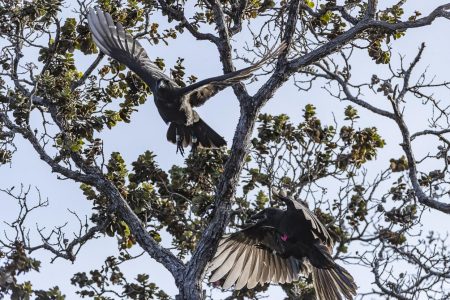
Admittedly, the Hawaiian crow or ‘alal? isn’t much to look at. It strongly resembles your regular carrion crow, being roughly 20 inches long from beak to tail and having a gothic all-black color.
The ‘alal? has more rounded wings and a noticeably thicker beak. Overall, though, you can’t get much more crow than this.
However, a couple of things set the ‘alal? apart from other corvids. First, it’s a remarkably chatty bird that can make two dozen different kinds of sounds, from deep growls to almost human-like wails.
Impressive, if a bit creepy.
Second, they’re one of the only two crow species known to naturally use tools. Most corvids can learn to use sticks and stones as tools if they’re shown how, but only the ‘alal? and the New Caledonian crow do so in the wild.
The ‘alal? is a very important bid in Hawaii for several reasons. The first is ecological, as the crows are (or were) one the most significant spreaders of seeds of many plants.
Being omnivorous, the ‘alal? eat fruits, nuts, and meat alike. They can’t digest seeds, though, so after feasting on fruits and berries, they help carry the plant’s offspring to new areas by pooping the seeds out.
Additionally, the ‘alal? is very important to Native Hawaiian spiritual life. After all, according to local mythology, they lead dead souls to their final resting place at the southernmost tip of Hawaii’s Big Island.
Not only that, according to Hawaiian beliefs, the ‘aumakua — ancestor spirits that have ascended to divinity — can appear in the form of the ‘alal?. These spirits could protect their descendants and carry their prayers and messages to the gods.
So, yeah, the crows are kind of a big deal in every way.
Extinction
Given their ecological and spiritual significance, it’s kind of a bummer that birds are dead. At least in the wild.
The ‘alal? were once abundant all over the Hawaiian Islands. However, approaching the turn of the millennium, their fortunes had fallen.
Habitat loss and hunting had taken a toll on the crows’ population. Additionally, European arrivals had introduced new predators — like cats, rats, and mongooses — the ‘alal? didn’t know how to deal with, so they made for easy meals.
And then there was disease. For example, avian malaria was introduced to Hawaii in 1826. With the birds having no resistance to it, it ravaged the ‘alal? population.
By 1994, there were 12 known ‘alal? living in their natural habitats. The last recorded ‘alal? chick in the wild broke out of its shell in 1997.
Then came 2002. This year marked the last time the two remaining wild ‘alal? were seen. In 2016, it was declared dead in the wild.
Homecoming
However, that wasn’t the end of the ‘alal?. Aware of the crows’ plight, conservationists from the San Diego Zoo captured around a dozen birds and brought them to two conservation centers on Maui and the Big Island.
While not all wild animals thrive in captivity, that wasn’t the case with the ‘alal?. Their numbers grew from fewer than 20 in the early 1990s to more than 110 birds today.
With the birds breeding successfully, the time finally came to try and take them back home. Out of the 110-strong flock, San Diego Zoo chose five birds — two females and three males — to become the first ‘alal? in the wild for more than two decades.
They didn’t just dump the birds back in the forest, though. In preparation for the reintroduction, the five ‘alal? went through a relationship-building program to ensure they got along and could help each other.
You know, it’s not good for the figurative Adams and Eves of their species to tear each other apart at first sight.
In October 2024, the fivesome was taken to a temporary, protected habitat to see how they would manage to live in the forest. They did just fine, and so, on November 11, the big day came.
San Diego Zoo released the five ‘alal? into the Kipahulu Forest Reserve on the island of Maui. The spirit guide of the Native Hawaiians has come back home.
There are still many threats facing the birds, and there’s no guarantee these five will live long and prosper. But whatever their ultimate fate may be, they’ll help the ‘alal? make a full return to Hawaii.