
- People of the Midwest, you should be very happy right now.
Crickets to the left of me, cicadas to the right — here I am, stuck in the middle with you.
This could be Midwesterners’ theme song for the early summer of 2024. After all, they’re about to be crushed between two apocalyptic insect swarms.
The one in the West has already emerged. Thousands upon thousands of Mormon crickets are crawling across the western states in search of food, covering roads and buildings as they devour all vegetation in their path.
In some places, it has gotten so bad that authorities have had to plow the roads as if they were covered in snow. Only, they’ve swarming with crickets.
Things aren’t much better in the eastern states, either. They, however, are dealing with potentially up to trillions of cicadas.
A rare double-hatching of cicada Broods 13 and 19 has released its payload from Illinois to the East Coast. It’s a rare occasion, though, as the last time this happened was more than 200 years ago.
What a privilege to be able to get completely covered in bugs in our lifetimes.
Crickets in the West…
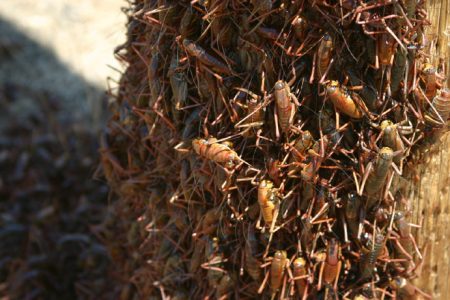
In the West, the bugpocalypse is possibly at its worst in Idaho. Mormon crickets have emerged in such enormous swarms that they’re overrunning everything in their path.
By the way, these bugs aren’t called Mormon crickets because they’re adherents of the faith or anything. They got the name in the 1800s when they completely devastated the fields of Mormon settlers.
And that’s pretty much what they’re doing today, 200 years later. Mormon crickets travel in large swarms that completely cover the ground as the insects are flightless.
As they move along, they’ll devour crops and virtually all other vegetation they come across. After their feeding frenzy, the barren ground is vulnerable to soil erosion.
The crickets emerge every year, but their swarms have grown larger with every passing year. Experts suspect the warming climate is either helping them reproduce or driving them on the move in larger numbers.
And this year’s swarm is perhaps the biggest ever. The crickets have covered some towns almost entirely, crawling over homes, public buildings, and roads alike.
“They cover our homes, buildings and when run over will bloody our roads and leave a horrible smell from sitting in the hot summer sun!” Spring Creek, Nevada, resident told UPI.
In Idaho, the situation is so bad the state’s transportation department has broken out the snow plows. Only, they’re clearing the roads of insects.
They posted a video of the road-clearing process on X. Just as a heads up, turn off the sound unless you’re okay hearing thousands upon thousands of crickets crunch under the plow.
Fun fact — Mormon crickets aren’t actually crickets but shield-backed, short-winged katydids. We’re sure the people of Idaho appreciate the distinction.
…And Cicadas in the East
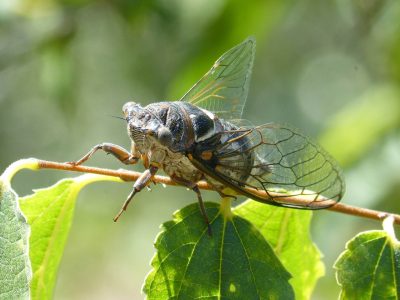
So that’s the West. In the eastern U.S., another insectile plague has started its emergence.
We’re talking about the extremely rare double-emergence of two periodical cicada broods. This year, Broods 13 and 19 will crawl out of the ground.
To put the rarity of this event into perspective, the last time it happened was in 1803. That year, President Thomas Jefferson signed the Louisiana Purchase as Napoleon Bonaparte needed money for his planned invasion of the British Isles.
Yeah, it’s been a while.
Brood 19 has already begun emerging in huge numbers. In South Carolina, for example, the intolerable buzz of the cicadas has sparked 911 calls — they’re being so obnoxiously loud that people don’t realize the noise is coming from the bugs.
Yet, things will be (if they aren’t already) at their worst in Iowa and Illinois. These two states sit right in the overlapping area of Broods 19 and 13.
That means double the cicadas. And if just Brood 19 is being that much of a problem in South Carolina…
Well, Iowa and Illinois probably aren’t in for a particularly good time.
Look on the bright side, though. Periodical cicada emergence happens in April-May and the bugs only live for a month.
That means the eastern insect plague will be over in a couple more weeks. In the meantime, why don’t you try cooking up some cicadas — as long as you’re not allergic to them.