
- An anatomy student shouldn’t be squeamish, but you can’t really blame this guy.
When you’re studying in college, sometimes your classes can delve into uncomfortable topics. But nobody usually ends up running screaming out of the class.
But nothing could’ve prepared Nigerian anatomy student Enya Egbe for what he would face in class one Thursday afternoon. It was supposed to be a regular study of some recently deceased corpses.
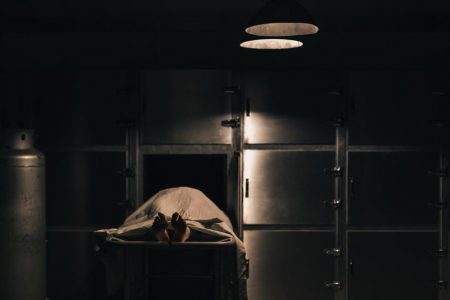
As usual, Egbe and his fellow students gathered around three examination tables at the University of Calabar. On each table laid a cadaver, covered by a blanket.
When the professor pulled the covers away, Egbe let out a bloodcurdling scream and fled the classroom. But his response wasn’t because he couldn’t handle seeing a dead body.
It was about who the body had belonged to. On one of the tables laid the bullet-wounded corpse of Divine, Egbe’s good friend of more than seven years, who had recently disappeared.
“We used to go clubbing together. There were two bullet holes on the right side of his chest,” Egbe told the BBC.
‘Not Real Criminals’
Some of the other students ran after Egbe as the fled the room. One of them, Oyifo Ana, later found Egbe sobbing outside.
Earlier that morning, Ana had seen a police van bring corpses of supposed dead criminals to the medical school. The school also operates a mortuary, so there wasn’t anything unusual about the delivery.
What Ana so far hadn’t realized was that not all the corpses necessarily belonged to criminals.
“Most of the cadavers we used in school had bullets in them. I felt so bad when I realized that some of the people may not be real criminals,” Ana recalled.
After he regained his composure, Egbe contacted Divine’s family to let them know where their son’s corpse was. It turned out that they didn’t know he was dead, either.
According to the family, Divine and his three friends had been out on the town. Suddenly, security agents had arrested and taken them away for unknown reasons.
Divine’s family has been going from one police station to another, trying to find out where their relative was held. Unfortunately, they would never see him alive again.
Eventually, they were able to claim the body from the school and give it a proper burial.
‘Nothing Has Changed’
It has now been seven years since Egbe’s nightmarish anatomy lesson. But according to him and Nigerian officials, the case highlights two problems the country is facing.
The first one is that there aren’t enough corpses to train medical students. Models and lectures are all well and good, but doctors can’t get the hands-on experience they need without a real body. Schools receive practically zero body donations.
So, where do the few bodies they get come from? Unfortunately, their source is often the second problem Nigeria struggles with — police brutality.
According to Nigerian law, the government hands “unclaimed bodies” in public mortuaries to medical schools. More than 90% of the bodies delivered to schools are from supposed criminals shot that were shot dead, a 2011 study found.
But Emeka Anyanwu, a professor of anatomy at the University of Nigeria who co-authored the study, said that in practice the bodies come from people the country’s security forces have shot under unclear circumstances. That was the case seven years ago with Divine, and that is the case today.
“Nothing has changed 10 years later,” Anyanwu said.
Forced ‘Ambulance Duty’
It’s regrettably common for people to get arrested and shot for seemingly no reason in Nigeria. And when the victim’s family doesn’t know what has happened, their body never gets claimed and ends up at an anatomy lecture.
The Nigerian government has launched inquiries to investigate the claims of police brutality. The program was a response to the #EndSars protests, during which the Nigerian police’s Special Anti-Robbery Squad (SARS) allegedly shot dead a young man.
SARS has said that everyone they’ve shot has been killed during a robbery-related gunfight. Police spokesman Frank Mba claims the police doesn’t know of any cases of bodies being dumped at medical schools.
However, a 36-year-old tradesman Cheta Nnamani tells a different story. In a written testimony presented to one of the government judicial panels, he says he was in the custody of SARS for four months in 2009.
During that time, Nnamani had assisted security guards in loading cadavers of tortured and executed people into a van. Among prisoners, the job was known as “ambulance duty.”
Nnamani was also taken in chains to a mortuary, where he helped unload the bodies. According to him, the police threatened him by saying that if he didn’t comply, he’d make one last trip on the van — in the cargo space.
The police moved to using public mortuaries to dump off the bodies due to the possibility of medical donation, says Ugonna Amamasi, the administrator of the private Aladinma Hospital Mortuary.
“Sometimes, the police try to strong-arm us into accepting bodies but we insist that they take them to a government hospital. Private mortuaries are not authorized to donate bodies to medical schools but government mortuaries can,” he said.