
- From calming down babies to torturing prisoners, this earworm has seen a lot.
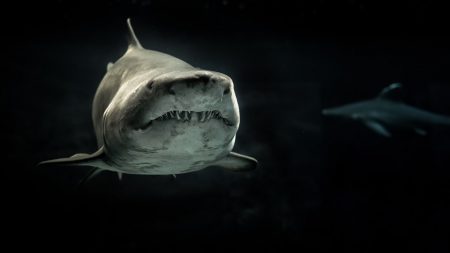
Sharks are divisive creatures. On one hand, most of us terrified of them. At the same time, though, things like Shark Week prove that equally many people have a fascination with these sleek, toothy fish.
On the terror end of the shark scale, there are shark attacks. While having a shark take a bite out of you while swimming is extremely unlikely, it’s a fact that sometimes it happens. For some examples, go read our fresh listicle on 20 scary shark attacks.
With that said, it’s also very hard to not be intrigued by the massive biological variety that sharks as a species have. Did you know that some of them are even capable of walking on land?
And then, there are the mostly harmless sharks that we see in cartoons and children’s media. One of the most irritatingly popular of these shark depictions in recent years has been Baby Shark.
You know the one. Baby shark, doo doo doo doo… Yeah, it’s stuck in our heads now, too.
As a testament to the songs popularity, on November 2, 2020, it dethroned Luis Fonsi’s Despacito as the most watched video on YouTube of all time. The repetitive chant has been played a staggering seven billion times since it was uploaded on the platform in June 2016.
In total, the Baby Shark song has been streamed for 30,187 years, if played back-to-back. Its publisher, South Korean company Pinkfong, reports that it’s earned more than $5 million just from Baby Shark’s YouTube streams.
So, with all due respect, eat your heart out, Mr. Fonsi. Your song might be catchy, but it’s got nothing on this juvenile fish.
History of the Shark
But what most people (we think) aren’t aware of is that the version that’s leaped to popularity on YouTube is not the original Baby Shark song. In fact, the history of this ear worm stretches back almost half a century.
According to the BBC, the song was most likely invented in the 1970s in the U.S. as a song sung around campfires in summer camps. It seems like a realistic theory, considering how easy it seems to be to get kids to hum along to its melody.
There is another theory that posits that Steven Spielberg’s smash box office hit movie Jaws – which features a man-eating shark – sparked the original Baby Shark song. Jaws came out in 1975, though, so these two theories are not necessarily mutually exclusive.
It’s hard to say certain who invented the song, as the underlying melody is considered to be in the public domain, says New York Times. There is also probably an infinite number of variations of the lyrics, although most revolve around a family of sharks.
Not all these variations are as family friendly as the YouTube hit, either. Some alternative lyrics have the sharks rip off a surfer’s arm, while in others they straight up eat a poor sailor alive.
It’s okay, though, since the people the sharks killed reach Heaven. At least in one variation.
Go to hell, doo doo doo doo doo…
Anyway, as we mentioned, the version of Baby Shark that made YouTube history was born in South Korea. Its creator, Pinkfong, is children’s educational brand, owned by educational entertainment firm SmartStudy.
The original Pinkfong version of Baby Shark was sung in the company’s native Korean. This version hit the internet in November 2015.
Eight months later, the company localized it for English-speaking audiences. And the rest is history.
A Tool of Torture
The smash hit song hasn’t stayed just on YouTube, either. Go to any toy section at any supermarket and you’re pretty much guaranteed to find at least one toy humming the melody.
Despite its apparent immense popularity, the Baby Shark song is just as divisive as sharks themselves. Some people clearly love it. Others find it so infuriating that rupturing your own eardrums is not completely out of question if it means never having to hear it again.
The song has garnered some controversial public attention as well. In January 2018, the original Korean version received accusations of sexism due to very traditional gender roles it assigns to each member of the shark family.
The most morbid use of the song, however, came to light this year in early October. Two detention officers at the Oklahoma County jail used the song to torture inmates, reported The Oklahoman.
At least four people were subjected to what District Attorney David Prater called “inhuman” treatment. The inmates were reportedly forced to stand, handcuffed to a wall, while speakers blared Baby Shark on a loop at an extreme volume.
The detention officers in question were suspended form their duties as soon as the county sheriff found out about the torture. DA Pater charged both misdemeanor counts of cruelty to a prisoner and conspiracy.
“It was unfortunate that I could not find a felony statute to fit this fact scenario,” Prater told The Oklahoman.
Other U.S. towns have also used the song on repeat to deter homeless people from congregating in certain areas, according to The Pigeon Express.
Ending on a Positive Note
But it’s not all bad. In October 2019, the song emerged in Lebanon, where the people at the time were engaged in anti-government protests.
Eliane Jabbour was caught in the middle of the protests with her one-year-old son, Robin, in her car. As the toddler started getting scared, the protesters surrounding the car started singing Baby Shark to him.
On a video of the event published by the BBC, Robin isn’t crying. He doesn’t seem to exactly know what to make of the singing crowd, but all’s well that ends well, we suppose.
And with that, we’re done. Now excuse us while we go and try to get this song out of our heads.