
- Here are a few creatures so rare you may never get to see one.
Seeing a rare and unusual animal is a… Well, rare treat. There’s just something about witnessing an elusive creature that few others have ever seen.
Unfortunately, not all animals are rare simply because they live in remote places or are good at hiding. Some are being driven toward extinction, and may soon go from extremely rare to nonexistent.
We at Oddee figured we’d highlight some of these animals with a little article series. Starting with mammals, we’ll also cover birds, fish, insects, and even plants in the future.
To kick things off, here’s a selection of nine of the rarest mammals in the world.
1. Hispaniolan Solenodon
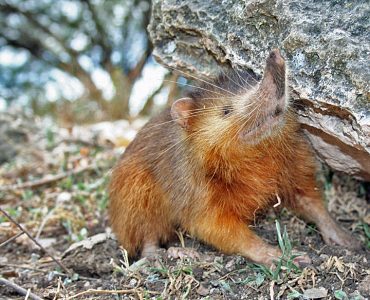
The Hispaniolan solenodon, also called the agouta, is a small shrew-like critter (but not a shrew). It lives only on limited areas on the island of Hispaniola within the areas of Haiti and the Dominican Republic.
Two features make the Hispaniolan solenodon unique among mammals. First, it’s a living member of an ancient line of mammals that coexisted with dinosaurs. Second, it’s one of the rare few venomous mammals, capable of delivering a toxic bite.
Although the solenodon (like most animals on Earth) is threatened by habitat loss, its numbers are relatively stable. It’s rare simply for living exclusively on specific parts of a single island.
2. Hainan Gibbon
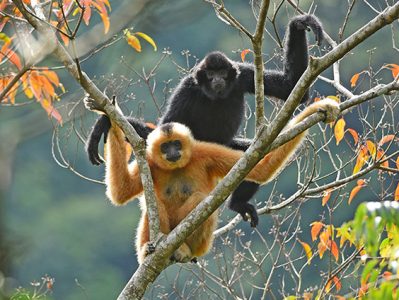
The Hainan black-crested gibbon, or simply Hainan gibbon is the world’s rarest primate. Living exclusively on the Chinese island of Hainan, there are only about 30 of these long-armed monkeys remaining.
The gibbons live in the trees of Hainan’s ever-shrinking forests. They eat a variety of foods, from insects to sugary fruits and plain leaves.
There are multiple conservation efforts, both Chinese and international, that are trying to save the gibbons. Unfortunately, they don’t have much living space left, they don’t do well in zoos, and their slow rate of reproduction means they can’t boost their numbers with any haste.
3. Seneca White Deer

In the area of the former Seneca army depot lives a unique herd of white-tailed deer. Unlike regular white-and-brown deer, these beasts are entirely snow-white.
They’re not a separate species or even albinos, for that matter. They’re regular deer with the leucistic color morph that turns their fur white.
An estimated 200-300 of the white deer inhabit the old military installation. The land has been sold to private developers, but there are efforts in place to help the unique deer survive.
4. Vaquita
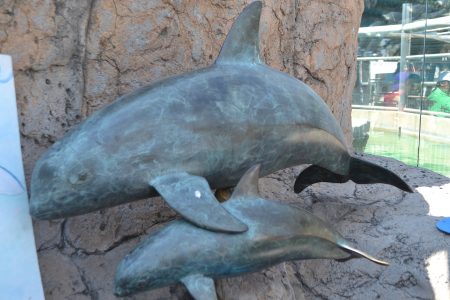
The vaquita (“little cow” in Spanish) is the world’s smallest living cetacean, belonging to the same order as whales and dolphins. These adorable blob-headed porpoises grow to be only five feet long at maximum.
They live in the warm coastal waters of the northern parts of the Gulf of California. Due to their limited range and small size, they’re under real threat from fishing vessels and habitat loss.
It’s unclear how many vaquitas are left, but the numbers don’t look good. At best, there are a couple of dozen — but you may as well be able to count the remaining tiny porpoises with your fingers.
5. Okapi
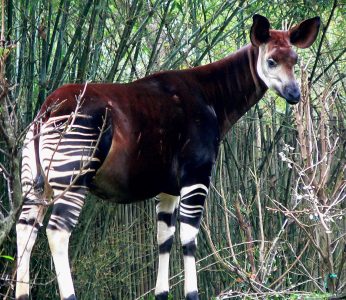
Despite its striped behind, the okapi is not related to the zebra. Instead, these African weirdoes are the relatives of giraffes, hence their alternative name, forest giraffe.
Okapis live in the canopy forests located in the Democratic Republic of the Congo on mountainsides between 1,500 and 4,000 feet. They consume leaves, fruit, and flowers from tree branches, using their giraffe-ish long neck and tongue.
Although they are endangered, the okapi is not under an immediate threat of extinction. There are also about 100 okapis in zoos around the world, so you may actually be able to see this animal.
6. Sumatran Rhino
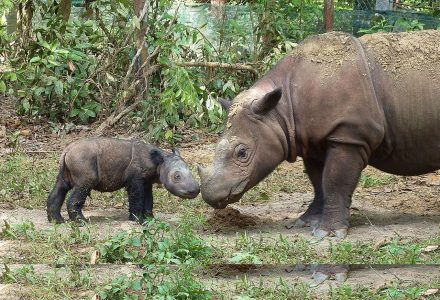
The Sumatran rhino is the world’s smallest rhinoceros. They’re about 4 feet tall, 8-10 feet long, and weigh roughly 1,500 pounds — which makes them featherweights for rhinos.
They’re also the world’s rarest rhinos. There are fewer than 80 adult rhinos left in the wild, mostly due to poaching and illegal hunting.
Some Sumatran rhinos are kept in zoos, but they don’t stomach captivity. Unfortunately, despite some conservation efforts, it seems the Sumatran rhino may not be long for this world.
7. Hairy-Nosed Wombat
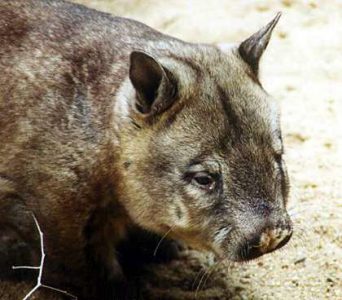
The northern hairy-nosed wombat is one of the three living species of wombats. Out of that trio, it’s the rarest and most elusive.
These critters live in underground burrows, emerging only at night to eat grass. Due to their nocturnal lifestyle, their eyesight is so bad that it’s practically useless — but fortunately, their sharp (if hairy) nose guides them to food.
Too bad for the wombats that their primary food source consists of grasses that are quickly disappearing from their tiny habitat area in northeastern Australia. With the grasses, the number of the wombats is dropping as well.
In fact, the northern hairy-nosed wombat was already considered extinct until the sneaky creatures were rediscovered in 1933. The next time it disappears, though, there’s likely no coming back.
8. Asian Unicorn (Saola)
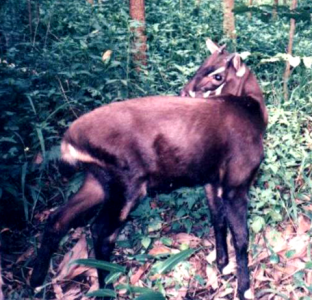
The saola is a unicorn in many senses. Not only are these relatives of goats and cows called Asian unicorns, but they’re also so rare that they live up to the figurative meaning of the word as well.
Saolas live in the Annamite Mountains of Vietnam and Laos. They’re so timid and rare that they were only first documented in 1993.
Saolas have been captured for placement in zoos, but that doesn’t work as they die within weeks if removed from their habitat. The animals are so elusive that they have been sighted only a handful of times, with the last photo dating to 2013. Some even worry they may have already gone extinct, but due to their rarity, it’s next to impossible to confirm or disprove the theory.
9. Baiji (Yangtze River Dolphin)

The baiji, or the Yangtze River dolphin, may be the world’s rarest mammal. That is, if it even exists anymore in the first place.
These long-nosed dolphins once swam up and down the Yangtze, but industry, construction, and pollution have all but wiped them out. The last known baiji, called Qi Qi, died in 2002 and there have been no confirmed sightings since.
People, fishermen in particular, do still report seeing aquatic creatures swimming in the Yangtze that may be some of the last remaining baijis. However, all official surveys in the last few years have come back empty-handed.