
- Don’t trust your brain. It lies — a lot.
The human brain is a miracle. There’s simply nothing in nature that can compete with our superior ability for analysis and high thinking.
Yet even then, our brains struggle to process the world around us. But that’s okay because they’ve found a way to cover up their shortcomings — by constantly lying to us.
And if your brain is good at thinking, it’s even better at lying. Chances are, you may be viewing the world mostly through blatant lies.
Here are seven ways your own brain deceives you every single day.
7. Pattern-Seeking

Our brains are compulsive pattern seekers and for a good reason. In evolutionary terms, this brain trait helped our ancestors survive — but the problem is that our brains look for patterns where there simply are none.
This deceptive pattern-seeking behavior can be completely harmless. Have you gotten spooked by a pile of clothes on a chair? That was your brain telling you, “That’s an unknown person, watch out.”
Pattern-seeking can take other forms than visual, however, and it can become a real problem. For example, when faced with a series of completely unrelated misfortunes, your brain can start trying to pick up on nonexistent connections between them, which could lead to anxiety and other mental issues.
6. False Memories

You think you know your own life, but you probably don’t. At least, not as well as you imagine and it’s all because of false memories.
At their mildest, false memories are simply distorted recollections of actual events. We all have them, but you can surely see how they could be an issue in, say, a criminal trial.
But then there’s the more malicious concept of completely artificial memories. Studies have shown that it’s shockingly easy to get people to “remember” something completely imaginary.
Although life seems too short, your brain is still constantly trying to maintain decades upon decades of memories and it just can’t cope. So, it gets lazy and starts lying to you — if everyone around you says something happened, surely it must be true, so your brain may build a stunningly vivid memory of things that never were.
5. Distance Measurements

Ever had to walk home from work when you’re dead tired and it seems the journey is much longer than usual? You’re not completely wrong — how tired we are has a significant effect on how we perceive distance.
When you’re tired, you’re much more likely to overestimate how far an object is. That’s your brain trying to persuade you to not even bother trying to reach it and rest instead.
The opposite is also true. If we think something is easy to reach or obtain, we tend to think it’s closer than it is. This effect can be rather extreme — one study found that people thought objects were nearer simply because they were holding a long grabber tool.
4. Heuristics

Heuristics are essentially mental shortcuts the brain takes to arrive at decisions. They tie partially to the pattern-seeking behavior we mentioned earlier, but they can take many other forms as well.
However, the brain is lazy and might take a shortcut even when it’s not appropriate in reality. For example, let’s imagine Frank, who’s terrified of flying because he believes planes get into accidents constantly.
Yet, Frank happily drives his car, even though he’s much more likely to get in an accident on the road than on a plane. Frank’s brain has falsely used the shortcut of availability heuristic.
Plane accidents are more likely to be serious and make the news than car crashes, so Frank has read more about them. Consequently, his brain has fooled him into thinking planes are much more dangerous than cars, even though his Ford is much more likely to kill him.
3. ANTs

Your brain is infested with ANTs, but they’re not bugs. Instead, they’re Automatic Negative Thoughts.
Studies estimate that the majority of our thoughts are negative ones. You can’t help having them, since they crawl into your mind like ants into a house.
Have you ever been chided for doing a less-than-great job at something and immediately thought, “I’m a total incompetent hack who can’t do anything right?” That’s an ANT that your brain automatically fed into your mind.
But why would your brain do this? Weirdly enough, it’s trying to protect you from negative feelings. As it turns out, our brains are extreme pessimists — they believe the best way to avoid disappointment is to always expect the absolute worst.
2. Change Blindness

Our brains like to focus on one thing and one thing only. That can lead to a bizarre phenomenon called change blindness.
On the surface, change blindness is pretty simple. Your brain is too preoccupied with something to register a change in your immediate surroundings and keeps functioning as if nothing happened.
But it’s shocking how extreme change blindness can be. For instance, in one experiment, researchers had test subjects converse with a volunteer before setting off a loud alarm.
While the test subjects were trying to figure out what was going on, the researchers quickly swapped the volunteers. Once the situation calmed down, the test subjects continued the conversation — without realizing they were talking to a completely different person.
Now, consider a similar thing happening while you’re driving a vehicle. You might crash into a car you could swear wasn’t there.
And it wasn’t, if you believe your brain.
1. Filling-In
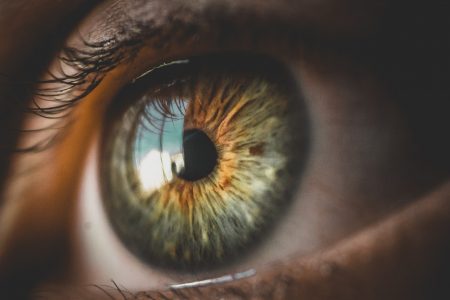
What can you trust in this world if not your own eyes? Well, we’re very sorry to tell you that even your eyes are thoroughly unreliable.
Humans have a roughly 180-degree field of vision. However, we are able to focus on maybe a tenth of it at the time, according to studies.
The rest of your vision? Your brain fills it up with an approximated image it has built based on previous observations, pattern recognition, and a handful of pure assumptions.
This means that you may not actually see up to 90% of what you think you see at any given moment. What really occupies your vision is a pretty picture your brain painted that may or may not reflect reality.