
- Accidents can happen, but this stuff fortunately doesn’t take place every day.
Some kinds of accidents happen every day. Every so often, though, unfortunate events come together in a way that feels less like reality and more like a cruel, universal prank.
When the stars align just wrong, everyday items can turn deadly, normally benign natural phenomena become killers, and usually reliable machines fail horribly. That, or something so outlandish happens that no one could’ve ever seen it coming.
Here are six examples of some of the most bizarre accidents ever, from a daring hero’s anticlimactic end to one of the filthiest disasters of the medieval world.
1. Bobby Leach and the Orange Peel
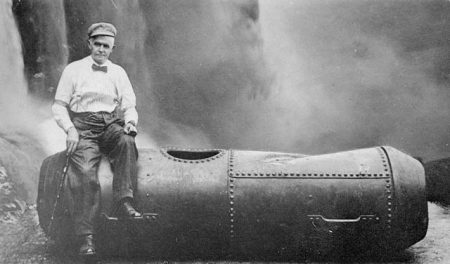
Born in 1858, Bobby Leach was one of those early 20th-century daredevils who went over the Niagara Falls in a barrel. Can you guess where this is going?
No, you absolutely can’t. Leach survived his stunt in 1911, becoming the first man and the second person to survive a trip down the falls (although he fractured both of his kneecaps and jaw and spent six months recovering).
However, 15 years later, he was visiting New Zealand when he slipped on an orange peel. He hurt his leg so badly that it got infected and became gangrenous. Despite an emergency amputation, he died of complications soon after in 1926.
What an end for a man who pulled through falling down the Niagara.
2. Donora Death Fog

In the middle of the 20th century, Donora, Pennsylvania, was a bustling industrial town with zinc and steel factories. But in 1948, its industry and freak weather conditions combined to create one of the worst air pollution events in U.S. history.
In the days before strict environmental regulations, Donora’s factories belched out large amounts of hydrogen fluoride, sulfur and nitrogen dioxides, carbon monoxide, and other toxic chemicals. On October 27, this horrible cloud descended upon the town and didn’t lift for five days.
A temperature inversion event had created a bubble of warm air above Donora. It prevented the pollution-laden colder air from dispersing, blanketing the town in choking smog.
Of the 14,000 people living in Donora, around 6,000 came down with moderate to severe respiratory illness, while 20 died outright. Even a decade later, illnesses stemming from the disaster continued to plague Donora, prompting the government to put in place more stringent clean-air legislation.
3. British Airways Flight 5390

On June 10, 1990, a BAC One-Eleven passenger jet took off from Birmingham Airport in England. Designated British Airways Flight 5390, it was taking a bunch of tourists to Malaga in Spain.
Soon after the takeoff, the plane ran into a small problem – half of its cockpit windshield popped off and flew away.
The decompression from the accident sucked pilot Timothy Lancaster off his seat. Fortunately, his legs got tangled in his controls, and his copilot, Alastair Aitchison, grabbed his belt. That, however, left Lancaster hanging halfway out of the plane in the freezing air.
Two flight attendants grabbed Lancaster to allow Aitchison to attempt to land the plane. Miraculously, he was able to do so, and Lancaster survived with his torso flopping out of the plane for 20 minutes.
4. Anatoli Bugorski’s Proton Beam Incident

Dr. Anatoli Bugorski is a retired Russian particle physicist. Considering what he went through, it’s a mystery how the 84-year-old is still alive.
In 1978, he was working on a malfunctioning particle accelerator at the Institute of High Energy Physics in Protvino when the machine suddenly activated. It shot a proton beam through his skull and brain.
Bugorski’s head instantly received 300,000 roentgens of radiation. For reference, a lethal full-body radiation dose is 500 roentgens.
The man, however, continued working, stopping only once his face started swelling beyond recognition.
Nobody expected him to survive, so he was taken to a minimum-care clinic just so he could help medical science by allowing doctors to watch his inevitable death. Yet he pulled through and went on to get a PhD and a long career in physics.
He wasn’t unhurt, though. For the rest of his life, half of Bugorski’s face was paralyzed, he suffered mild seizures, and – although the man was obviously still highly intelligent – got tired quickly from mental work.
5. Erfurt Latrine Disaster

In 1184, the King and Holy Roman Emperor Henry VI had summoned the who’s-who list of medieval Germany to Erfurt for a meeting to settle a land dispute. More than 100 nobles and high church officials gathered at a two-story building near Erfurt’s cathedral.
However, the building was in worse shape than Henry VI had been led to believe. Under the weight of the gathered nobility, the floor’s rotten support beams collapsed. The crowd fell onto the first floor, which broke upon impact as well.
So, they kept falling – straight into the underground cesspit below the floors.
Henry VI and his #1 man, Archbishop Conrad, managed to save themselves by hanging onto a windowsill. Others weren’t so lucky. Records from the incident state that around 60 people died, either from the fall or by drowning in excrement.
The meeting was not finished, and the land dispute went unresolved, by the way.
6. Goiania Radiation Accident
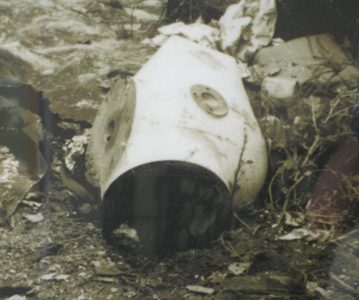
You may not have heard of the Goiania accident. You should know about it, though, as it’s one of the worst nuclear disasters in history.
However, it didn’t involve a bomb or a nuclear plant meltdown. Instead, it started on September 13, 1987, when scavengers discovered a radiotherapy machine in an abandoned hospital in Goiania.
The device’s radiation source should’ve been removed when the hospital closed. It wasn’t, and there weren’t any warning signs around either. So, the clueless scavengers pried the thing off the machine.
Inside the container, they found funny glowing rocks. Having no clue what they were, they took the rocks home to show their families. Some of them gave them away to neighbors or sold them to strangers to use as home decoration.
The stones were caesium-137 crystals. Translated from nerd to English, this is the nightmare fuel that atomic explosions and nuclear disasters spread around.
Four people died shortly after from radiation exposure, while 249 others developed radiation sickness. What’s more, the caesium-137 contaminated the houses and possessions of those who handled it. Authorities had no option but to demolish multiple houses and incinerate the victims’ personal property to control the radiation.
Want some more odd accidents? Check out our list of the strangest food floods ever.