
- Baby cubs are just about one pound when they're born.
Do you know these black bear fun facts? Did it surprise you to learn that a baby black bear is so little?
- Despite their size, black bears are generally shy and avoid humans whenever they can.
- Black bears are classified as “Least Concern” by the IUCN due to stable populations.
- Black bears are highly intelligent and capable of
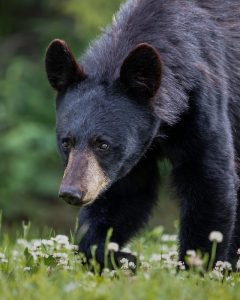 problem-solving and memory retention.
 - Black bears play important roles in Indigenous myths, folklore, and spiritual traditions.
- In fall, they enter hyperphagia, consuming up to 20,000 calories per day to prepare themselves for hibernation.
- Changing climates may affect food availability and hibernation patterns for these animals.
- Dens may be located in caves, hollow trees, brush piles or dug into hillsides.
- Black bears sometimes enter human communities due to food availability, which can lead to conflicts.
- These bears are highly adaptable animals capable of living in diverse habitats, from dense forests to suburban areas, as long as food and shelter are available.
- Some subspecies, like the Kermode bear (spirit bear), are white due to a recessive gene. Did you know this as one of the black bear fun facts?
- They are not strictly territorial but have home ranges that may overlap with others.
- Black bears are strong swimmers and can cross lakes and rivers easily.
- They can run up to 30 miles per hour for short distances and are extremely strong, capable of flipping large rocks or breaking into cars.
- The American black bear’s scientific name is Ursus americanus. But black bears can appear in many
 colors, including black, brown, cinnamon, blonde and even bluish-gray.
 - Regulated hunting is allowed in many regions and contributes to wildlife management and conservation funding.
- Newborn cubs weigh less than one pound and are blind and almost hairless.
- During hibernation, a black bear’s heart rate can drop from around 40 beats per minute to as low as 8 beats per minute. Did you know this as one of the black bear fun facts?
- Males are significantly larger than female black bears, sometimes weighing twice as much.
- Typical litters for a black bear contain two to three cubs.
- Female black bears experience delayed implantation, meaning the fertilized egg does not implant in the uterus until fall.
- Black bears have an extraordinary sense of smell, around seven times stronger than that of a bloodhound.
- They survive hibernation by metabolizing stored body fat, which provides energy and water for them.
- Black bears are the most numerous bear species in
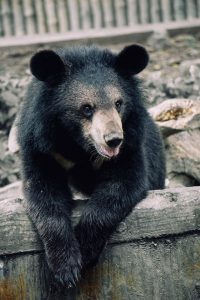 the world, with an estimated population of over 900,000.
 - They can produce grunts, huffs, moans, jaw pops and woofing sounds.
- Black bears are native to North America and are found across Canada, the United States, and parts of northern Mexico. They live in forests, swamps, mountains, and climates with little to no rain.
- Cub survival rates depend heavily on food availability and how much they learn from their mama.
- Adult black bears typically weigh between 100 and 600 pounds, though some males can weigh more than 700 pounds. Black bears are usually 4 to 7 feet in length.
- Black bears are excellent climbers and often climb trees to escape danger or to access food, especially as cubs. Did you know this as one of the black bear fun facts?
- Their eyesight and hearing are comparable to humans but not even close to their amazing ability to smell.
- Black bears can live 20–30 years in the wild, if not killed by humans or disease.
- Mating season occurs between May and July for black bears.
- Cubs are born in January or February while the mother is hibernating.
- Black bears hibernate during winter months, but not as deep as some smaller animals.
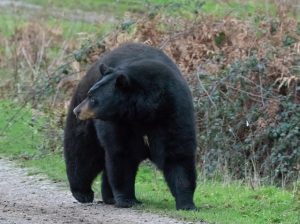
- Adult black bears have few natural predators and humans are the largest cause of death to these animals.
- Black bears communicate through vocalizations, body language, scent marking and tree scratching. Did you know this as one of the black bear fun facts?
- Cubs stay with their mother for about 16–18 months to learn survival skills.
- Black bears are omnivores, with about up to 85% of their diet coming from plant-based foods.
- Black bears eat berries, nuts, roots, grasses, insects, fish, small mammals, carrion, and human food when they find it.
- Black bears help spread seeds and regulate insect and prey populations.
- While hibernating, black bears do not eat, drink, pee or poop for several months.
Did you know all of these black bear fun facts? Tell us something new you learned in the comments!