
- Do you prefer your monkeys with magnificent facial hair or completely bald heads?
Monkey see, monkey do; you see the monkey and the monkey sees you. But while the monkey knows it’s looking at some kind of hairless ape, you might have trouble deciding what the monkey is supposed to be.
We typically think of monkeys as silly and maybe a bit dumb, but that really does these animals a disservice. They can be extremely clever, both when acquiring food and sneaking out of human-made enclosures.
With that said, there are plenty of strange monkeys out there. Whether it’s about their looks or behavior, some monkeys are just made a bit different.
Here are 10 decidedly odd monkey species living around the world.
1. Emperor Tamarin
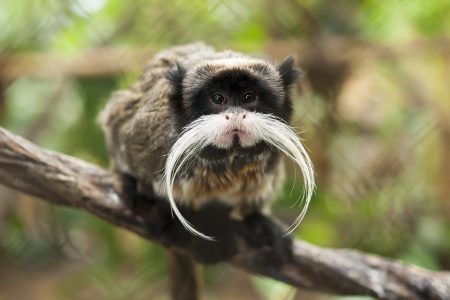
Let’s start things off relatively normally. There’s nothing that weird about emperor tamarins, as long as you ignore their magnificent mustache.
The South American monkeys were named after their facial hair’s supposed resemblance to that of the German Kaiser Wilhelm II. We have to say, the monkeys ‘stache is much better.
That said, emperor tamarins are divided into two subspecies. The black-chinned emperor tamarin has just a mustache, while the bearded emperor tamarin also sports a beard, true to its name.
2. Black Howler
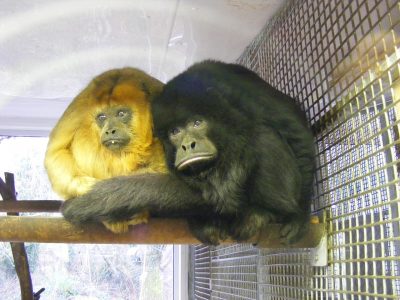
Black howlers are one of the largest species of New World monkeys. Their name is completely misleading, though, since not all of them are black.
The black howler males take after Johnny Cash and clad themselves in black. The females, however, only have black faces and their fur is more of a gray-ish blonde.
The “howler” part is accurate, though. They have one of the loudest voices out of any primates, and their screams can be heard up to two miles away.
3. Red-shanked Douc
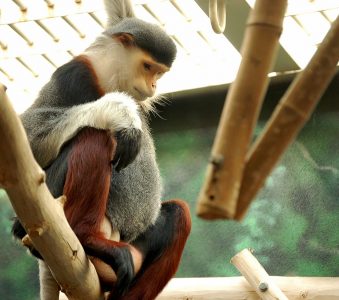
Take one look at a red-shanked douc, and you won’t have to wonder where its name came from. These monkeys have bright, reddish-orange legs while the rest of their fur is gray or white.
Another bizarre feature that’s not obvious is that red-shanked doucs have four-chambered stomachs, resembling the four-stomach configuration of cows and other ruminants. They eat mostly leaves, so they need that extensive digestive tract to get the necessary nutrition out of their high-fiber diets.
4. Roloway Monkey

The Roloway monkey gives emperor tamarins a run for their money when it comes to impressive facial hair. They sport long white beards that trail majestically from their chins.
Although the beard is their most striking feature, Roloway monkeys sport distinctive fur elsewhere on their bodies as well. Their arms and chests are white, their sides are a shiny dark gray, and their backs an orange-y brown.
All in all, they look quite dapper.
5. White-faced Saki
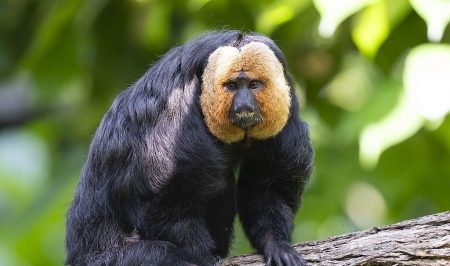
Whereas Roloway monkeys and emperor tamarins look rather sophisticated, you can’t say the same about the white-faced saki. These South American monkeys aren’t winning any beauty contests anytime soon.
The species is named after the males that have patches of white fur surrounding their black faces. Their facial coloration stands out like a sore thumb from their otherwise black fur.
The females, however, really drew the short straw when it comes to looks. They just look like shaggy monkeys, and not in any particularly appealing way.
6. Spix’s Night Monkey
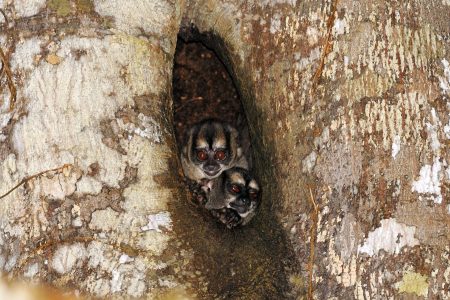
Spix’s night monkey is a strange small monkey species from South America. It exhibits several strange behaviors, the first being that it’s entirely nocturnal.
During the day, the monkeys snooze away in hollow trees. They’re even known to share their nests with other mammals. The more, the merrier, we suppose.
But don’t assume Spix’s night monkeys are friendly. Despite their small size, they’re some of the most aggressive New World monkeys. Although they live communally, they may start a fight at any moment.
7. Mandrill
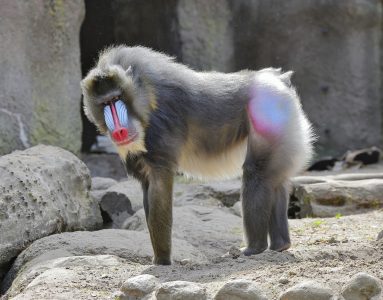
If you think of colors associated with monkeys, you might think of brown, black, white, gray, or orange. But what about bright blue and red?
That’s what you’ll find on the face of a male mandrill. These central African monkeys sport an impressively bright “war paint” on their faces… And their butts.
Yep, you’ll find the same colors on a male mandrill’s butt. Look, lady mandrills just like seeing colorful makeup on a man, no matter which end they’re looking at.
8. Proboscis Monkey
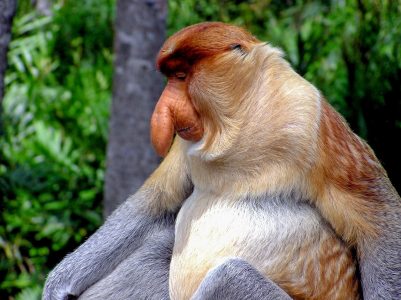
The proboscis monkey is sometimes also called the long-nosed monkey. Can you guess why?
Yeah, it’s the enormous schnoz.
However, the nose shape depends on the monkey’s sex. Male proboscis monkeys have bulbous, sack-like noses, whereas the females’ noses are flat and upturned.
9. Black Snub-nosed Monkey
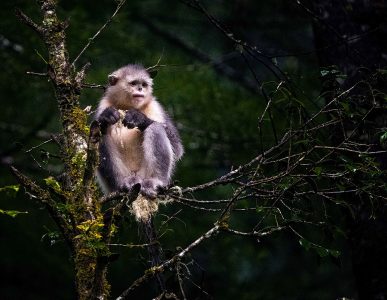
If the proboscis monkey has too much nose, the black snub-nosed monkey sits at the other end of the scale. It barely has a nose at all.
They lack nasal bones altogether, giving them an eerie, skull-like face. Frankly, they look a little creepy.
Perhaps that’s why they decided to retreat to the mountains. Black snub-nosed monkeys are the highest-dwelling non-human primates, with populations discovered as high as above 15,000 feet.
10. Bald Uakari
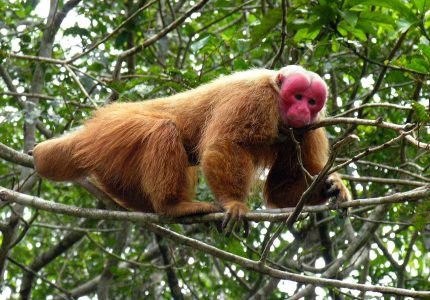
Finally, we have the bald uakari. This is another monkey where it’s not difficult to figure out how they got their name.
That said, there’s a good reason why bald uakaris have hairless, permanently blushed faces. Their head is basically a health indicator.
These monkeys live in groups as large as 100 individuals, which could leave them vulnerable to easily-spreading disease. So, if they spot a monkey with an unusually pale face, the rest of the group can take appropriate measures to protect themselves from disease.