
- You’d imagine a coffee shop would be happy to have customers who stay forever, but it’s a problem when they don’t pay.
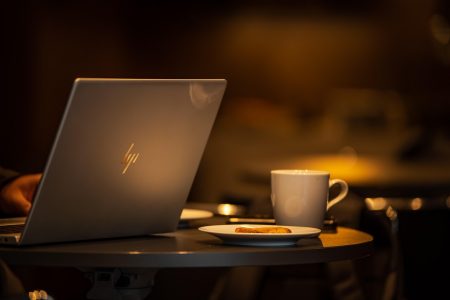
Go into any coffee shop in a big city and you’re likely to see someone sipping their drink while using a laptop. Perhaps it’s a college student trying to escape a noisy roommate, or a professional checking emails before heading to a business meeting.
Really, there’s nothing wrong with any of that. These people by their refreshments, enjoy them while doing some work or study, and then leave.
Now, meet the Cagongjok. The problem with them is that they don’t leave.
This South Korean term describes people who sit down in cafes, set up their home office, and then stay for hours upon hours on end. And when we say “home office,” we mean it.
Some Cagongjok aren’t satisfied with just a laptop. They might break out a mouse, a laptop stand, a second laptop, a power strip, seven different chargers, and even a printer.
Coffee shop owners are growing frustrated with the Cagongjok, who take up space but don’t necessarily buy anything but one drink. Meanwhile, other customers who don’t plan to live in the cafe are left without a place to sit or plug their phones in for a minute.
Consequently, coffee shops have started resorting to increasingly strict measures to control the Cagongjok. Some have blocked all public outlets and charging ports, while others have put in place “No Study Zones” — if you take out a phone, book, or laptop, you’re out.
A Cagong-what?
First, let’s clarify what a Cagongjok is. This term can be both a noun and a verb, describing someone who works or studies at a coffee shop (or a comparable public place).
So, you can commit cagongjok. And if you do, you are a Cagongjok. Make sense?
Cagongjok isn’t a new phenomenon and has existed in South Korea for quite some time. It may have its roots in internet cafes, which were and still are very popular in South Korea.
Before widespread home internet, internet cafes were convenient places for people to take care of their online business. Known in Korea as “PC bang,” some of these establishments serve general customers, but a great number are geared toward online gaming.
It’s quite possible that Cagongjok are a spawn of Korea’s internet cafe culture. And really, in the early 2000s, it was very handy to be able to study or work in these places.
However, now that Wi-Fi is available in most regular cafes, Cagongjok have started treating them like internet cafes. The phenomenon exploded particularly in the aftermath of the COVID-19 pandemic.
And that is becoming a bit of a problem.
Setting Up Shop
Not everybody who brings a laptop to a coffee shop in South Korea is a Cagongjok. To become one, you have to do some work or study on your phone for an extended period of time.
Again, that’s not a problem if the Cagongjok keeps buying drinks or food at regular intervals, paying rent for the table, power, and internet connection they’re using. The issue is that most Cagongjok don’t.
What’s more, they may not be satisfied with just their laptop either. According to Starbucks Korea, the Cagongjok can go outlandish lengths to set up their work environment.
Some of them hook up a laptop stand, an external keyboard, and a mouse. And then there are those who essentially set up an office.
They might walk in with a desktop PC and a monitor, alongside a keyboard and other peripherals. Of course, all that equipment needs space and power, so they’ll push together several tables and hog power outlets — if they don’t bring their own power strips.
On the most extreme end of things, people have even brought printers to cafes.
After a Cagongjok has rooted in a coffee shop, it can be difficult to get rid of. Consequently, this leads to lost business, as the Cagongjok may not buy drinks (and might even leave to eat elsewhere, leaving their computer setup at the cafe) and takes up space from paying customers.
“With Daechi’s [an expensive Seoul neighborhood] high rents, it’s difficult to run a cafe if someone occupies a seat all day,” coffee shop manager Hyun Sung-joo summarized for the BBC.
Enough is Enough
Now, you shouldn’t assume all South Koreans set up home offices away from home all the time. Cafe owners admit that Cagongjok are rare in overall terms.
“It’s maybe two or three people out of a hundred. Most people are considerate,” said Hyun. “Some even order another drink if they stay long, and I’m totally fine with that.”
But, as it usually goes, there are those few bad apples that spoil the bunch. Now coffee shop managers have started resorting to relatively extreme measures to deal with the space-hogging Cagongjok.
Hyun, for instance, has blocked all power outlets in his cafe. He’s not happy about having to do it, but he simply can’t have people sit around for 10 hours at the price of one coffee.
Another coffee shop said it had set “No Study Zones.” Essentially, once they see a customer break out a book or laptop, they start a timer. Once two hours are up, the person will be politely but firmly asked to leave.
And then there’s Starbucks Korea, whose new official line is to provide “guidance” to customers who stay for a long time on a laptop. Now, don’t quote us on this, but we have a sneaking suspicion that this might be a PR-coded way of saying that the problem customers will receive guidance toward the nearest exit.