
- With the U.S. Air Force behind Santa, Grinch doesn’t stand a chance.
As everybody knows, Santa climbs into his sleigh on Christmas Eve and flies across the world to bring presents to all nice children. It’s a vital mission that must be carried out without delay or failure.
Fortunately, Santa has friends in high places. Important people and organizations make sure his travels go without a hitch.
For instance, did you know that NORAD (North American Aerospace Defense Command) tracks and reports Santa’s progress every Christmas?
Yes, we’re talking about the same joint military command between the U.S. and Canada that’s responsible for protecting the continent from strategic bombers, nuclear weapons, and cruise missiles.
Of course, NORAD doesn’t really have radars on a flying sleigh. The NORAD Tracks Santa program answers calls from children (and curious adults) to report on a fictional flight path that Santa might take, while also displaying a Santa tracker on its website.
Yet, the strangest part of the whole project is that it got started because of a misprinted phone number. Here’s the story of why NORAD began to track Santa.
Slight Misprint
In 1955, in the early years of the Cold War, the Sears department store in Colorado Springs got a bright idea for a seasonal publicity stunt. They’d set up a Santa hotline, allowing children to call “Santa” at any hour and ask him whatever burning question might be on their mind.
That’s nothing unusual these days, but it was pretty novel at the time. So, Sears hired some holly jolly old guys to man the phones and opened the lines.
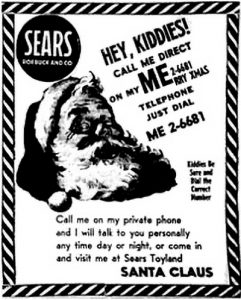
However, they also needed to let children know that Santa was taking calls. Sears ran an ad in the local The Gazette newspaper.
“Hey, kiddies! Call me on my private phone and I will talk to you personally,” Santa declared in the ad.
Unfortunately, someone had made an itsy-bitsy mistake when printing the ad. The phone number displayed on the ad — ME 2-6681 — was wrong.
A single digit (we couldn’t find out which) on the number had been misprinted. Instead of ending up with a dead line, though, the calls started connecting when kids dialed the number.
But where was the ringing phone?
‘We Have Santa on Radar’
In 1955, NORAD didn’t exist yet. At the time, U.S. airspace was monitored by CONAD, the Continental Air Defense Command.
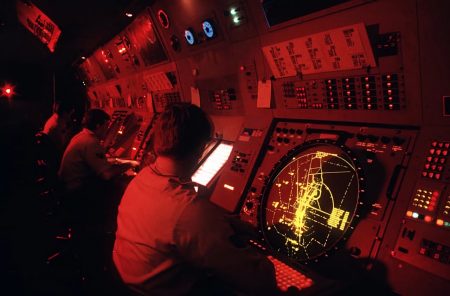
CONAD operated a nuclear early-warning bunker in the Colorado area. That bunker had an emergency phone that, should it ring, marked some very unpleasant news.
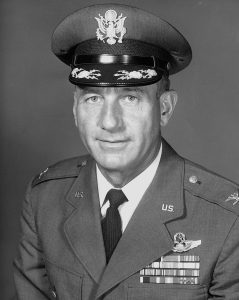
On December 24, 1955, that phone rang. As the officer in charge, Colonel Harry Shoup picked up the receiver.
“Yes, sir. This is Colonel Shoup,” he answered. However, instead of a serious military man informing him about Soviet aircraft encroaching on American airspace, Shoup heard a young girl’s voice.
“Is this Santa Claus?” she asked.
Initially confused, Shoup thought the call was a prank, and he got rather aggressive as he demanded to know how the girl had gotten the bunker’s phone number. Eventually, the teary girl gave the phone to her mother, who explained the number had come from a Sears ad.
Gruff as he was, Colonel Shoup wasn’t made of stone. Realizing he had gotten tough with a little girl who was thinking she was just calling Santa, he softened his tone.
Shoup told the girl about the mistake in the ad and explained he wasn’t Santa. However, he could find out where Santa was.
Making sure the girl could hear him, Shoup commanded his staff to search for and track a sleigh recently believed to have left North Pole. After an appropriate pause, he informed the girl that their systems had a lock on Santa.
“We have him on radar. Santa is heading south,” Shoup reported, much to the girl’s delight.
Santa Colonel
Accounts from the time differ on whether Colonel Shoup received additional calls that night. If he did, he did what he had done with the girl — explained the mistake and reported Santa’s current location.
Afterward, Shoup had to report the compromised phone line to his superiors. However, he saw a good publicity opportunity for CONAD in the incident.
Shoup requested CONAD to put out a press release explaining how the command had tracked Santa with their fancy radars to “guard Santa and his sleigh on his trip to and from the U.S. against possible attack from those who do not believe in Christmas.” Public relations officers acquiesced, seeing it as a perfect opportunity to show taxpayer money in good use.
The story was picked up by many of the major newspapers of the time. It proved so popular that CONAD decided the stunt should be repeated.
Coloner Shoup himself hadn’t planned on being on Santa service again, but in December 1956, the brass informed him that big news organizations were awaiting reports on Santa. Shoup agreed to take calls again, starting an annual tradition.
For his part in the story, Colonel Shoup earned the nickname “Santa Colonel.” In 1958, CONAD was reorganized into the joint NORAD project, which took on the duty to continue tracking Santa.
So, if your kids are nervous about whether Santa will make it to your house this year, you know how to put their minds at ease.