
- From salmon to rhinos, everything just used to be a lot bigger.
Think about the biggest living animal you’ve ever seen in person. Here’s a fun fact — it’s small compared to what came before it.
With some very rare exceptions (whales, mostly), modern animals are smaller than their ancient relatives that lived thousands or millions of years ago. There are many reasons for that, from higher oxygen levels to not having humans around to drive them to extinction.
We’ve written about giant versions of modern animals before, but this is just one of those topics that’s always fascinating to come back to. So, here are another seven monstrously huge relatives of modern animals.
1. Glyptodon (Armadillos)
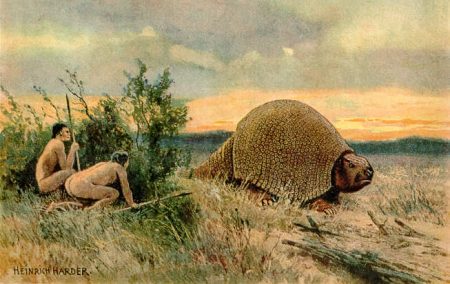
The armadillo isn’t the most fearsome beast (not to mention they make lousy pets). Yet, if its ancient relative Glyptodon emerged from the bushes, you might think about backing off.
Various Glyptodon species existed from 3.2 million years ago to just 11,000 years ago. They varied greatly in size, but the largest known species — Glyptodon clavipes — could be 11 feet long and weigh more than 4,000 pounds.
In other words, it was slightly shorter but heavier than a Volkswagen Beetle.
These lumbering ancient VWs were clad in a round, thick turtle-like shell. Yet, they were still common prey to saber-toothed tigers, ancient bears and wolves — and our very own ancestors.
2. Saber-toothed Salmon (Salmon)
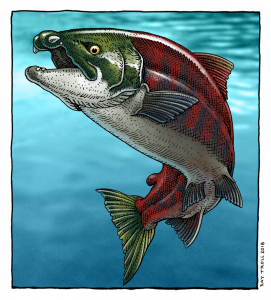
You know, we don’t think the saber-toothed salmon actually went extinct some five million years ago. It must still exist because this fishy behemoth is the one that got away from every fisherman who ever lived.
The saber-toothed salmon is the largest salmonid species to ever exist, rivaled only by the modern Siberian taimen. Researchers estimate that at its largest, this fish could grow to be more than eight feet long and weigh nearly 450 pounds.
Its name stems from the pairs of tusk-like teeth at the tip of its snout, although unlike a saber-toothed tiger’s, the salmon’s tusks pointed directly sideways (for some reason). The saber-toothed salmon ate plankton and small fish, though, and the tusks were there to beat up enemies and rivals.
3. Josephoartigasia (Capybara)
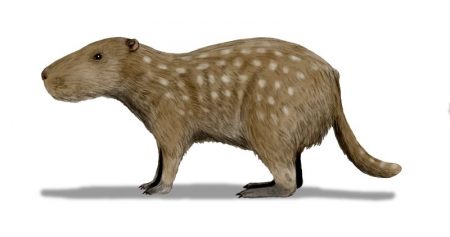
The capybara is the world’s largest rodent. Yet, it’s a pale shadow of its dead relative, the Josephoartigasia.
These ginormous rodents lived some three million years ago. Scientists haven’t found that many parts of their skeletons, so how big they were exactly, is a bit of a guesstimate. Nonetheless, the Josephoartigasia is estimated to have weighed 1,100 pounds at its largest.
Now, compare that to a capybara, which averages 130 pounds. Funny enough, the animals are speculated to have looked extremely similar so visualizing the Josephoartigasia is easy.
Just take a capybara and scale it up a few times.
4. Arctotherium Angustidens (Spectacled Bear)
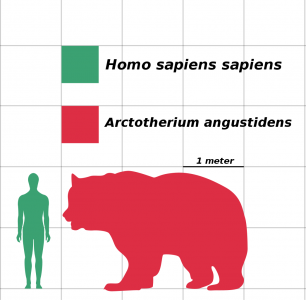
The modern spectacled bear is already a respectable size, being the largest land carnivore in South America. But then there’s its relative Arctotherium angustidens, which didn’t go extinct until some 10,000 years ago.
And it was the largest bear to ever exist.
This Arctotherium species’ size was up to speculation until 2011, when they discovered some remains of an absolutely massive specimen in Buenos Aires, Argentina. This hulking monster weighed an estimated 3,500 pounds and had a standing height of anywhere between 11 feet.
And that’s the most conservative estimate. It may have been significantly bigger than that.
5. Paraceratherium (Rhino)
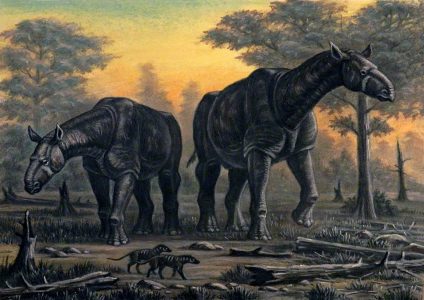
If you saw a living Paraceratherium, you’d probably think it’s some kind of a strange offshoot of an elephant. But no — this humongous animal was a relative of modern rhinos.
The Paraceratherium lived in what is modern Eurasia around 34-23 million years ago before disappearing. Although its exact proportions are unknown due to incomplete fossils, it’s estimated to have stood 16 feet tall and 25 feet long.
Weight-wise, the Paraceratherium was probably between 33,000 and 44,000 tons. So, a lot bigger than even the largest modern elephants.
6. Daeodon (Pigs, maybe)
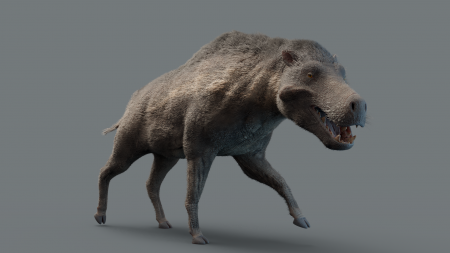
A charging wild boar is already enough to send most people packing. A Daedon careening toward you would probably make even the biggest, toughest, most macho muscle man need a change of pants.
This beast, which lived around 20 million years ago, sort of resembled a gigantic pig. It was around 6 feet tall at the shoulders (so about as tall as a grown man).
And what did the Daeodon eat? Whatever it damn well pleased.
Like modern pigs, the beast was omnivorous and gorged itself on anything it found. The jury is still out on whether it actively hunted for meat, but the Daeodon was certainly able to kill most things it came by.
Recent studies, however, suggest that the Daeodon may not be that closely related to pigs. Despite its pig-like appearance and behavior, researchers now believe it may be more closely related to hippos and whales.
7. Megalodon (Sharks)
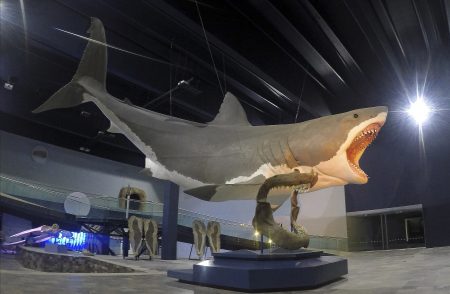
Ah, the Megalodon. We all know this huge ancient shark was massive from all the movies it’s appeared in. But how big was it in reality?
Well, that’s a good question. Sharks are mostly cartilage, so the only fossilized pieces we’ve found of the Megalodon are teeth and a couple of vertebrae.
Nonetheless, at its smallest, it was estimated to be 36 feet long. The largest estimates put it at 65 feet.
So, it may not have been as big as some movies make Megalodon out to be. Still, it was at least about twice as long as the biggest great white sharks.
Yeah, you wouldn’t want to spot even a small Megalodon swimming circles around you.