
- If bigger is better, then these beasts are some of the best.
What do Texas and prehistoric Earth have in common? At least one thing — everything is bigger in both places.
Many types of animals that still roam the planet today already existed millions of years ago. Many of them were just a whole lot bigger.
We’ve covered some monstrous versions of modern animals before. That time, though, we called the listed creatures “ancestors” of their current counterparts. That’s not correct in many cases, since the modern version didn’t descend from the giant precursor.
So, we thought we’d revisit this subject so we could own up to our mistake and bring you more gigantic monsters. Here are seven more enormous relatives of still-living animals.
1. Paraceratherium (Rhinos)
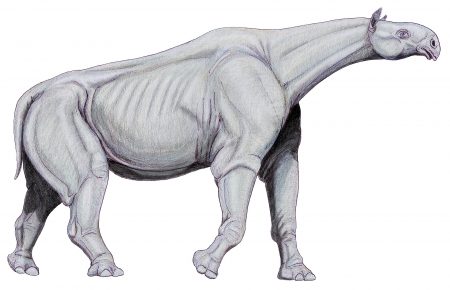
Rhinos are big enough already, but their ancient relatives were much bigger. The Paraceratherium family of prehistoric rhinos reached truly gigantic proportions — in fact, they’re among the largest land mammals to ever live.
That said, you might not recognize them as rhinos, since they didn’t have horns and had much longer limbs and necks. Still, they belong in the same lineage as modern rhinos.
Multiple species of Paraceratherium existed, but likely the largest was Paraceratherium transouralicum. This behemoth is estimated to have been about 25 feet long and 16 feet tall, and to have weighed up to 45,000 pounds.
2. Diprotodon (Wombats)
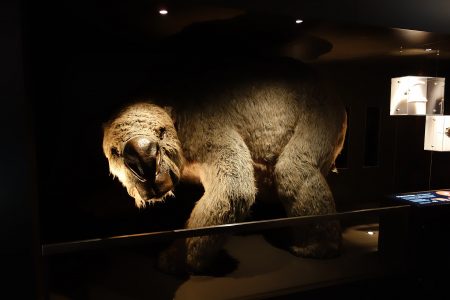
Unlike the Paraceratherium, the Diprotodon does resemble its currently living relatives — wombats and koalas — enough that you might acknowledge the relation. As the largest marsupial ever, though, it’s several times the size.
The Diprotodon was anywhere between nine and 11 feet in length and nearly six feet tall. Depending on estimates, it weighed somewhere in the ballpark of 6,000 pounds.
To give you a comparison, wombats are about three feet long and weigh 50-60 pounds. An American bison, meanwhile, weighs roughly 2,500 pounds.
Yeah, that’s a lot of marsupial.
3. Doedicurus (Armadillos)
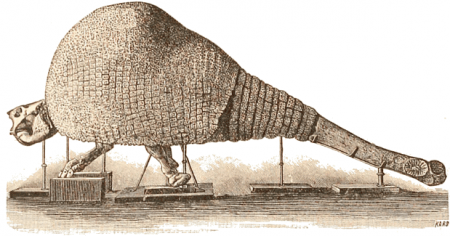
The Doedicurus is an ancient take on the concept that we today know as armadillos. As one of the largest glyptodons, this five-foot-tall and 12-foot-long armored beast was about the size of a small car.
And while armadillos sport respectable armor, they have nothing on the Doedicurus. Its dome-shaped carapace was exceptionally thick and it also had a 100-pound clubbed tail it could swing at potential attackers.
Yet, well-armored as it was, the Doedicurus’ shell was no match to one species of stick-wielding hairless apes. Ancient humans hunted the Doedicurus and other glyptodons to such an extent that some researchers believe we played a not-insignificant role in driving them to extinction.
4. Steller’s Sea Cow (Dugongs)
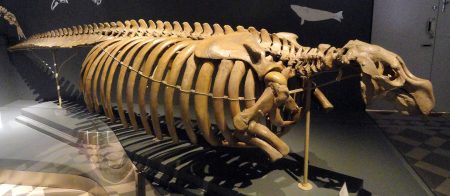
Speaking of humans driving ancient giants to extinction, meet the Steller’s sea cow. Belonging to the same Sirenia order as dugongs, the Steller’s sea cow was one of the largest animals of the currently ongoing Holocene epoch, alongside whales.
The Steller’s sea cow grew to be up to 30 feet long and weighed between nine and 11 tons. Despite its size, it was a gentle giant that floated in the waters between Alaska and Russia, munching on marine vegetation.
Sadly, its peace-loving nature and huge size made it irresistible prey for hunters. Western explorers first discovered the Steller’s sea cow in 1741 and hunted it to extinction within 30 years.
5. Archaeoindris (Lemurs)
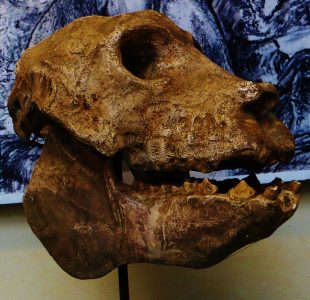
Lemurs, native to Madagascar, are funny little creatures with their long tails and their desire to move it, move it. Yet, none of them can move like the Archaeoindris.
This giant lemur is the largest primate known to have evolved on Madagascar — and one of the largest primates in general. Roughly the size of a gorilla, the Archaeoindris weighed a whopping 350-500 pounds.
The estimated maximum weight varies a lot, since no one has found a complete Archaeoindris skeleton. Researchers have to try and make guesstimates based on the creature’s humongous skull, which is likely much larger in comparison to its body than any modern primate’s.
Oh, and it didn’t have a tail.
6. Daeodon (Pigs)
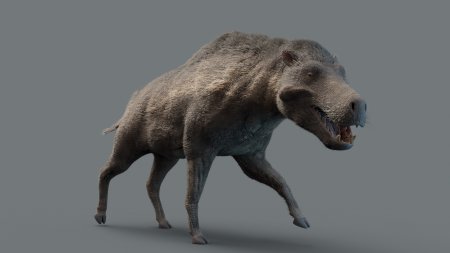
Most people would panic if a full-grown modern hog charged at them. With that in mind, we’re really lucky the Daeodon no longer exists.
This relative of pigs grew to be around six feet tall at the shoulders and nine to 10 feet in length. Of that length, its huge skull made up around a third.
Just like pigs, the Daeodon ate anything it could find, from plants to meat. Although it likely wasn’t able to actively hunt, you still wouldn’t want to get this behemoth angry.
7. Deinosuchus (Crocodiles)
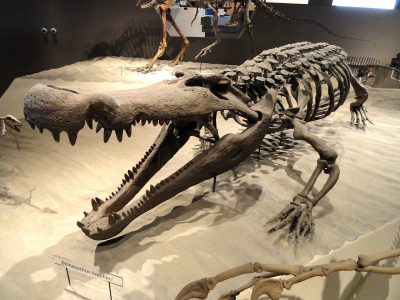
The saltwater crocodile is the largest living crocodilian and one of the most fearsome creatures on the planet. At a maximum of 20 feet in length and 3,000 pounds in weight, they can pretty much anything they come across.
Now, consider the Deinosuchus, one of the largest known crocodilians. Researchers aren’t exactly sure how big it could get, but recent evidence suggests it could grow to a whopping 32 feet in length.
And what did it eat? Again, probably whatever it dang well felt like — including the dinosaurs it shared the planet with.