
- Not every egg is suitable for cracking into an omelet.
Picture an egg. You probably imagined a white or brownish oval-shaped hard shell.
The egg we are all familiar with, however, is in the minority in nature. Eggs come in all shapes, sizes, and colors to keep them camouflaged, anchored in place, or for various other purposes.
Here’s a curated selection of nine of the oddest eggs out there. Which one’s your favorite?
1. Kiwi
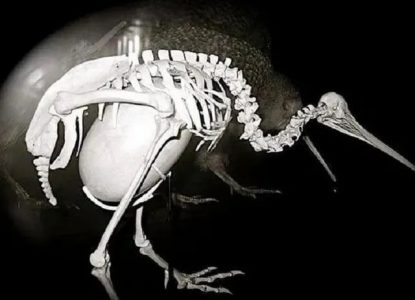
In itself, the egg of the kiwi bird doesn’t look like much; in fact, it’s your standard white egg. But it’s the size that makes it remarkable.
The kiwi lays the world’s largest egg in proportion to its body size. When carrying the fully developed egg just before laying, it can make up a quarter of the female bird’s weight. In comparison, that’d be the equivalent of a human woman carrying a roughly 24-pound baby.
The egg is so massive that it compresses the female kiwi’s organs to the point that she can barely breathe. In the days before laying an egg, she can’t eat because her stomach is squished flat against her abdominal cavity wall.
2. Tinamou
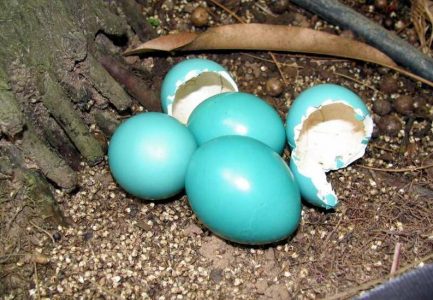
Many animals try to have their eggs blend into their surroundings to keep predators from noticing them. The tinamou has taken the polar opposite approach.
This small South American bird, distantly related to the ostrich, lays what are basically Christmas ornaments. Its eggs are a bright turquoise color and have a shiny coating that makes them looks like they’re made of porcelain.
The eggs are so flamboyant because of the tinamou’s strange nesting behavior. A male bird builds a nest and entices one female to lay its eggs in it. He hopes that other females notice the shiny eggs and come to mate as well.
Afterward, the male bird incubates the eggs while the females go on their merry way. While he sounds like a good dad, he’s actually anything but. The whole point of having so many eggs in one nest is that any predators that find them will get full before they eat all of them.
3. Horn Shark
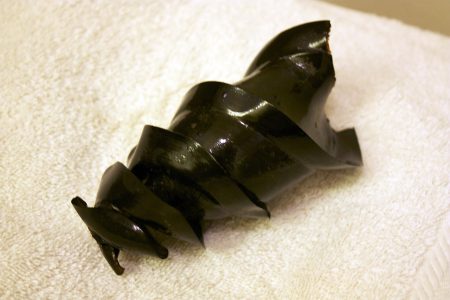
The horn shark shows that eggs do not need to be oval. This small shark’s eggs are shaped like screws.
Not only do they look like screws, but they also function like them. The female shark lays her eggs into a crevice between rocks, and they rotate as they come out, screwing themselves into sea floor detritus.
With the egg lodged firmly in place, it’s much harder for potential predators to pry them out of their hiding spot. However, due to their shape, it can take the female shark several hours to squeeze one out.
If you’d like to learn about other animal mothers that sacrifice a lot for their offspring, check out these 7 animals that take good parenting too seriously.
4. Drongo
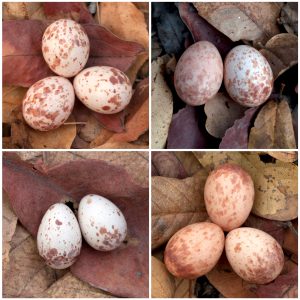
Drongos are black birds living in Eurasia that resemble crows (although they’re not related). Their eggs aren’t particularly interesting in appearance, but if you pay attention to their nests over time, you’ll notice something strange.
Each female drongo always lays her eggs in a very specific order. Her meticulous egg organization is a safeguard against the drongo’s mortal enemy: the cuckoo bird.
As you’re certainly aware, the cuckoo will take over another bird’s nest, destroying the host’s eggs and laying its own in their place. However, the mother drongo always knows the exact way her eggs lay in the nest.
If a cuckoo messes with them, the furious mother drongo can throw the intruder’s egg out of the nest and keep looking after her own, perfectly organized babies.
5. Stink Bug
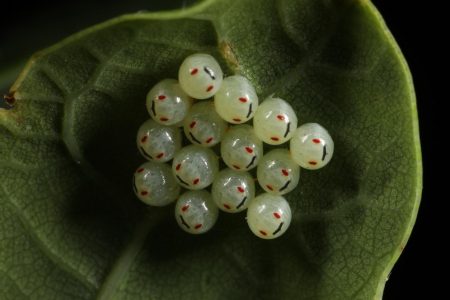
Stink bugs get a bad rap, what with their swarming behavior and off-putting odor. But have you ever seen their eggs?
They look like a bunch of tiny smiley emojis!
Those red eyes you see on the egg are actually just that. They’re the developing baby stink bug’s compound eyes that are visible through the translucent egg shell.
The black like, however, isn’t a mouth. Instead, it’s a fracture spot that will pop open when the baby bug is ready to come out.
6. Glass Frog
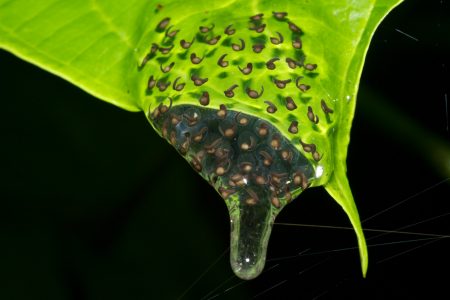
The glass frog is famous for being almost transparent to the point that you can see its organs inside its body. It makes sense then that the frog’s eggs are also like little glass marbles, with the growing tadpole plainly visible inside them.
But that’s not the only oddity about these eggs. Unlike what you may expect, this tree-dwelling frog attaches its eggs to a leaf with a sticky (and also transparent) goo.
That would leave the tadpoles stranded once they hatch, but the frog has a plan. It always makes sure that the eggs are above a permanent body of water. Once the tadpoles wiggle out of the eggs, they fall straight into the water.
7. Green Lacewing
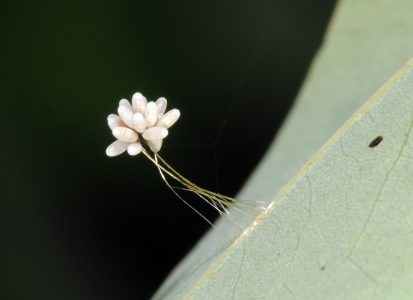
The green lacewing is a common bug that you’re definitely familiar with, even if you’re not conscious about it. After mating, this insect builds a bizarre-looking egg scaffold.
The female lacewing carefully places each egg at the tip of a long, hair-like stalk. And she has to keep her babies apart from each other for a very good reason.
Lacewing larvae are voraciously carnivorous. They don’t discriminate when it comes to their prey and will gleefully cannibalize their own siblings (whether hatched or not) if they get a chance.
By placing the eggs on thin stalks, the mother lacewing tries to make sure that the first hungry larva to hatch doesn’t immediately devour the rest.
8. Spined Soldier Bug
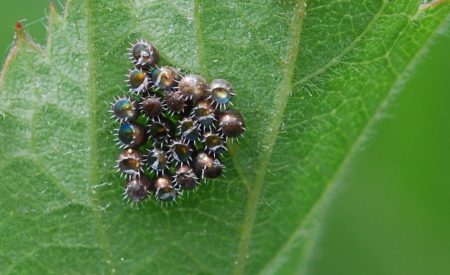
The spined soldier bug is a kind of shield or stink bug living all over North America. But unlike the emoji-laying stink bugs from earlier, the soldier bug does something with its eggs that no other animal can.
The female soldier bug is able to control the color of her eggs. If she lays them on a light-colored surface, the eggs come out light; if they’re in the shade, the eggs turn out dark.
Add to that the eggs’ sharp spines and their metallic sheen, and you have something you’d expect an alien to lay in a sci-fi movie.