
- Would you commit a crime against fashion to hide from AI cameras?
It seems every day you hear about another AI-powered form of surveillance creeping into our lives. Don’t you wish you could fool the devices and disappear from their prying eyes?
Now you can. But doing so requires you to don one butt-ugly shirt.
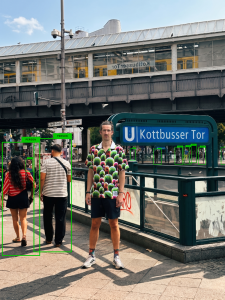
German designer Simon Weckert has designed a veritable invisibility cloak that makes its wearer undetectable to certain AI-powered surveillance cameras. However, instead of a snazzy cape, the garment comes in the form of a hideous Hawaiian shirt.
The AI-fooling shirt comes either in a green-and-red leaf-like design or an orange-blue-black splotchy pattern. Although the shirts are offensive to anyone with even the slightest concern for fashion, they’re equally toxic to AI’s ability to recognize a human being.
Their outrageous colors and patterns fool the system’s recognition algorithm. Although any human viewing the video will see you (very clearly too, thanks to the garish shirt), the machine brain does not understand that it’s looking at a human being.
Consequently, while wearing the shirt, you may not trigger any automated alarm systems the AI may be trained to operate. Surely, you would only use this ability for good, right?
Having said all that, are we sure the AI doesn’t see you just because it doesn’t want to acknowledge anyone with such horrible taste in clothes?
Privacy-Minded Artist
Simon Weckert is, in his own words, a “modern-day digital wizard and mischievous tinkerer.” In plainer terms, he’s an artist, designer, programmer, and musician.
Although he has worked in and experimented with many fields over his career, he’s particularly fascinated with privacy in our digital age. He has created various privacy-themed works that blend IT and art, such as a blank “Null Island ID Card” that fools ID check systems and a Bluetooth Jammer that renders nearby Bluetooth devices inoperable.
Now, he has designed what he dubs Digital Camouflage. These clothes disrupt AI-powered video surveillance systems and render their wearer invisible to their electric eyes.
Weckert created Digital Camouflage in reaction to the experimental AI video cameras installed on Berlin’s streets. He didn’t like the idea of machines observing his every move, so he decided to create something to throw them off.
And that something comes in the form of tasteless Hawaiian shirts.
Human No Longer
Weckert’s original Digital Camouflage shirts feature a garish, leafy design of overlapping green and red patterns. He has since developed a 2.0 version, which features a more traditional, spotted camo pattern – only in blue, orange, white, and black.
But while the shirts look horrible to humans, they don’t look like anything at all to the AI cameras. Weckert explained that he created the design painstakingly to interrupt the AI’s human recognition algorithm.
At the heart of Digital Camouflage is the fact that an AI-powered camera doesn’t actually “see” anything. Instead, it looks for the averages of various patterns over multiple layers to determine if it’s witnessing a human being.
“In the early layers it’s edges, contrasts and texture gradients; deeper in the network it’s part-like patterns: the head-and-shoulders silhouette, the proportions of limbs against a torso, the continuity of a body’s outline against the background,” Weckert told Dezeen.
“A ‘person,’ for the machine, is a bundle of visual statistics.”
His shirts’ garish designs confuse this multi-layered interpretation process. The colors and patterns break the human silhouette in the algorithm and prevent the AI from “seeing” you.
“The pattern essentially shouts over the quiet statistical whisper that says ‘person.’ To a human it reads as an almost hypnotic textile; to the AI model it reads as nothing at all,” said Weckert.
Adversarial Loop
To create the design, Weckert used what’s called an adversarial loop. He made a shirt pattern, pulled it on, and stood in front of a camera powered by an open-source object recognition system called Yolo.
He then checked how reliably the AI recognized him as a human. Based on the results, he altered the design and went back in front of the camera. Once it no longer read him as a human being, Weckert knew his job was done.
This gradual process was necessary because you can’t really know what the AI camera is actually looking for when determining whether something is a person.
“A machine’s blind spots are not intuitive to humans; you cannot design against machine perception by eye. Only the machine can tell you what it fails to see,” said Weckert.
Artistic Protest
Now, Weckert is selling his shirts through his web store. They’re pricey, but if you want to protect yourself from AI surveillance, they’re probably worth it – if they work against the AI your local cameras use.
But what can you do with Weckert’s shirts? Nothing really. They’re more of an artistic protest against AI surveillance than something meant to be used in real-life situations.
Besides, if you wore the shirts while engaging in illegal activities, you might fool the AI, but not a real human checking the footage. If anything, the horrible Hawaiian shirt will only make you stand out like a sore thumb to human eyes.