
- The appearance of this fascinating bridge is dire news for Italy’s water situation.
Italy is struggling with a difficult drought, and it’s painfully clear to see in Rome. The water levels of the Tiber River, which flows through the Eternal City, have fallen significantly.
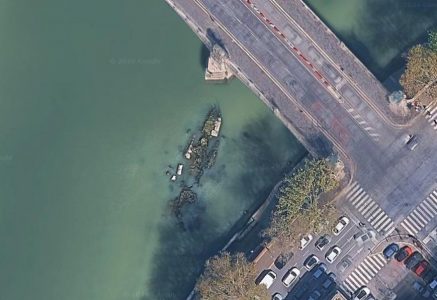
Although the river drying up is alarming, it has come with an unexpected silver lining. As the waters have receded, a historical curiosity has emerged from underwater.
Namely, an ancient bridge attributed to Emperor Nero.
Pons Neronianus, or Nero’s Bridge, once connected various imperial palaces of Rome to the opposite side of the Tiber. It remained in use for a couple of hundred years before a new one made it obsolete.
Despite its name, though, the notorious Nero probably didn’t order the building of the bridge. No, it’s more likely the work of his much more unhinged uncle, Caligula.
Let’s take a closer look at this rare sight associated with two of Rome’s most bloodthirsty emperors.
Crazy Predecessor
It’s not entirely clear when Pons Neronianus was constructed. Considering its name, nobody would blame you if you assumed the infamous fiddling emperor decreed its construction.
Most historians, however, believe that the bridge was already in place in 39 CE – 25 years before Nero ascended to the imperial throne. That would likely mean that it was built during the reign of Nero’s uncle, Caligula.
Caligula is widely regarded as one of the most deranged, hedonistic, and straight-up evil emperors Rome ever had.
If you’d like to read more about his antics, you can check out our list of 5 historical rulers who were bat***t insane.
Bridge to Pleasure
In addition to his vice-filled life, however, Caligula is famed for the many construction projects he carried out in the city of Rome. Most were monuments for his own glorification, but some had a public utility, like this bridge.
Even then, though, the bridge’s construction wasn’t an entirely selfless act. It likely served as a shortcut for Caligula and his mother to get to the city’s circuses.
“[The bridge was] built by Caligula, Nero’s uncle, to connect the villa of Agrippina, who was Caligula’s mother, on the other side, currently roughly corresponding to the Santo Spirito Hospital (near the Vatican),” Antonella Bonini, an archeologist working for the City of Rome, told EuroNews.
From the western bank of the Tiber, the bridge ran to the Campus Martius area of Rome. Originally a military garrison, it had, by Caligula’s time, transformed into the city’s entertainment hub.
Campus Martius was full of theaters, temples, baths, palaces… It’s no wonder, then, that the notorious arch-hedonist wanted a shortcut from his residence to the fun part of town.
But why is the bridge called Nero’s Bridge if it has nothing to do with him? That would be because after Nero came to power, the areas that Caligula used to frequent became so strongly associated with Nero instead that his name stuck to the bridge.
In a way, he out-debauched his (arguably more) debauched uncle. Quite an achievement.
‘Water Crisis’
As curious of a relic as Nero’s Bridge is, it’s usually not there for you to gawk at. The bridge remained in use for around 200 or so years, but it eventually fell into ruin and presumably collapsed.
By the end of the 3rd century, accounts of Rome’s monuments and other significant structures (yes, the Roman kept count of them) no longer mention Pons Neroniuanus. Instead, they talk of Emperor Hadrian’s Pons Aelius (today’s Ponte Sant’Angelo) as the major bridge across the Tiber.
We can then assume that it was gone by that point.
These days, the bridge spends most of its time underwater. The Tiber runs higher than it used to back in the days of ancient Rome. The higher water levels and the fact that the bridge has collapsed leave it submerged most of the time.
Occasionally, when the waters recede, some stones of Pons Neronius peek out from under the water. Recently, however, the Tiber’s water levels have fallen so much that the remains of Nero’s Bridge are plainly visible above the surface.
While that’s great for fans of ancient Roman architecture, it’s bad news for most of Italy. The extremely hot and dry summer has created near-catastrophic drought conditions in the country.
“We are facing a major water crisis,” Giovanni Giganti, Rome’s water management coordinator, told the Associated Press.
We got to see a neat historical bridge, but at what cost?