
- Anything in the name of science, right?
Scientific experimentation is fundamental to advancing our understanding of the world around us. But those experiments can be strange or even horrifying at times.
Researchers across history have organized funny, mind-boggling, and revolting studies alike to test out their ideas. Sometimes the results have been worth it. Other times… Less so.
Here’s a collection of eight of the most bizarre scientific experiments ever conducted.
1. Transparent Frogs

In 2015, a research team published a paper on using CUBIC technology on frogs. They weren’t transforming frogs into cubes, though. Instead, CUBIC stands for Clear Unobstructed Brain/Body Imaging Cocktails.
In other words, they were injecting young frogs with chemicals designed to turn them transparent.
And it works, too. Frogs that have received CUBIC treatment develop an almost entirely transparent skin that leaves their internal organs on full display.
The procedure allows scientists to observe the function of living organs without cumbersome imaging technologies. As a side product, they get transparent frogs, which is kind of cool, I guess.
2. Ffirth’s Yellow Fever Study
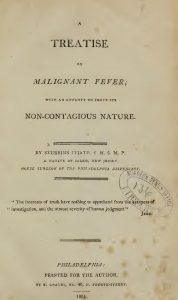
Stubbins Ffirth is known for two things. First, he had an odd name. Second, he conducted one of history’s most disgusting scientific experiments to study how yellow fever was transmitted.
Ffirth believe that yellow fever, common in the early 19th century, wasn’t contagious and was a reaction to summertime heat stress. To prove his theory, he collected various bodily secretions from yellow fever patients, including vomit, urine, saliva, and blood.
He then proceeded to… Apply these fluids to himself. He would drip them into his eyeballs, rub them into wounds he’d cut on himself, and even drink some of them.
He didn’t catch yellow fever, so Ffirth concluded yellow fever was a heat reaction. Unfortunately, he was wrong: the disease is transmitted by mosquitoes. Which means he drank vomit for nothing.
3. Brukhonenko’s Living Dog Heads
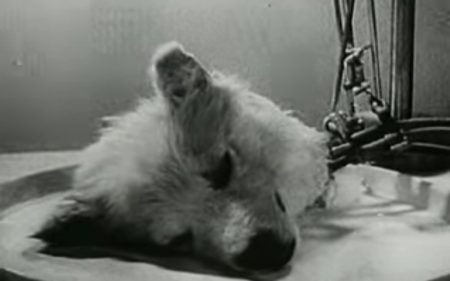
We’re now getting into some real mad scientist territory. In the late 1930s, Soviet physician Sergei Brukhonenko developed the “autojektor,” an early heart-lung machine.
To demonstrate that his device could keep living beings without functional lungs or hearts alive, Brukhonenko staged a macabre show. He hooked his autojektor up to dogs’ severed heads and rolled them out to display.
And to be sure, the heads “lived” for several days. Later reevaluations of the experiment have shown they all suffered severe brain damage that inevitably killed them, but they did respond to stimuli before expiring.
Gruesome as it may have been, Brukhonenko’s autojektor study paved the way for the life support machines doctors use today.
4. Ivanov’s Human-Ape Hybrids

Not to be outdone by his compatriot in the mad scientist category, Russian biologist Ilya Ivanov traveled to Africa in 1927. He had a singular mission: to crossbreed a human being and a chimpanzee.
Sound gross? Well, it was, and Ivanov knew it. In fact, he had to approach the true purpose of his research trip with such extensive secrecy that he never really could conduct any real experiments.
He did record two attempts to artificially inseminate female chimpanzees with human sperm, but I honestly don’t want to know anything more about that.
Ivanov eventually returned to the Soviet Union with an orangutan he hoped to breed with willing human female test subjects. Bizarrely enough, he found volunteers, but the orangutan (fortunately) died before Ivanov could stage any experiments.
5. ‘My Fingernails Taste Bitter’
Imagine a dark cabin in the woods, with preteen boys sleeping soundly on a row of beds. In their midst stands a man endlessly chanting, “My fingernails taste bitter. My fingernails taste bitter.”
That was the reality of psychologist Lawrence Leshan’s 1942 experiment to cure chronic nailbiters of their habit. He theorized that by telling the sleeping boys that their nails tasted disgusting, they would subconsciously become averse to biting them.
He initially used a phonograph to play the phrase, but the record broke from overuse. So, Leshan resorted to repeating the phrase himself 300 times every night.
In the end, 40% of the boys lost their nail-biting habit. However, it’s not clear at all whether Leshan’s chanting had anything to do with it or if they grew out of it on their own.
6. Elephants on Acid

Have you ever wondered what would happen if you gave an elephant a ridiculously huge dose of LSD? Louis Jolyon West and Chester M. Pierce had, and in 1962, they decided to find out.
West and Pierce traveled to the Oklahoma City Zoo and injected Tusko, the zoo’s elephant, with 297 milligrams of LSD. For reference, that’s about 3,000 times the dose your average human tripper ingests.
Tusko didn’t like the drug one bit. He reportedly reacted to the injection as if a bee had stung him, and then he went nuts.
He ran around his pen for several minutes, trumpeting loudly, before slumping down onto his side. Panicking, West and Pierce gave the poor elephant antipsychotic drugs to revive him, but to no avail. Within an hour, Tusko was dead.
What’s not certain is whether it was the LSD or the antipsychotics that eventually killed Tusko. But the scientific community did learn a valuable lesson that day: don’t give elephants drugs.
7. Landis’ Facial Expressions Study

In 1924, psychology student Carney Landis wanted to research whether certain emotions evoke universally characteristic facial expressions. He rounded up a group of volunteer subjects and drew a pattern of lines on their faces to better record their expressions.
He then asked them to perform certain tasks to study their faces. These tasks ranged from looking at a pornographic picture to smelling ammonia or sticking their hand into a bucket full of frogs.
But it’s the final test that was the most horrendous. Landis handed the subjects a rat and a knife and told them to decapitate the animal.
Most people initially resisted the order, but two-thirds ultimately complied. Sadly for Landis, he didn’t discover any universally applicable expressions.
However, his methods paved the way for a more sinister study, namely…
8. Milgram’s Obedience Experiment

Psychologist Stanley Milgram was aware of Landis’ results, but he wasn’t concerned about the facial expressions. Inspired by the horrors of the Holocaust, he took a page from Landis’ playbook to try to answer whether people were ready to kill simply because they were ordered to.
For his experiment, Milgram used two test subjects. One’s job was to memorize word pairs, and the other’s job was to punish the former for wrong answers with electric shocks.
The thing is, the first person was secretly a fellow researcher. The electric shocks were also fake, but the real test subjects didn’t know this.
With each wrong answer, the shocks got increasingly powerful. The fake subject would eventually begin to scream in agony and beg the real subject to stop.
Yet, despite their hesitation, two-thirds continued “shocking” the other person when they were ordered to continue in the name of the experiment. They kept going even when the shocks reached a fatal strength, and the other subject’s screams were replaced by an eerie silence.
Of course, nobody ever actually killed anyone. But the real test subject couldn’t have known that.