- You may have had some dinosaur for lunch.
You’re probably aware that a lot of things we “know” about dinosaurs aren’t exactly true. Our perception of these ancient reptiles is colored by misunderstandings, outdated ideas, and popular media.
But then there are some real facts about dinosaurs that seem like they couldn’t possibly be true. Yet, they are.
Let’s take a look at 10 of the most bizarre dinosaur things researchers have discovered.
1. Dinosaurs Were Bigger Than You Think
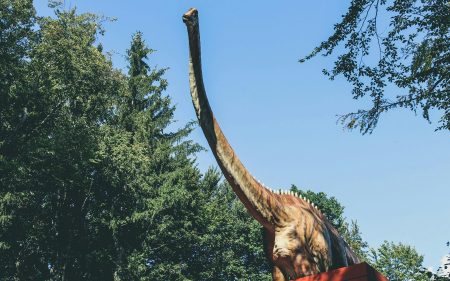
We all know dinosaurs were big. Huge. But even after seeing their fossilized skeletons in museums, it’s difficult to appreciate just how massive dinosaurs could get, because we simply have no remaining frame of reference.
Some of the largest sauropods (four-legged, long-necked dinosaurs like Diplodocus) could raise their heads roughly 60 feet above ground, according to modern estimates. The bones of a single leg of one of these behemoths can be as tall as an adult African elephant.
That’s still a little vague, so let’s try some numbers. Currently, the average animal in North America weighs about 20 pounds. According to some calculations, the average dinosaur weighed an estimated 9,500 pounds.
2. Dinosaurs Were Also Smaller Than You Think
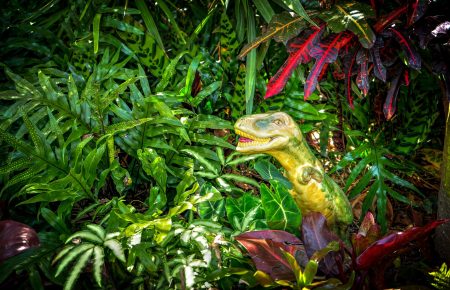
But not every dinosaur was a humongous giant. They could also (especially early on in their evolution) be very, very small.
The smallest known dinosaur that hasn’t been reclassified as a lizard is the Epidexipteryx. This small bird-like dino was about a foot long and weighed half a pound.
There were other tiny dinosaurs in this same family, such as the appropriately named Microraptor, which was about chicken-sized.
3. There Was Never an Aquatic Dinosaur
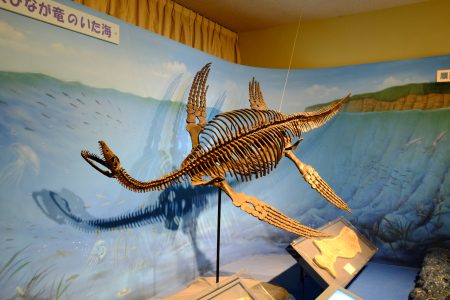
Many land-dwelling animals of today, from mammals to snakes and turtles, have relatives that have become fully aquatic, rarely if ever venturing on land. In comparison, it’s a bit weird that dinosaurs, who ruled the land for millions of years, never tried getting into water.
“But what about all the ancient reptilian sea monsters, like Plesiosaurus or Kronosaurus?” you ask. Well, those guys weren’t dinosaurs. Giant reptiles, sure, but an entirely different lineage.
Part of the reason might be that dinosaur bones were poorly suited for aquatic life, being mostly hollow and buoyant. Yet, that hasn’t stopped birds…
4. Most Famous Dinosaurs Never Met Each Other
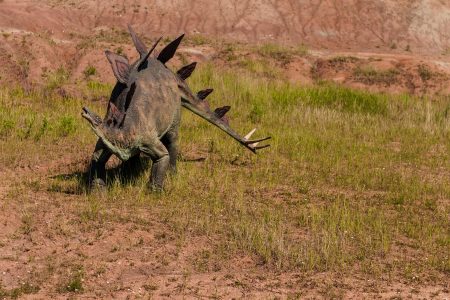
We like to think of the most famous dinosaurs living together at the same time, preying on each other and having epic battles. Sadly, though, most of the best-known dinosaurs never met each other.
Let’s look at Jurassic Park, for instance. The T. rex lived about 68-66 million years ago.
The movie’s second-biggest villain, the velociraptor, died out some 70 million years ago, leaving a two-million-year gap between it and the Rex. And if we look at Deinonychus (which is what the movie’s “velociraptors” really were), they died 100 million years ago—40 million years before the T. rex ever appeared.
But perhaps the best illustration of this is the Stegosaurus. This renowned dinosaur became extinct 145 million years ago. This means that you are closer in time to a T. rex than any T. rex was to a Stegosaurus.
5. Dinosaurs Shed Their Skin (and Had Dandruff)
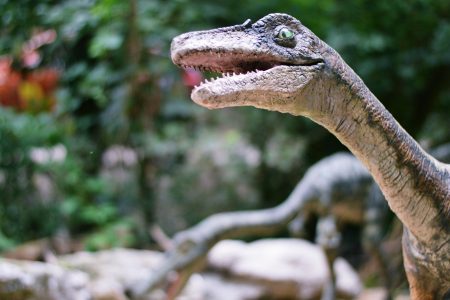
Like modern reptiles, dinosaurs shed their skin. However, they didn’t do it in one huge piece like snakes or reptiles.
Instead, they dropped their old skin off in small bits and pieces. We know this because we’ve found fossil evidence of dinosaur dandruff. That is, dead bits of skin still clinging to them.
Gross. Yet, many animals on Earth still shed their skins like this, like crocodiles and birds.
6. Most Dinosaurs Are Known Just from Bits and Pieces
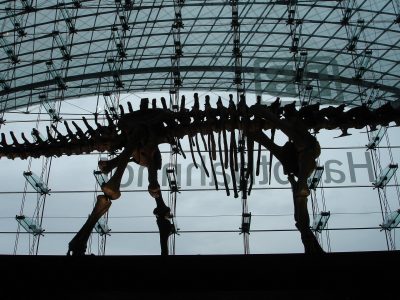
While we may see a lot of dinosaur skeletons put together, in the vast majority of cases, most of the skeleton is built on guesswork. For most dinosaurs, we’ve only ever found small bone fragments, or perhaps a single intact limb at most.
But how can they then reconstruct a skeleton with such limited evidence? Well, part of it is always guesstimating, but researchers can also make very educated guesses based on existing fossil records of related dinosaurs.
Additionally, it may help to look at living animals. Many birds, for instance, have assisted in rebuilding partial dino skeletons.
Sometimes, though, those guesses are very wrong. For an example, check out Deinocheirus in our list of 8 of the weirdest dinosaurs.
7. Dinosaurs Predate Flowers and Grass

Picture the world dinosaurs lived in. What does it look like? Did you imagine grass and flowers? Well, that’s where you’d be wrong.
Dinosaurs are so ancient that they existed for millions of years before flowers or grasses did. The first recognizable dinosaurs appeared in the late Triassic Period around 240 million years ago.
Flowers didn’t evolve until the early Cretaceous Period, some 140 million years back. Grass, meanwhile, appeared only in the mid-to-late Cretaceous, 100 million years ago.
8. We Know What a Dinosaur Brain Looked Like
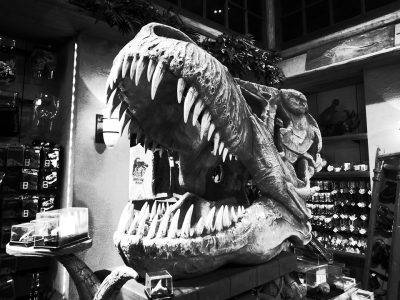
Their bones are the most famous parts of dinosaurs. But we also know what other parts of them looked like — such as (some of) their brains.
Granted, nobody’s ever found a fossilized dino brain, because brain matter simply doesn’t tend to fossilize. However, we’ve discovered very well-preserved skulls that still had the shape of the brain embedded inside them.
The brain may be gone, but its surroundings molded around it to preserve a cast of it. With that, researchers have been able to understand the structure of the brains of some dinosaurs, like the T. rex.
9. We Know What a Dinosaur Butthole Looks Like
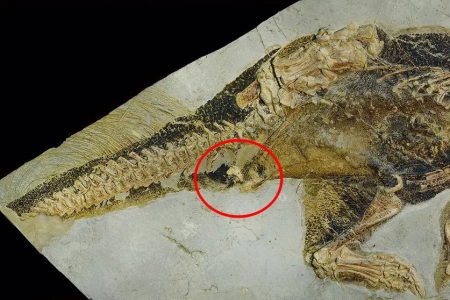
On top of their brains, we also know what a dinosaur butthole is like. Yes, really.
In 2020, scientists discovered the fossilized cloaca of a Psittacosaurus. If you don’t know what that is, a cloaca is a multi-purpose rear orifice used both for defecation and mating, also found on animals like birds.
Thanks to this incredible discovery, scientists have now been able to study dinosaur sex in greater detail than ever.
If you’d like to know more about the dinosaur butthole (and I know you do), read our story about it.
10. Dinosaurs Didn’t Go Extinct
It’s a commonly cited fact that all dinosaurs died in a meteor impact incident some 66 million years ago. But that’s not true.
Did you wonder why I kept bringing up birds earlier? That’s because dinosaurs didn’t go extinct. They still live all around the world — we just call them birds.
And no, it’s not that birds are distantly related to dinosaurs. They are dinosaurs, tracing a direct, unbroken line from those avian dinosaurs that survived the meteor.
In fact, in 2007, scientists were able to sequence a tiny bit of T. rex DNA, finding a specific strain of collagen protein. Guess what animal carries a virtually identical protein?
It’s the chicken. Dinosaurs may have changed a lot, but they’re still there.