
- Which legendary creature do you think a pygmy elephant would inspire?
Throughout human history, people have told tales of mythical monsters and legendary beasts. It’d be easy to dismiss most of these outlandish creatures as nothing but made-up stories.
However, many of these fantastic critters may be based on real-life animals. For instance, most people know the kraken of Norse myth likely stems from Viking encounters with giant squid
The connections between legendary monsters and actual critters aren’t always straightforward, though, since ancient folks tended to interpreted unfamiliar animals in wild and often wacky ways. Additionally, you may not even have heard of some monsters from other cultures that have more clear equivalents in reality.
Here are eight mythological beings — both familiar and strange — that may have been inspired by real-life animals.
1. Dragon
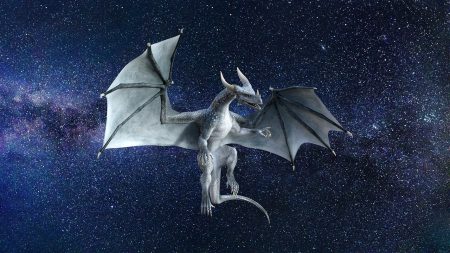
The depictions of dragons vary between Western and Eastern worlds, but some features between them are consistent. Dragons are nearly always large, reptilian creatures that have typically vanished from the mortal realm.
Can you think of an animal that fits that description to a tee? That’s right — dragons are probably dinosaurs.
It’s easy to see how a person accidentally unearthing a, say, T-Rex skull might conjure up the idea of a dragon. In fact, preserved documents from ancient China detail “dragon bones” that are pretty unmistakably dinosaur fossils.
The dragon myth also has a hefty dose of influence from good old snakes, too. But it’s hard not to think dinosaurs played their role as well.
2. Quugaarpak
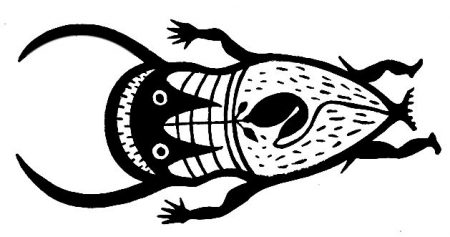
Not all fossils that can be misinterpreted are from dinosaurs, though. Allow us to introduce you to the quugaarpak, a strange beast from the folklore of the Alaskan Yupik peoples.
The quugaarpak is a massive, vaguely muskrat-shaped monster that burrows underground with its long ivory tusks. Accustomed to subterranean life, these creatures can’t breathe air and will die immediately if they accidentally poke their heads out of the ground.
Alaskan wilderness and large animals with tusks? You probably guessed where this is going. It’s likely the quugaarpak stems from an ancient Native American seeing a mammoth skull peeking out of the ground and having no idea what they’re looking at.
3. Sea Serpent
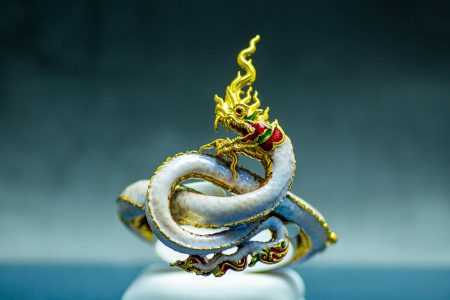
It might be tempting to write the various sea serpents from mythologies all around the world as sightings of some long-dead giant sea snake. Sea snakes do indeed exist, but it’s likely that the sea serpent has fishier origins.
Namely, the legend of the sea serpent may have started with the giant oarfish. Also called the king of herrings or ribbonfish, these slender, shimmering fish can grow to be more than 30 feet long.
Additionally, they swim with an undulating, squirming motion that resembles the slithering of a snake. As with all legendary monsters, there’s no hard proof of a connection, but the oarfish seems like a perfect candidate for the father of the sea serpent.
4. Cyclops
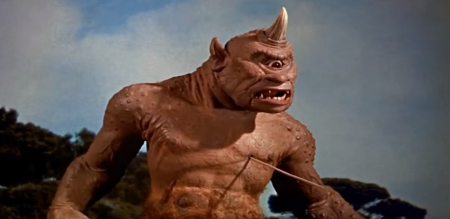
When thinking of the origins of the cyclops from Greek myth, you might first think that it’s based on some ancient, huge ape. Yet, everyone’s favorite monocular monstrosity is likely based on the skulls of extinct, short-tusked pygmy elephants that lived in Southern Europe.
You see, an elephant’s trunk has no bones in it. So, when an elephant dies and the flesh rots away, you’re left with a big skull with a giant round hole seemingly in the forehead.
Of course, that’s just the elephant’s nasal cavity. But most ancient Greeks had likely never seen an elephant, let alone one’s skull, so they likely interpreted the hole as a single, massive eye socket.
From there, it’s just a short leap of imagination to a fang-mouthed, huge monster with one eye.
5. Phoenix
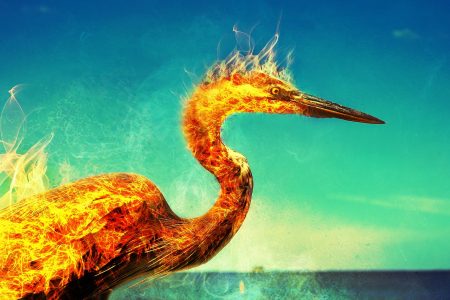
Most people are probably familiar with the eternal phoenix bird from Greek sources, but the phoenix myth actually originates in Ancient Egypt. And what do you know — there used to be birds living on the shores of the Nile that are ideal inspirations for the phoenix.
The phoenix is typically depicted as a large, slender bird with bright red or orange plumage. There used to be large red flamingoes and cranes (much bigger than their still-living relatives) in Egypt that could very well have turned into the phoenix.
As to the being reborn in fire, there’s a possible explanation for that too. Some researchers suggest that the relentless Egyptian sun may have caused heat rippling effects — like those rising from hot pavement — around bird nests, making them seem like they’re simmering with flame.
6. Pouakai
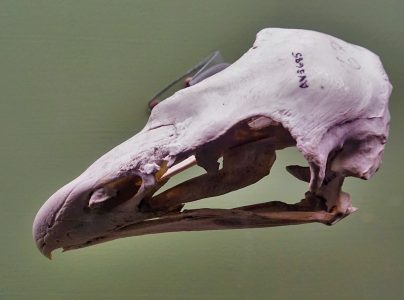
In the Maori mythology of New Zealand, the pouakai is an enormous carnivorous bird. It swoops down from the sky to slaughter livestock and children with an endless appetite.
The pouakai is unique among legendary monsters in that the stories about it are very likely true. When the first Maori arrived on New Zealand’s South Island, the area was inhabited by the Haast’s eagle.
This is the largest bird of prey to have ever lived, with an estimated weight of up to 40 pounds (super heavy for a bird), a nine-foot wingspan, and talons big enough to wrap around and crush a human skull. It could kill a moa — an ostrich-sized flightless bird — in one swoop, and it most certainly could kill a human too.
Ironically, though, the Haast’s eagle likely vanished after the Maori hunted the moa to extinction. Yet, the eagle’s monstrous child-eating legacy lived on in their stories
7. Bunyip
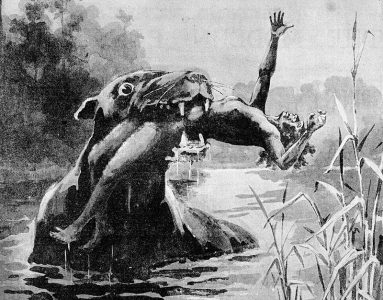
In the folklore of Australian aboriginals, the bunyip is a huge, semiaquatic, dog-faced, man-eating marsupial. It bounces out of the water to grab and devour anyone foolish enough to get too close.
Now, let us introduce you to the extinct Diprotodon. Its was six-foot tall, giant marsupial that often waded through bodies of water.
Here’s the kicker — the Diprotodon died off only 10,000 years after humans arrived in Australia. It’s quite likely chance encounters with the (fortunately vegetarian) Diprotodon spooked some folks enough that it transformed into the bunyip.
8. Ebu Gogo
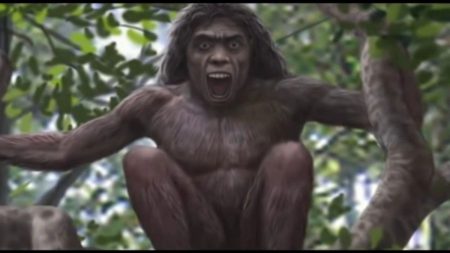
The Ebu Gogo are a strange, diminutive people from the mythology of the native peoples living on the island of Flores, Indonesia. They were supposedly small humans, but much hairier and with wide flat noses.
In 2003, an excavation of the Ling Bua Cave on Flores unearthed bizarre bones. They belonged to roughly three-foot-tall previously unknown species of archaic humans.
Today, we call these hominins Homo floresiensis. Reconstructions have depicted them as small human, but much hairier and with wide flat noses.
Sound familiar?
With all that said, it’s unlikely the first modern humans actually met H. floresiensis, since the small folk had been for thousands of years before the first known arrival of Homo sapiens on Flores. It’s more likely they saw their bones and came up with the Ebu Gogo as an explanation — or perhaps H. sapiens got to the island earlier than previously estimated.