
- Why is the hatter mad and who is the ‘Gibber’ in ‘gibberish?’
We all use plenty of traditional phrases and sayings. Often, they’re delightfully rustic, with their origins in everyday rural life or traditional tales.
For example, a “wild goose chase” must originate from someone trying to catch a goose. Right?
That’s where you’d be wrong.
Many sayings have strange origins and etymologies that seemingly have nothing to do with the actual saying. Here are 11 examples of common phrases and sayings whose origins might surprise you.
1. Wild Goose Chase

We already teased you about “wild goose chase,” so let’s spill the beans about it. It actually has to do with horses.
A wild goose chase was a type of horse race in late Medieval and Renaissance England. In the race, a lead rider would take off and ride in an erratic, challenging manner through an open field. The racers, then, had to ride behind the leader following his every unexpected move.
They started calling the race a “wild goose chase” because the riders would follow one another like geese flying in formation. We guess that means the phrase does kind of originate from geese, but with a twist of horse.
2. Spill the Beans

Well, we used the phrase “spill the beans” in the above entry so we might as well explain that too. This saying is as old as democracy, as its origins lie in ancient Greek elections.
One of the methods of voting was for voters to place differently colored beans in a jar. If somebody knocked the jar over and spilled the beans, they would reveal the current situation and ruin the election.
No pressure, Greek bean counters.
3. Mad as a Hatter

You might think the phrase “mad as a hatter” comes from the Mad Hatter of Alice in Wonderland fame. However, both the saying and the character are inspired by the frankly horrific working conditions of 17th and 18th-century hatmakers.
They would use mercury to process the felt they needed for the hat, without wearing any protection. Consequently, they would inevitably give themselves mercury poisoning, which causes tremors and wild mood fluctuation — essentially driving the hatter mad.
4. Cat’s Out of the Bag

Why was the cat in the bag in the first place? Well, that’s because of medieval market swindlers.
A dishonest vendor might show you, let’s say, a healthy and vigorous piglet. After you buy the animal, the vendor would then place it in a sack or a crate behind his counter. He would hand you the sack, sealed with his personal marque.
But once you got home and opened the sack, a completely different and (most importantly) less expensive animal would jump out. And so, the cat that the vendor sold you was out of the bag.
5. It’s Gibberish

In the 9th century, Abu Musa Jabir ibn ?ayyan was a famous Arabic philosopher, mathematician, magician, alchemist, and a whole lot more. When his work and writings were imported to Europe, however, people found ibn Hayyan name impossible to pronounce (so don’t feel bad if you couldn’t do it).
Consequently, he was given the moniker Gibber or Geber, based on his name Jabir. However, some readers still couldn’t understand his complex thoughts and theories, so they dubbed his whole literary output as “Gibberish.”
Perhaps ibn Hayyan should’ve expressed himself a bit more clearly.
6. Saved by the Bell

What is the bell that saves you in a tough situation? It’s not a church bell but the referee’s bell in a boxing match. The phrase likely originates from situations where a boxer was about to lose the bout, only for the final bell to ring and save them from defeat.
There’s also a more morbid theory positing that the saying stems from people being buried with strings attached to bells in their coffins. If it turned out that the buried person wasn’t quite as dead as they seemed, they could pull the string and the ringing bell would alert people to dig them back up.
That said, the boxing theory is the more likely origin story.
7. The Apple of Your Eye

Apples have nothing to do with eyes, at least according to modern scientific knowledge. Back in medieval England, however, it was believed that the pupil was an apple-shaped solid blob inside your eye.
This eye-apple was vital for your eyesight, so you’d better take good care of it. And if you started lavishing excess attention on someone or something else, people might compare the object of your affections to the apple of your eye.
8. Go the Whole Nine Yards

If you go the whole nine yards, you do something very thoroughly. The origins of this saying come from a humorous short story published in the 19th century.
To summarize, a local judge goes to a tailor and orders a new shirt for a gala that evening. The tailor asks his wife to make the shirt, while also mentioning that he has enough fabric for three shirts — nine yards in total. Due to a misunderstanding, the wife uses the whole nine yards of fabric on the judge’s shirt, forcing him to attend the part in a comically large shirt.
The phrase got a boost in popularity during World War II, when fighter pilots were given nine yard’s worth of ammunition belt for their planes’ machine guns. If the pilot returned having shot off the whole nine yards, you knew he’d given his all in the battle.
9. Cat Got Your Tongue
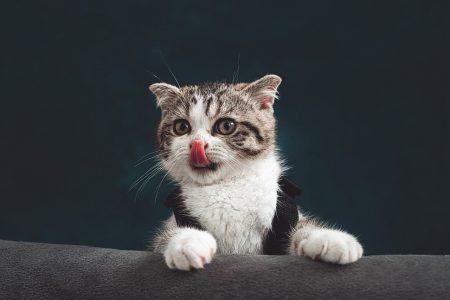
Unlike the cat in the bag, the feline in this saying isn’t an actual animal. Instead, the “cat” is the cat o’ nine tails, a vicious nine-tailed whip used to punish undisciplined sailors in the British navy.
So, let’s say a sailor got disobedient and talked back to his commanding officer. After the whipping, he would be in excruciating pain that would certainly motivate him to keep his mouth shut. Thus, the cat got his tongue.
10. Dead as a Doornail

We don’t know about you, but we’ve never seen a nail that was particularly animated or alive. Doornails, however, were intentionally rendered “dead” by Medieval carpenters.
The thing is, nails used to be expensive. Those on a door were often facing out in the street and an enterprising thief could theoretically pull them out and make a pretty penny selling them (or break into the house after the door fell apart).
To combat possible nail theft, carpenters used special, extra-long doornails that they hammered through the woodwork. They would then pound the protruding end of the nail flat sideways against the door so that it couldn’t be pulled out, thus creating a “dead doornail.”
11. Take It with a Pinch of Salt

These days, we take dubious stories with a pinch of salt so that we won’t believe just any hogwash. The phrase’s origins, however, lie in the account of the ancient Roman author Pliny the Elder.
He recorded that an even more ancient king would take small amounts of various poisons, mixed with a grain of salt, to render himself resistant to them. According to Pliny, the plan worked and the king became fully immune to common poisons.
That, however, backfired when his kingdom was conquered by Romans and the king tried to commit suicide by drinking poison to avoid a humiliating execution. Of course, the poison didn’t work, so he ended up having to stab himself to death.
The phrase’s meaning has changed a little since ancient times, but the spirit is still there — take questionable stories with a grain of salt to render yourself immune to their nefarious messages.