
- The pigs are blue, da-ba-dee, da-ba-die — and if you eat them, you might da-ba-die.
When a domestic pig gets on the loose and does the hanky-panky with a wild boar, you end up with a wild pig. Also called feral pigs, they live like wild animals, looking much like domestic pigs except with the coarse hair of a boar.
And they have blue flesh. At least if you’re in California.
Of course, that’s not natural, yet pigs that are blue on the inside keep cropping up in the Golden State. Are they aliens or what’s going on?
The answer’s much more mundane, both fortunately and unfortunately. The pigs have simply been exposed to rat poison.
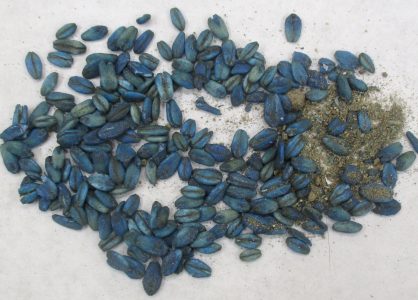
A popular rodenticide in the area uses a blue dye to make both the poison itself and exposed vermin easy to identify. Obviously, the wild pigs have gotten into food that they shouldn’t have and now carry the toxins in their meat.
Well, at least you’ll know immediately from the color if the pig on your plate is laden with poison — maybe. Not all pigs that eat the poison turn blue, so California authorities are now warning hunters and trappers not to eat their catch.
‘That’s Weird’
Dan Burton owns a wildlife and pest control company called Urban Trapping Wildlife Control. Located in Salinas, he has trapped hundreds upon hundreds of wild pigs over his career to then put them down according to state laws.
Even a man with his experience, however, was taken aback by his recent run-in with the blue-fleshed pigs.
An agricultural firm hired Burton and his company earlier this year to get rid of wild pigs that were damaging their crops. He got to work and soon had trapped and euthanized several pigs.
However, when he cut the animals open to inspect their meat, he was in for a surprise. The pigs were entirely blue on the inside.
“I’m not talking about a little blue. I’m talking about neon blue, blueberry blue,” he told the Los Angeles Times.
“I thought, OK, that’s weird,” he added, delivering one of the most significant understatements we’ve heard all year.
It Started with Squirrels
Burton is in the habit of donating the meat he harvests from caught pigs to low-income families. Of course, he didn’t feel safe letting anyone eat the blue meat.
So, he began investigating and trying to find what had put a stopped to his charity. Eventually, the trail of blue pigs led to bait stations set up to control mischievous squirrels.
“These pigs were seeking [the bait traps] out. I saw them trying to flip it over, breaking them, trying to get access to the poison,” Burton explained.
The poison in question is diphacinone, an anticoagulant that eventually kills its victims through an irregular heartbeat and internal or external bleeding. The toxin is typically dyed a bright blue to make it and exposed animals — like the pigs — easy to identify.
So, obviously, the pigs are getting to the rodenticide, but they don’t necessarily need to. They could also absorb the toxins by eating animals that in turn have eaten the poison, like dead squirrels, which is perfectly possible for omnivorous, scavenging pigs.
Now, diphacinone is designed to kill animals much smaller than pigs, so it doesn’t necessarily harm them. Indeed, Burton said the pigs he trapped were behaving perfectly normally before stepping into their doom.
Of course, it’s still not a good idea to eat the blue pigs, so their meat will now go to waste.
Official Warning
Nobody probably needs to tell you that eating neon blue pork isn’t a good idea. The dangerous thing about diphacinone, however, is that it doesn’t always turn the exposed animals blue.
It usually does, but not always.
As such, the California Department of Fish and Wildlife (CDFW) recently released an announcement warning trappers and hunters against consuming caught wild pigs. Even a seemingly innocuous pig could be loaded with toxins — as might other animals.
“Hunters should be aware that the meat of game animals, such as wild pig, deer, bear and geese, might be contaminated if that game animal has been exposed to rodenticides,” the CDFW wrote.
“Rodenticide exposure can be a concern for non-target wildlife in areas where applications occur in close proximity to wildlife habitat.”
Additionally, the CDFW encouraged farmers to apply rodenticides so that non-target animals can’t get to the poison. That might be easier said than done, considering how stubborn and strong wild pigs can be.