
- Shower yourself in radiation, buy your kid a blazing hot oven, and enjoy a nice loaf of nerve agents.
They just don’t make ‘em like they used to these days. In some cases, that’s a good thing.
Although you can still absolutely buy very dangerous products and gadgets today, we can all be grateful to have at least some level of safety regulations in place for most things. It was a very different story back in the day when people were still figuring out how to do this whole mass market thing.
As such, you used to be able to buy absolutely crazy stuff that could hurt, maim, or kill you in seconds over the counter.
Here are seven examples of incredibly dangerous products that you used to be able to buy anywhere.
1. Roman Blinds

We call them Roman blinds, but they’re really Roman shades. These kinds of window shades fold neatly on themselves, and can be a good choice for your windows if you like sleeping in total darkness.
As long as you don’t have kids.
Roman blinds with looping pull strings were popular for a moment in the 2000s, but people quickly figured out that they’re lethally dangerous for small children.
According to various studies, anywhere from five to 200 toddlers and children globally essentially hanged themselves by getting the string from Roman blinds caught around their necks. Consequently, most stores (at least in the U.S.) no longer carry cord-equipped Roman blinds.
2. Empire Little Lady Stove
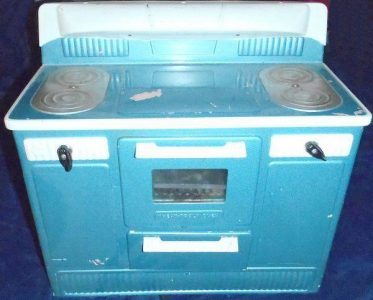
Are you familiar with Easy-Bake Ovens? These heating toy ovens, popular as they are, are somewhat notorious as kids can easily burn themselves on them (particularly with the older models).
But let us introduce you to the Empire-brand Little Lady Stove, a similar “toy” oven from the 1950s. This thing makes Easy-Bake ovens look incredibly safety conscious.
It’s all because the Little Lady Stove gets hot. You could crank these things up to 600 degrees.
To put that in context, most modern actual non-toy stoves shut themselves off if they reach 550 degrees. If you bought one of these for your child, not only would they burn the little cookies, but themselves and your house.
3. Agene-processed Flour

Today, artisan bread and sourdough are trendy. Back in the day, however, it was all about white bread — and the whiter, the better.
To that end, some flour producers started bleaching their flour to make it whiter than white. One bleaching agent they used was called agene.
If you’ve never heard of it, that could be because it was banned in 1949. You see, it had a little side effect of causing severe nerve damage, leading to people developing debilitating neurological disorders.
On top of that, agene is explosive. We couldn’t find any records of bread loaves blowing up, but we also didn’t find any record of it not happening.
4. Geyser Tricho System
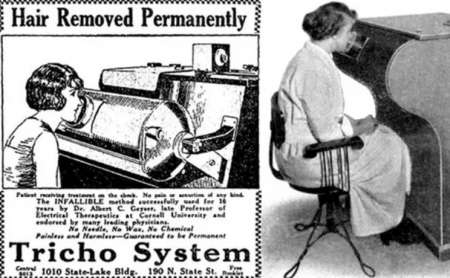
Shaving can be such a chore, right? If only there was some kind of wonderful machine that could render your bits permanently hairless.
Your prayers have been answered! In the early decades of the 20th century, Albert C. Geyser introduced his revolutionary Tricho System that would eliminate “excessive hair” to produce “faultless skin.”
And it did so by showering with X-rays.
To get perfectly smooth skin, you needed 20 X-ray treatments. Surprise, surprise, women who underwent the treatment quickly found themselves developing sores, tumors, and cancer in the treated areas.
In the end, Mr. Geyser kind of got his comeuppance. Before the end of his life, he needed to have both of his hands amputated after developing violent cancer from his X-ray experiments.
5. Gilbert Science Kits
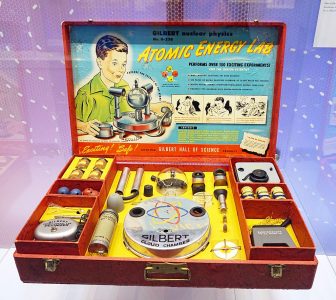
In the 1950s, the A.C. Gilbert company decided that kids should get into the sciences. To this end, the company produced several science kits to cultivate future brainiacs.
The problem was that it was the ‘50s. That meant that kids got to play with all the big-boy science stuff without any safety rails.
For instance, the Gilbert U-238 Atomic Energy Laboratory kit was… Well, pretty much what it says on the label. It contained a whole bunch of fun things for Little Billy and Lisa — like four jars of uranium and radiation sources for alpha, beta, and gamma radiation.
Okay, okay, maybe your kid shouldn’t become a nuclear scientist. Instead, you decide to buy them the Gilbert Chemical Magic kit to inspire them to explore chemistry.
The kit included a sizeable vial of sodium cyanide. Have fun, kids!
6. Samsung Galaxy Note 7

This entry might confuse you — perhaps you even owned a Samsung Galaxy Note 7. Actually, if you did own one, you definitely wouldn’t be confused.
That’s because the things tended to explode.
A massive screw-up in the design of the phone’s batteries caused their connectors to bend very easily. The faulty connectors risked overheating the battery, causing it to either burst into flames or burst apart in a violent explosion.
Airlines and government offices soon banned people from carrying the Galaxy Note 7, and Samsung was forced to recall and remotely disable all of the phones. The result was one of the biggest product failures in history.
7. Meth
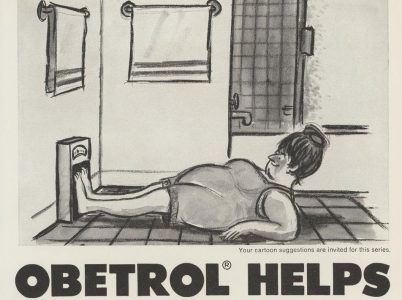
In the 1950s and ‘60s (which seems to be golden age of horrible products) a new weight loss drug called Obetrol was sweeping the nation. It was very effective, as it virtually eliminated feelings of hunger and significantly boosted your energy levels.
No wonder. It was meth.
We don’t mean that meth was one of the ingredients — it was the only ingredient. Obitrol was nothing but a cocktail of four different methamphetamine salts.
We probably don’t need to tell you why Obitrol use backfired on a massive scale. After all, it turned a large swath of the population into meth addicts.
Fun fact, Obitrol was the legendary artist Andy Warhol’s favorite mind-altering substance. Wonder if he’d been so into it if they’d called it… You know, meth.