
- It’s somehow heartwarming to know that this creature wasn’t lonely.
Life originated in Earth’s oceans some 4 billion years ago, but it took a hot minute for it to crawl onto dry land. The first creatures started flopping around on land some 400 million years ago, and they didn’t start truly walking until some 318 million years ago.
Or that’s what the general understanding has been so far. However, it turns out things have been walking on land for a good bit longer than that.
We know that because they found their footprints.
These oldest known footprints belong to a roughly two-foot-long reptile-like critter. Researchers know this was a true land-dweller because of various features in the footprints.
What’s more, the footprints were made by two of the animals, running about after a brief rain shower fell. It’s pretty jaw-dropping how much a chunk of ancient stone can reveal.
Changing Assumptions
Until the discovery of these new tracks, the common consensus in the scientific circles was that animals started living on land full-time some 320 million years ago. This idea was backed up by the fossil record and the previously oldest known footprints.
These tracks were left by some reptilian creature around 318 million years ago.
That said, life had come on land much, much earlier, somewhere around 400 million years ago. However, most animals still had to return to water to breed and keep their skins moist.
For example, there are footprints from 390 million years ago, but they belonged to creatures that hadn’t developed real feet and legs yet. Really, it might be more accurate to call them fin prints instead.
At that point, the only things crawling around on land on a permanent basis were insects and arthropods. For instance, cockroaches have been around for about as long as things have lived on land (and they still look pretty much the same as they did back then).
This entire timeline, however, went out the window recently. It’s all because of Australia.
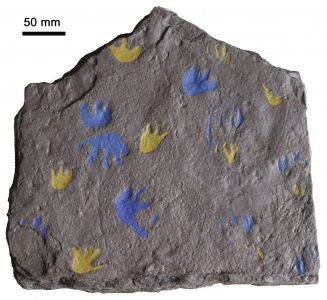
In the land down undah, they discovered a slab of sandstone that’s quickly changing our understanding of when animals started walking around. This piece of stone bears the oldest known footprints of a true land-dwelling animal.
And they date to at least 350 million years ago — a good 32 million years earlier than the previous record holder.
Who Left the Tracks?
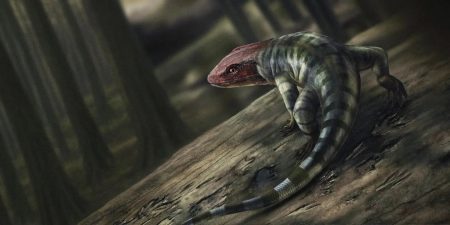
Sadly, we don’t know what this ancient resident of dry land looked like. Just kidding. It’s amazing what they can tell from a few footprints.
According to recent research published in the journal Nature, the creator of these tracks was a reptile-like animal. It wasn’t a true reptile like they exist today, but an earlier lifeform that may have eventually evolved into actual reptiles.
That said, it may have already resembled some modern reptiles.
Based on the size of the footprints, which are around two inches wide, researchers believe the animal may have been about 2.5 feet long. Taking into account its gait recorded in the tracks, it may have looked something like today’s monitor lizards.
Perhaps more importantly, however, the footprints contain one crucial clue that reveals this lizard-ish being lived permanently on land. It had claws.
“This is the earliest evidence we’ve ever seen of an animal with claws,” Stuart Sumida, a paleontologist from California State University, told the Associated Press.
According to researchers, the creature’s long toes and sharp claws are dead giveaways that it had transitioned to a fully terrestrial life. Earlier vertebrates that made forays to dry land, like some fish and amphibians, don’t have claws because they simply don’t need them in water.
Land-dwelling animals, however, developed claws because they’re just plain useful. They give you traction on slippery ground, help you hang onto stuff if gravity tries to pull you down, and you can catch prey with them.
So, one of the earliest land animals was a two-foot-long lizard-like critter with claws. Even without a preserved skeleton, you can pretty much picture this animal in your mind’s eye.
I’m Running in the Rain
The footprints, however, tell us more than just what this animal looked like. They also reveal things about the environment it lived in — and that it had company.
For instance, they show us that it rained on the day the footprints were created. That’s not surprising, as at the time Australia was a hot and wet part of the supercontinent known as Gondwana.
One of the reptile-like creatures walked across this patch of ground before it began to rain. Researchers can tell this because preserved splashes from the raindrop have partially obscured this first set of prints.
Soon after the shower passed and before the ground dried up, two more of these creatures ran in the opposite direction. This is clear because these prints are trodden deeper into the rain-softened soil, leaving sharper tracks.
Was it the same primitive lizard that returned the way it came after making a friend? We’ll probably never know for, but just being able to ask ourselves that is perhaps the most mind-blowing thing about discoveries such as this.
Today, 350 million years later, we can wonder what two of the very first animals living on land were doing together on this rainy day. That’s nothing short of incredible.