
- What would you want to do with a tail if you had one?
We humans (and our ape relatives) are somewhat of an outlier in the animal kingdom in that we have no tails. Although we’re not by any means the only tail-less creatures, many animals do sport a tail.
And if an animal has a tail, it must have some purpose. In many, if not most, cases, the tail serves to balance its owner or helps it grab onto things.
Some animals, however, have learned or evolved to use their tails in much more outlandish ways. Occasional, their entire tail has transformed into a specialized, bizarre-looking tool.
Here are eight tales of animals who use their tails in some weird and wild ways.
1) Weaponry
Some animals’ tails are obviously meant to serve as a weapon. Perhaps the most obvious of them is the scorpion (although their tails aren’t “true” tails, just basically elongated sections of their abdomens).
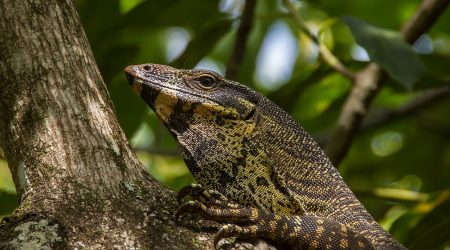
Yet, there are other animals, too, that can surprise you with a quick lash of their tails. For instance, monitor lizards and iguanas alike are quick to turn their long, muscular tails into a whip when necessary.
And then we have the thresher shark, whose name is incredibly appropriate. To catch prey, the shark swims into a school of smaller fish and begins whipping its slender tail fin back and forth. The strikes of the fin stun the smaller fish, leaving them helpless as the hungry shark chows down.
2) Additional Leg
For many beasts, their tails are essentially an additional limb. Yet, there are critters that take this whole concept to another level.
Take the aforementioned monitor lizards, for instance. Before they give you a tail slap, they might assume their threat position to scare you off. The lizard rises to its hind legs and props itself up with its tails to appear taller while hissing menacingly.
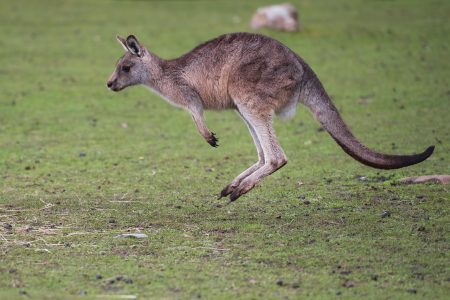
Kangaroos, however, actually use their tails like a real leg. During normal movement, the kangaroo’s tail serves to balance it. But if it feels the need for speed, the kangaroo can jam its tail to the ground to take off with additional acceleration.
3) Blanket
Perhaps the most adorable way for an animal to use its tail is as a blanket. Many fluffy-tailed critters cuddle up in their tails, with squirrels as the most famous example.
Now, squirrels use their tails for much more than that, from balancing to communication. But when it’s time to snooze, you can bet the squirrel tucks itself into its warm tail.
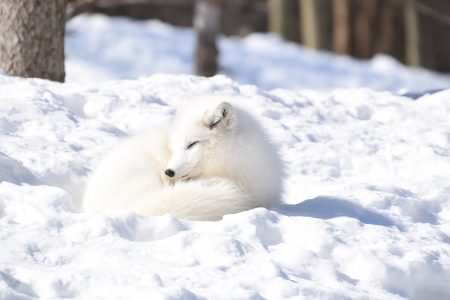
The same goes for the arctic fox. The nights of the far north are frigid, but these bushy-tailed foxes stay warm by burrowing into the snow and curling their tails around themselves.
4) Bat Distraction

The life of an adult luna moth is counted in days. As such, every second is precious to the pretty bug, and it can’t waste its precious moments by getting eaten by bats.
So, they’ve evolved a way to distract their nighttime predators with their fluttery pair of tails. Their movement throws off bats’ echolocation, making them think the moth’s body is actually at the tip of the tails.
When the bat strikes, it ends up with nothing but a mouthful of elongated wing tips. That might smart a bit, but the moth is more than ready to sacrifice its tails for a chance to make some babies.
5) Safety Line
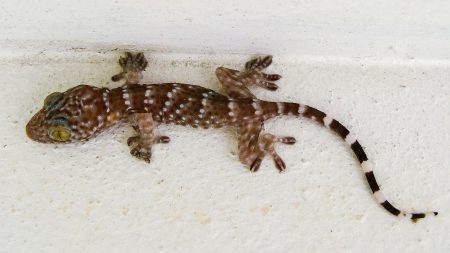
Geckos are incredibly adept climbers, easily scaling vertical trees and walls. Sometimes, however, even these master climbers’ suction-cupped toes slip.
Not to worry, though. A falling gecko will instantly slap its tail against the climbing surface. In most cases, this will slow down its fall enough for the gecko to get a fresh grip on the wall.
Even if the tail brake fails, though, the gecko isn’t in trouble. It will use its tail as a rudder to turn itself around in the air, making sure the little lizard lands on its feet.
6) Bird Bait
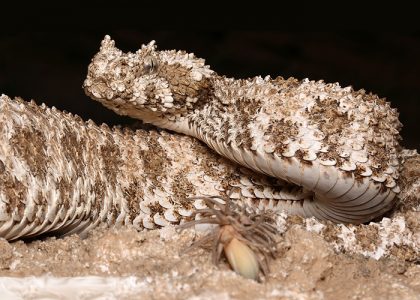
The spider-tailed horned viper is a rare snake from the arid border region between Iran and Iraq. It has one of the most bizarre tails of any animal, which helps it catch prey.
The tip of this snake’s tail has evolved to resemble a spider (albeit one drawn by a two-year-old). The tail has a bulbous central mass with multiple fleshy “legs” sticking out of it.
Yet, it’s spider-like enough to fool bug-eating birds, mammals, and reptiles. The hungry snake lies in wait with its tail exposed, ready to pounce on a hapless victim taken in by the trick.
7) Infrasound Emitter
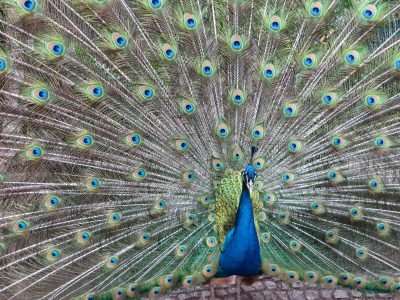
We all know peacocks use their flashy tails to woo peahens. If you’re anything like us, you probably thought it’s all about the looks — the most colorful tail gets the most tail.
Yet, that’s not how it goes. Instead, peacocks’ tails are also about sound.
Male peacocks flutter their extended tail feathers to produce ultrasound vibrations that are beyond human hearing. Peahens can hear them, though, and they like what they hear.
It all makes sense if you consider the peafowl’s natural habitat in tall grasslands. You can’t really see the tails for the grass, but you can certainly hear it.
8) Kindergarten
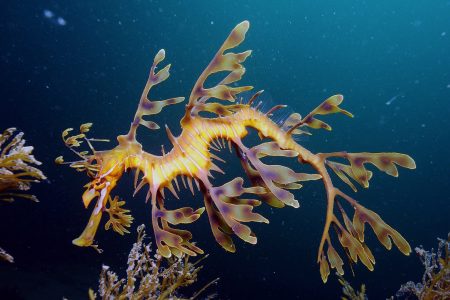
The leafy seadragon is a seahorse-like fish living in Australian waters. And this funky-looking creature doesn’t believe in your so-called “traditional gender roles.”
Instead of the female, it’s the male seadragon that takes care of the couple’s offspring. The female sticks around just long enough to perform some “wham, bam, thank you, sir” and lay its eggs — onto the male’s tail.
The male seadragon gently carries the egg cluster for nine weeks until the babies are ripe. He will then help the little guys break free of their eggs by carefully shaking his tail or rubbing it against soft seaweed.