
- Would you have what it takes to be the best at doing nothing?
If you engage in a competition, it usually involves doing something. You’re trying to find out who’s the best at running, lifting heavy objects, building a house of cards, or screeching like a seagull.
But not at the Tokyo Space-Out Competition. This is a contest to determine who’s the best at doing nothing at all.
At the contest, arranged for the second time this year, dozens of competitors gathered to stare vacantly into the distance. Yet, although spacing out sounds easy, it’s everything but.
The judges will deduct points for every movement the slackers take. Furthermore, the point of the competition is to daydream, not dream — falling asleep will get you instantly disqualified.
Who would’ve thought a contest about doing nothing would be so cutthroat?
Strict Rules About Nothing
The Tokyo Bouttosuru Competition, anglicized as the Tokyo Space-Out Competition, was the second iteration of the contest. However, space-out competitions have a surprisingly long history in Asia, with the first one taking place in Seoul, South Korea, in 2014.
With ten years of experience under their belts, the organizers and judges can enforce the competition’s rules effectively. And for a contest about doing nothing, the rules are very strict.
Then again, they should. If you’re meant to do nothing, doing anything should earn you a strike.
The competitors must space out, but that doesn’t mean they can just lie down and close their eyes. They must appear as if they started daydreaming while doing something else, so their eyes must stay open.
For the 90 minutes that the competition lasts, they aren’t allowed to talk or even move around to get more comfortable. The judging is done on soccer logic, and even the slightest movement can earn you a yellow card.
Repeat offenders will receive a red card and be disqualified from the contest. Yet, the greatest offense is falling asleep, which will get you thrown out immediately.
Sound tough? Well, wait until you hear about the heart rate monitors.
That’s right — every 15 minutes, the judges will check the competitors’ heart rates. If their heart is beating too fast, that’s a disqualification.
We’d imagine that’s partly to make sure nobody has fallen into a coma or something. But, at the same time, when your entire body is supposed to be doing nothing, that includes your heart.
Entertaining Idleness
That’s a whole bunch of rules, but the judges aren’t the only ones judging the competition. The audience has their say as well, but they’re not rewarding the contestants just for staying still.
No, the public wants to be entertained. To that end, the spacers-out are allowed to use outfits and props to put on a little show of doing nothing.
And there was quite a variety of props and costumes on display among this year’s 90 contestants, representing 60 teams. If that sounds like a lot of people, it’s nothing compared to the number of applicants — in total, the organizers received 528 applications for participation.
Some of the teams were laying partially on top of each other. One person was dressed in a business suit and zoned out with a laptop sitting idly on his legs.
You can’t help but wonder if he was living out his regular workday.
Other competitors got very creative. One woman held an ice cream stick in her hand, allowing the melting treat to slowly drip down her arm over the one-and-half-hour competition.
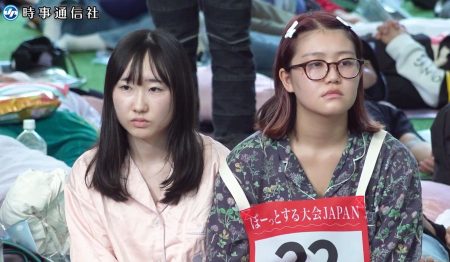
But you don’t necessarily need to get fancy. This year’s winners were a female duo, who had donned their pajamas and sat leaning lightly against each other.
As their prize, they won a trip to Japan’s south-central Mie prefecture, known for its beautiful and relaxing seaside resorts.
That’s a pretty good reward for doing nothing. Then again, your talent deserves recognition — even if that talent is sitting and staring at nothing.