
- You wouldn’t expect cats to be a problem for crocodiles, yet here we are.
When it comes to the food chain, you can’t climb much higher up on the ladder than a crocodile. Aside from the occasional human hunter, adult crocodiles simply have no natural predators.
Recently, however, crocodilians seem to be in a lot of trouble. When it’s not an emotional support alligator getting stolen, then crocodiles are getting eaten.
By cats.
For the past couple of years, something has been devouring dozens upon dozens of baby Cuban crocodiles. That’s bad news for the species, as Cuban crocodiles are critically endangered.
Recent research and observations have revealed that local feral cats are behind the attacks. While adult crocodiles are virtually impervious to cat claws, their young make for much more manageable prey for the felines.
Now, biologists both in Cuba and elsewhere are trying to devise methods to prevent the cats from slaughtering baby crocodiles. Yet, it’s still unclear whether simple neutering will suffice, or if the feral cats will have to be unceremoniously wiped out to save the crocodiles.
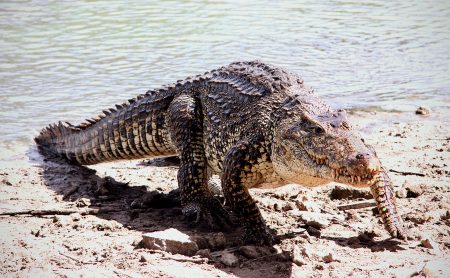
What’s a Croc?
The Cuban crocodile is a critically endangered species of crocodile that’s found only in the Zapata Swap and Isla de la Juventud in Cuba. There are currently only about 3,000 individuals remaining in the wild.
What makes the Cuban crocodile a big deal is that it’s quite unique among its relatives. It’s a rather small crocodile, meaning it grows to be only around 7.5 feet long and weighs less than 200 pounds on average.
Basically pocket-sized.
Despite its (relatively) small size, Cuban crocodiles are kind of psycho. They’re one of the most territorial beasts of their kind, which — combined with their natural curiosity — makes them very aggressive.
They essentially see you and go: “How dare you look interesting? Time to die!”
Another distinguishing feature is the crocodiles’ long legs, which make them relatively nimble and agile out of water. Finally, Cuban crocodiles are very intelligent, and captive individuals have even learned to do tricks.
It’s those captive individuals that are relevant to this story. Several farms in Cuba are breeding the crocodiles to help them boost their numbers and avoid extinction.
Incriminating Evidence
Over the past few years, however, Cuba’s crocodile farms have struggled with a mystery killer. Something, or someone, has been eating baby Cuban crocodiles in droves.
For example, just between October and November 2022, the perpetrators killed 145 crocodiles aged four months and younger at the Zapata Swamp Crocodile Breeding Farm. At such a young age, even apex predators like crocodiles are vulnerable and they have a high mortality rate even in the wild.
But the crocodile farm was supposed to be a safe place. So, what’s killing the crocs?
It’s feral cats, according to a new analysis.
Some signs of cats’ presence in the crocodile enclosures include tufts of fur and unusual scratching marks. Surveillance cameras have also caught one cat entering the pens.
Yet, the most damning evidence is the time the farm staff caught the cats red-handed (quite literally). Noticing a bunch of cats eating something, they went to investigate and found the torn-apart remains of several crocodiles.
“We did not get evidence of other predators present in these enclosures,” concluded Etiam Pérez-Fleitas, a biologist affiliated with the Zapata crocodile farm, to LiveScience.
Mitigating the Problem
Feral cats being a danger to local wildlife is in itself nothing new. In fact, kitties — both feral and escaped domestic ones — are ranked 38th out of the 100 most dangerous invasive species, given that they’ll readily slaughter millions of birds, rodents, and other critters.
Yet, so far no one had ever heard of them being a problem for something like crocodiles.
“I would say this is the first time that I’m aware of that there is a suggestion that feral cats might be a problem for crocodilians,” George Amato, a Cuban crocodile expert from the American Museum of Natural History, said.
What, then, can be done about the cats? Well, that depends on how many cats there are.
Pérez-Fleitas said that he and his team are monitoring both the farm and areas where wild crocodiles live to determine the size of the feral cat populations. If they’re small enough, it may be enough to catch and spay male cats, and they will disappear soon enough.
But if there are more cats, well…
“In places where populations were abundant, unfortunately our recommendation will be to use lethal methods to reduce their effective size and then sterilize,” admitted Pérez-Fleitas.
Choose the cats or crocodiles — either way, someone’s going to die.