
- What a cute solution to help cute little critters.
Helping our animal friends can be done in many different ways. Some of them are pretty darn cute.
Take the dormice of England, for instance. These cute little furballs are struggling due to a bout of tree infections in the European country.
The types of trees the dormice prefer to live in have been hit by a highly infection fungal disease. To prevent the fungus from spreading, the forestry department has had to chop down the trees.
However, this solution has left the dormice unable to move around. They don’t want to come down to the ground since there’s a high chance they’ll get eaten, but they also can’t move to another tree because they’re now spaced too far apart.
So, Forestry England came up with a solution. They’ve installed adorable little rope bridges in the Forest of Dean that dormice can safely travel along.
Cute and effective, how about that?
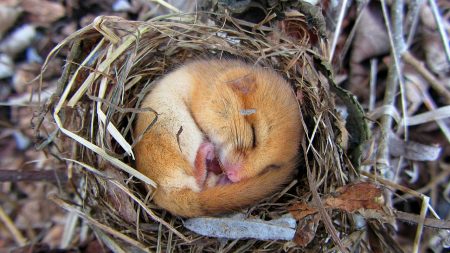
Sleepy Furballs
What’s that we hear from the back row? You’ve never heard of a dormouse?
Well, you’ve been missing out. Dormice are ridiculously cute.
There are many dormouse species spread across Africa, Asia, and Europe. In England’s case, the most common species is the hazel dormouse.
These light brown rodents grow to be about four inches long (six if you add the tail). As their name implies, they love to feast on hazelnuts and other nuts.
For roughly six months of the year, dormice hibernate in their concealed nests. But once spring comes around, they wake up and climb to the trees to find food and be out of most of their predators’ reach.
“Dormice do not like to come to the ground except for hibernation. They feel vulnerable to predators when on the ground,” ecologist Kate Wollen from Forestry England told the BBC.
In the ancient Forest of Dean western England, the dormice seem to like the local ash trees. And that’s part of the problem.
Fungus Among Us
The ash trees of the Forest of Dean are sick. They’ve been hit by a fungal infection that’s virtually a death sentence for any diseased tree.
“The fungus blocks the tree’s water transport system, causing leaf loss, and lesions in the wood and on the bark,” Forestry England explained.
Without water, the tree is not exactly going to thrive. Even if it doesn’t die off completely, the lack of water dries up the wood and turns the tree’s branches fragile and brittle.
“If left untreated, trees can potentially collapse, presenting an immediate danger to the surrounding area,” said Forestry England.
Add to that the fungus’ high transmission rates and you have an issue. Sadly, there’s no other real solution than chopping down infected trees — which is what the UK’s forestry management has been doing.
Felling the trees has in turn had unintended consequences for the forest’s dormice. With the loss of so many ash trees, the remaining ones are now so far apart that the dormice can’t make their way safely from one tree to another.
There no longer are interlocked branches for them to travel along and they don’t want to descend to the ground where something would likely eat them. So, they’re stranded in the trees with no food.
That’s not ideal.
Build a Bridge and They Will Come (Hopefully)
Forestry England, not wanting to leave the poor little dormice in trouble, began thinking of ways to help them. In the end, the solution was pretty obvious.
If the trees are now too far apart, the dormice need a bridge.
And a bridge is what they got. Two, in fact — Forestry England has set up two simple rope bridges for the dormice.
Each bridge is roughly 65 feet long and made up of a sturdy and durable rope lattice. At the height of 16 feet, they span the now-empty gap between ash tree batches.
It wasn’t enough to put up the bridges, though. Forestry England wanted to know whether the dormice would actually dare (or understand) to use them.
To that end, they plan to set up trail cameras at the bridges. The cameras haven’t gone up quite yet, since the dormice are only starting to come out of their annual torpor.
Once they install the cameras, though, Forestry England hopes to spot plenty of small fuzzballs traversing the bridges.
“We hope the bridges will complement this work and that dormice will do well. We’ve never tried this before and it is exciting to see what will happen,” said Leoni Dawson, a volunteer who helped set up the cute little bridges.