
- It’s gotten so bad, the states are calling their residents to arms
How’re you enjoying your coronavirus quarantine? Everything going well? Would you like another layer of quarantine on top of it?
No? Well, if you’re currently in a number of states on the US east coast, we have bad news for you. You may already be living under double quarantine and not even know it.
Several counties across New Jersey, New York, and Pennsylvania are under quarantine not only because of the COVID-19 bug. There’s another bug spreading at an alarming pace, and this one is an actual insect.
The spotted lanternfly is a species native to eastern Asia, including China, South Korea, and Vietnam. Outside of its native countries, it is considered a dangerous invasive species.
While they are harmless to humans and animals, they’re capable of feeding on more than 70 plants. Among them are important agricultural crops, including apple trees, grape vines, and hops.
According to the New Jersey Department of Agriculture, 26 counties in Pennsylvania have been put under quarantine ever since the bug was first sighted in the US in 2014. In New Jersey, eight counties are under lockdown as well.
Luckily, these quarantines don’t stop people from moving around. Instead they prohibit the movement of certain agricultural items, like logs and landscaping waste.
You Give Bugs a Bad Name
If you’ve never even heard of the spotted lanternfly, you’re probably not an East Coast farmer. And if you are, then oh boy, you’ve been living under a rock.
But for those of us who don’t farm, a quick crash course. The spotted lanternfly is actually not a fly but a planthopper.
What’s a planthopper, you ask? It’s a kind of bug that lives on plants and likes to hop around. Such creative naming.
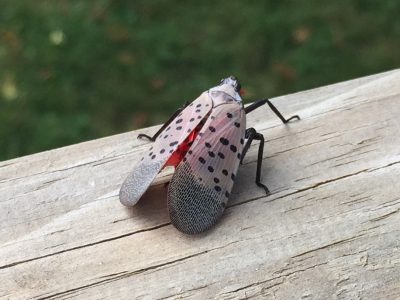
Anyhow, the bug in question is reddish-pink in color, with black spots on its wings. Man, they really don’t put any effort into these name, do they?
Anyhow, the Pennsylvania Department of Agriculture says the lanternfly feeds on tree sap and can cause a number of plant ailments. Among them are leaking sap, wilting, leaf curling, and tree dieback.
Dieback is when a tree slowly but surely drops dead, starting from the tips of the branches and progressing towards the trunk.
The bugs are also prolific breeders. Each female will lay 30-50 eggs. Even when most of the offspring would die, their numbers will basically grow tenfold after each breeding cycle.
“In counties infested and quarantined for spotted lanternfly, residents report hundreds of these bad bugs that affect their quality of life and ability to enjoy the outdoors during the spring and summer months,” said the Pennsylvania DOA. “Spotted lanternflies will cover trees, swarm in the air, and their honeydew can coat decks and play equipment.”
‘Kill it!’
So, to battle the bugs, the agriculture departments of the affected states are requesting help not only from farmers, but from everyone. And the more violent the help, the better, they seem to think.
“Kill it!” said the Pennsylvania DOA. “Squash it, smash it… Just get rid of it. These are called bad bugs for a reason, don’t let them take over your county next.”
Sheesh. Then again, it’s nice to for once have a clear idea about how you can make a difference as a citizen.
The New Jersey DOA was a bit more diplomatic in its call to action, but the message is still pretty much the same.
“We have been working diligently to slow the advance of this bug,” said NJ DOA Secretary Douglas Fisher.
“We are targeting areas where severe infestations have been confirmed, and we also encourage residents to destroy the spotted lanternfly if possible when they see it. It will take a combined effort to help keep this pest from spreading.”
New Jersey authorities are also asking residents to check their vehicles if they’ve been traveling in the affected counties. Apparently, the lanternflies are lazy and like hitching rides on cars and trucks.
“Its ability to travel easily on any mode of transportation has allowed it to spread. We are asking residents to do their part by eliminating this bug whenever possible,” said NJDA Plant Industry Division Director Joe Zoltowski.
Pick Up the Arms
Do you live in one of the infested states and want to be like a Starship Trooper and do your part in the fight against the bugs? There’s a number of options available for you.
But first, a disclaimer. Please, please don’t start messing around with pesticides if you don’t know what you’re doing. You could easily kill useful insects or even bigger animals, not to talk about the dangers these poisons can pose to you.
If you spot lanternflies on your property and want to get rid of them, contact your local agricultural department. With that said, should you have the knowhow needed for pesticide use, the New Jersey DOA has a list of recommended pesticides.
The bugs lay their eggs in early to mid-September. If you find any egg masses, that’s your chance to shine as a citizen.
“The gray-looking egg masses can be scraped off, double bagged and then thrown away. The egg masses can also be placed into alcohol, bleach, or hand sanitizer to kill them,” the New Jersey DOA said.
They even have a handy instructional video available. This is even arguably the more effective approach as you’ll be preventing the next generation of the bugs from ever becoming a threat.
Have you seen spotted lanternflies on your property? Ever dealt with another kind of a bug invasion? Tell us your story in the comments!