
- From frozen deserts to pits of boiling acid, you will find something living in there.
In the immortal words of Jeff Goldblum: “Life finds a way.” Even in the most horrible, utterly inhospitable corners of Earth, there is usually life.
And when we say inhospitable, we mean it. There are places on this planet where life simply shouldn’t exist — yet it does.
Here are eight examples of places where life thrives, despite having practically nothing to support it.
1. Clean Rooms
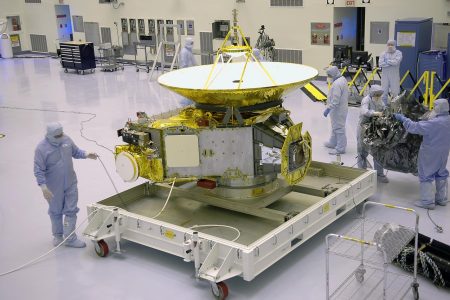
A clean room is supposed to be clean — it’s right there on the label. Clean rooms are spaces designed to be so sterile that no microbes could possibly live.
They’re used for many purposes, from repairing sensitive technology to treating patients in hospitals. NASA, for example, uses clean rooms to prepare its space probes to make sure they don’t accidentally launch terrestrial organisms into space.
That said, making something completely sterile is a tall order. There are plenty of microbes that thrive even in the cleanest of rooms; they’ve even fooled NASA into thinking a poor bacterium stuck to a space probe was alien life.
2. Mariana Trench
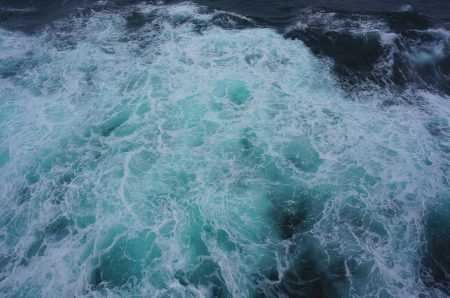
With a depth of 35,814 feet, the Mariana Trench is as deep as you can go on Earth without digging underground. That said, the trench is at the bottom of the Pacific, and at those depths, life becomes a bit difficult.
There’s no light and the surrounding water pushes down on you at a pressure more than 1,000 times greater than sea level air pressure. That’s enough to start warping proteins, so there couldn’t possibly be anything living down there.
Yet, the Mariana Trench is practically teeming with life, only a very small kind. Scientists have discovered amoebas and oil-eating bacteria, among other things, in the Mariana Trench.
3. Deep Sea Vents
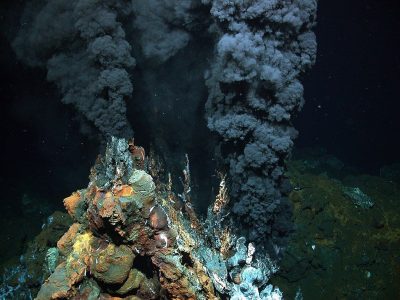

Okay, so extreme pressure and lack of light aren’t enough to stop life. But what if we add ridiculous heat and toxic minerals to it?
That’s what you find at undersea hydrothermal vents. With a direct connection to Earth’s molten core, these holes belch gases and minerals while boiling the water around them.
Unlike you might think, though, that just makes the vents a better place to live than the Mariana Trench. Hydrothermal vents support entire ecosystems with fascinating creatures, such as snails with iron shells.
4. Boiling Tar
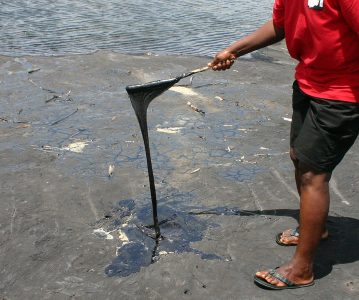

Pitch Lake in Trinidad is the world’s largest natural deposit of asphalt. It’s about 250 feet deep and boiling hot.
We would’ve put it on our list of the most terrifying lakes, but it didn’t make the cut because Pitch Lake has no water. It’s essentially a massive cauldron of scalding tar.
And every ounce of the black sludge contains millions upon millions of microbes that are having a grand old time in their nightmarish environment.
5. Ultra-Salty, Zero-Oxygen Sludge
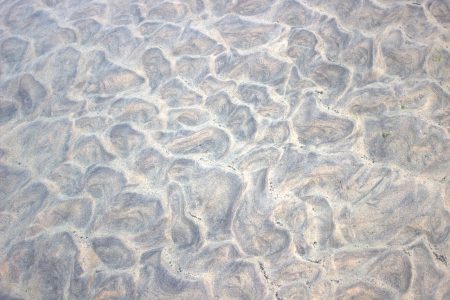
Speaking of nightmarish sludge, how about the stuff on the bottom of the Mediterranean Sea? Away from the beaches of Greece, Italy, and Spain, the deepest parts of the Mediterranean are covered in a thick layer of mud.
This goo is extremely salty, but that’s not all. It doesn’t allow any oxygen to permeate it, resulting in a totally zero-oxygen environment.
That’s just the way tiny marine creatures called loriciferans like it. The horrible Mediterranean goo supports scores of these little guys who look kind of like somebody turned a jellyfish inside out.
6. Antarctica Deserts
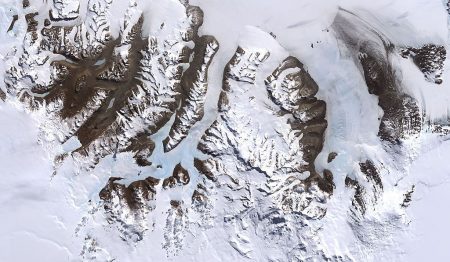
Antarctica is inhospitable enough already, what’s with the constant extreme cold. But the McMurdo Dry Valleys throw another challenge into the mix — they’re among the driest places on Earth.
The McMurdo Dry Valleys are so cold and dry that their conditions are comparable to Mars. So, nothing could possibly live in there.
As you’ve probably guessed by now, the valleys’ soil is chock-full of extremophile microbes who don’t give a hoot or a holler about how inhospitable their home supposedly is. In turn, they have given scientists hope that there may be equally tough tiny troopers living on Mars.
7. Nuclear Waste
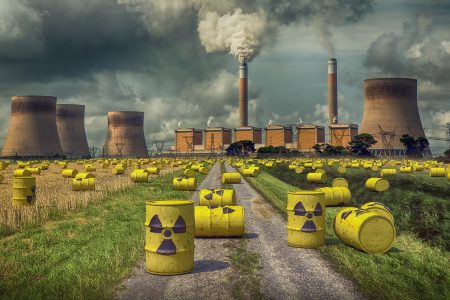
Alright, so natural places and clean rooms can support life, no matter how extreme. Let’s turn up the disaster dial and look at some radioactive waste.
Well, let’s imagine it, at least. We probably don’t have to tell you that nuclear waste will kill you — unless you’re a Deinococcus radiodurans bacterium.
These things can shrug off 5,000 grays of radiation, which is 500 times greater than the dosage that would kill a human being. They can do even better — even at 15,000 grays, the D. radiodurans has a decent chance of survival as long as it doesn’t stick around for extended periods.
8. The Vacuum of Space

Fine, there’s no place on Earth where life doesn’t exist. So let’s leave the planet behind and hop over to the vacuum of outer space.
Finally — a perfectly sterile environment where no life can…
Is that a tardigrade floating by?
Yes, it is! Tardigrades, also called water bears, are probably the toughest creatures on Earth. These tube-faced badasses can survive radiation, starvation, total lack of oxygen, and complete absence of water.
So, scientists wanted to know what would happen if you exposed tardigrades to the vacuum of space.
Well, not much happened since the things just didn’t care. They were and probably would’ve continued to be perfectly fine in space if the researchers had left them there.