
- Who knew trees could be so fascinating?
You might think trees are boring. All they do is stand still, grow leaves or needles, and occasionally produce fruit.
But that’s where you’d be wrong.
While your average oak in the local park isn’t necessarily very thrilling, there are plenty of strange trees out there. Some grow into weird shapes, others sport bizarre colors, and still others might kill you for just being near them.
Here are eight strange trees you can (and can’t) find around the world.
8. Dragon Blood Tree
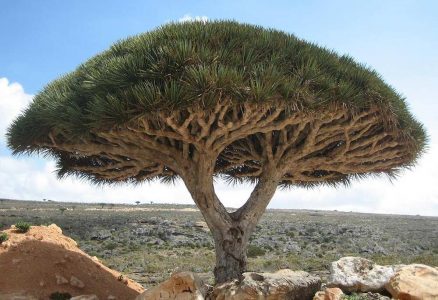
The dragon blood tree, also called the dragon tree, is one of the most famous sights of the Canary Islands. These funky-looking trees have a distinctive umbrella-like shape when fully grown.
However, their strangest feature is that they bleed — kind of. When cut, the dragon tree secrets a red resin, which has historically been used for many purposes, from a dye to a hemorrhoid salve.
It’s this resin that gives the tree its name. Additionally, local stories tell that each tree grows where the blood of an ancient dragon splashed when it fought an elephant.
Wonder who won the fight.
7. Rainbow Eucalyptus
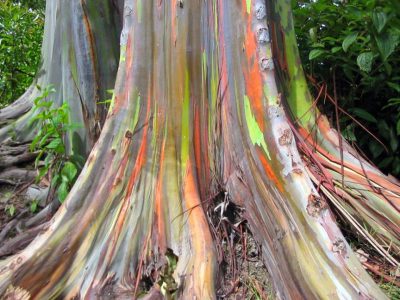
With most trees, any splashes of color that aren’t brown or green come from their flowers and/or fruit. The rainbow eucalyptus, however, is dressed in bright colors from roots to treetop.
This Philippine tree grows a thick, multi-layered bark. Each layer develops a different color, which are revealed as the tree gradually sheds its bark throughout the year.
As a result, the trunk of a rainbow eucalyptus has splotches of varied, bright colors. You can spot green, yellow, red, orange, purple, and even blue parts on the tree.
6. Giant Baobab
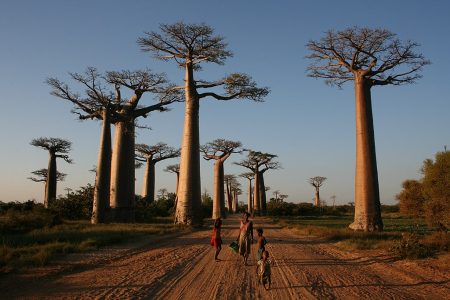
Ah, the giant baobab of Madagascar. If you can call any tree “adorable,” it has to be this one.
Giant baobabs are simply fun to look at. They grow a massively thick, smooth-barked trunk that looks like it could support the lushest, most expansive branches you’ve ever seen.
Yet, the baobab is topped by just a few odd, gnarled branches. They’re sometimes nicknamed “upside down trees” because the treetop kind of looks like a root system instead.
5. Walking Palm
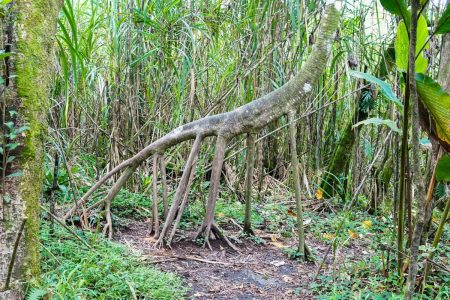
Speaking of root systems, the walking palm of Central and South America sports one of the weirdest ones. The tree grows very tall stilt roots that support the trunk several feet up in the air.
These roots are weird because nobody really knows why the tree has them. It doesn’t grow in wetlands where it would have to keep itself above the water level, which is why most trees have stilt roots.
One theory suggested that the tree could use the roots to “walk” across the jungle, growing new roots on one side and shedding them on the other. As amazing as that would be, there’s no factual evidence that a single walking palm has ever walked anywhere.
4. Wollemi Pine
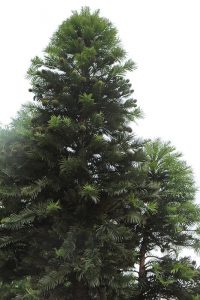
The Wollemi pine is a notable tree for two reasons. First, it’s one of the rarest plants in the world, with only around 60 trees growing in Australia’s Blue Mountains.
The tree is so critically endangered that the exact location of each pine is a closely guarded secret. This secrecy brings us to the second reason why Wollemi pines are kind of strange.
They’re stupidly old as a species. In fact, although it hasn’t been conclusively proven, it’s possible dinosaurs once walked in the shade of Wollemi pines.
3. Manchineel
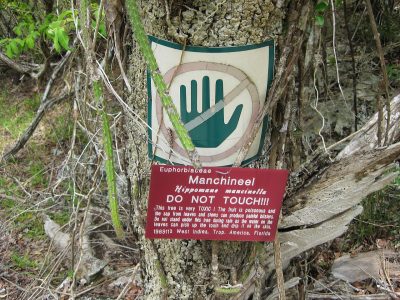
It’s nothing weird for a tree to grow fruit that are poisonous to humans. The manchineel growing in the Caribbean, however, ups the ante.
Every single part of the tree is toxic.
Naturally, eating the manchineel’s fruit can be fatal, but it doesn’t stop there. You shouldn’t even touch the tree, because its sap is a powerful skin irritant. It’s so strong that you can’t shelter under a manchineel because the sap turns any water dripping on you poisonous.
So why not just burn the tree? Well, you could, but the resulting smoke can damage your eyes and lungs.
Look, just stay away. The manchineel doesn’t anyone around — except the black-spined iguana which is inexplicably immune to the toxic monstrosity.
2. Cochlospermum adjanyae
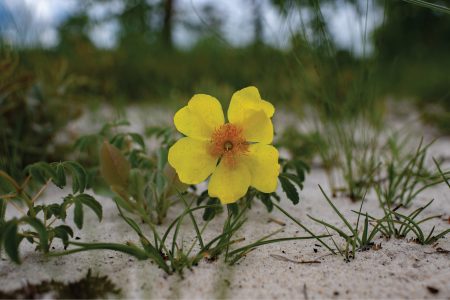
It can be hard to see the forest for the trees. That’s doubly true if you’re looking at a forest of Cochlospermum adjanyae in Angola.
That’s because you won’t see any trees since they grow underground.
This newly discovered species of tree is bizarre because 90% of its bulk is buried underground. Only the tips of its branches peek above the sand, occasionally blooming with yellow flowers.
You may think this isn’t even a tree, but it has roots, a sort of a trunk, and branches. The tree has simply decided to stay underground to help is conserve moisture in the Angolan desert.
1. The Tree of Life
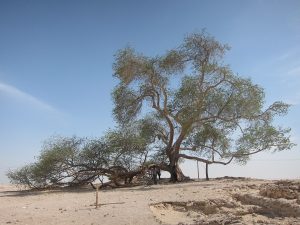
The Tree of Life is a roughly 32-foot-tall ghaf tree growing in Bahrain. In itself, there’s nothing weird about it, since ghaf trees are common the Middle East.
What is weird about the Tree of Life, though, is that it shouldn’t exist.
The tree grows on a hill in a completely barren area of the Arabian desert. To illustrate what a freak it is, it’s the only tree bigger than a tiny shrub you can find for miles and miles.
Nobody has figured out how on earth the Tree of Life stays alive. Its roots run 165 feet deep, but that shouldn’t be deep enough to reach groundwater in this region.
Despite it all, the tree is at least 400 years old. Due to its miraculous longevity, some people have theorized that the grows on the last remnant of the Garden of Eden.